


54 countries with over 1.4 billion people but no permanent seats at the table where major world decisions gets decided.
Africa is home to over 1.4 billion people across 54 countries and has the biggest voting bloc in the United Nations. Yet, in the Security Council’s 80-year history, no African nation has ever been given a permanent seat on the panel that decides global war, peace, and sanctions.
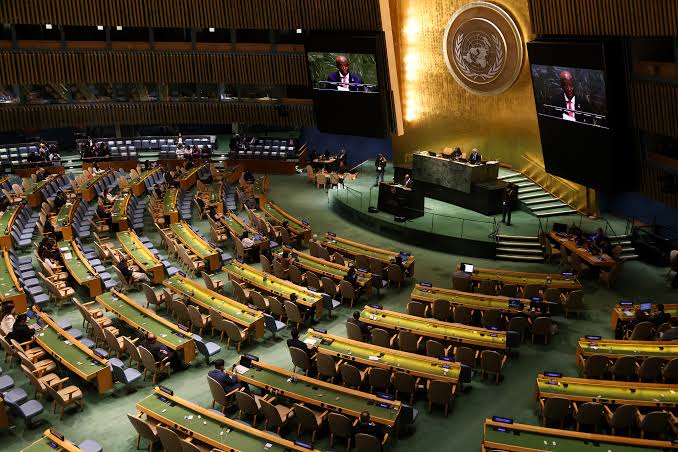
At September’s 81st UN General Assembly, leaders from Nigeria, Kenya, Namibia, Botswana, and even the UN Secretary-General all demanded this situation must change.
This is the story of why Africa remains left out, who profits from keeping things as they are, and what is really stopping the continent from getting a seat at the table.
The Security Council has 15 seats in total. Five are permanent, and those five carry veto power, meaning a single “no” from any of them kills a resolution outright, no matter how the other 14 members vote.
Those five are the United States, Russia, China, France and the United Kingdom, unchanged since the UN’s founding in 1945. The other ten seats are non-permanent, elected by the wider General Assembly for staggered two-year terms, with five new members rotating in every January.
Africa currently holds just three of those ten rotating seats. Yet by most tallies, well over half of everything the Council actively debates and votes on including armed conflicts, peacekeeping mandates and sanctions on regimes, concerns Africa. The continent supplies the bulk of the Council’s agenda, yet, it does not get a permanent vote on how that agenda is resolved.
How Long Africa Has Been Asking
This is not a new grievance as African leaders raised the injustice almost as soon as independence swept the continent in the 1960s, arguing that a council built by the war’s victors in 1945 could not fairly govern a world that no longer looked like 1945.
The demand went from informal complaint to unified continental policy in March 2005, when the African Union’s Executive Council adopted the Ezulwini Consensus at a summit in Eswatini, followed months later by the Sirte Declaration in Libya, which restated the same terms.
The demand hasn’t changed in over 20 years: Africa wants at least two permanent Security Council seats with full veto power, plus five rotating non-permanent seats. Crucially, the African Union, not outside countries, must choose which nations fill those spots.
This position was officially adopted 21 years ago, but African nations have actually been waiting for a fair seat at the table for more than six decades.
Why It Hasn’t Happened
The honest answer is that fixing this requires the Security Council’s five most powerful members to voluntarily give up a share of the power they’ve held exclusively since 1945 and none of them are in a hurry to do that.
Changing the Council’s composition means amending the UN Charter itself, which under Article 108 requires a two-thirds vote of all 193 General Assembly members, and then ratification by every single one of the five permanent members through their own domestic processes.
The UN’s Intergovernmental Negotiations (IGN) have been discussing Security Council reform for about 20 years without making any progress. As South Africa’s former UN ambassador, Mathu Joyini, put it, the topic stays permanently on the schedule, debated every year, but never actually resolved. It has basically become an endless talking group with no deadline.
Even in the rare moments the P5 say yes to African seats, they don’t agree on what “yes” should include. US officials reaffirmed this September a position first floated a few years earlier that Africa can have two permanent seats but without veto power attached.
Read Also: A Viral Claim Says The CIA Is Bankrolling Nigerian Music
France and the United Kingdom have instead said they’d support permanent African seats that come with the veto.
China and Russia have offered far vaguer, less committal language, without laying out a clear position of their own.
African diplomats feel that a permanent seat without veto power is just a permanent chair with no real say. To them, it creates a fake reform that leaves two classes of members. This exact compromise is what Africa’s shared diplomatic policy, the Ezulwini Consensus, rejected two decades ago.
Africa still hasn’t agreed on who would actually occupy those two seats.
Nigeria, Egypt, South Africa and Algeria have all, at different points over the past two decades, been floated as the continent’s likeliest candidates but the Ezulwini Consensus deliberately left the names blank, handing that decision to the African Union to settle later.
Two decades later, nothing has changed. Experts point out that a loose group of smaller African countries, nicknamed the “Coffee Club,” is secretly fine with the status quo. To them, it’s better for no African nation to get a permanent seat than to see a neighboring rival get one instead.
Some researchers proposed a clever fix: why not rotate the UN seat based on who leads the African Union each year? That way, the current leader and the former leader would share the term, just like other temporary UN members. It sounds practical, but the AU has never actually made it official rule.
What Africa Stands To Gain
A permanent seat would mean Africa deciding on sanctions, peacekeeping mandates and conflict resolution on its own soil, rather than having those outcomes negotiated and imposed by countries with no direct stake in the outcome.
This push is part of a bigger goal. African leaders link Security Council reform to getting a fairer deal inside the IMF and World Bank. As the outgoing UN Secretary-General, António Guterres, noted this September, global financial systems were built “by the rich for the rich” and need fixing just as much as the UN.
Beyond the mechanics of voting power, there’s a demographic and economic case as the UN’s figures put Africa’s trade potential under its continental free trade area at roughly $230 billion in 2026 alone, alongside the world’s fastest-growing labour force and close to a third of global mineral resources. A seat, in this framing, is simply that weight finally matching a vote.
$230 Billion: What Does It Actually Mean?
Africa’s projected $230 billion in intra-continental trade by 2026 under the African Continental Free Trade Area (AfCFTA) represents a massive shift in global economic weight.
• Larger than the GDP of entire nations: $230 billion is greater than the total annual GDP of countries like New Zealand ($250B), Hungary ($220B), or Qatar (~$215B).
• Surpasses major UN peace & aid budgets: It is over 35 times the UN’s total global peacekeeping budget (~$6.5 billion annually).
• Matching global economic blocs: It rivals the entire annual bilateral trade between major global powerhouses like the US and UK.
The Bottom Line: An economic block capable of generating this scale of internal trade can no longer be treated as a passive bystander in global security decision-making.
Patience is visibly running thinner than it has in previous years. Kenya’s President William Ruto used his floor time at this year’s General Assembly to argue the UN cannot credibly call itself a body of “united nations” while sidelining the voice of 54 of them.
If UN reform remains stuck as it has for twenty years, three main trends will accelerate: African nations will apply heavier diplomatic pressure at the UN, anger will grow over a system seen as hopelessly outdated, and countries will increasingly bypass the UN altogether.
Instead, they will focus on groups like BRICS (Brazil, Russia, India, China, South Africa) and regional African frameworks, where they don’t need to beg every year just to have a voice.
What Transpired at UNGA 81?
At September’s 81st UN General Assembly, Nigeria’s Vice President Kashim Shettima delivered President Bola Tinubu’s national address, explicitly invoking both the Ezulwini Consensus and the Sirte Declaration to demand two permanent African seats carrying full veto rights, plus five non-permanent seats. He argued that the world of 2026 “cannot remain captive to the distribution of power in 1945.”
Incoming and outgoing UN leaders, including former UN Secretary-General António Guterres, acknowledged from the assembly podium that Africa was a “double victim of colonialism,” and suffering under colonial rule first, and then being excluded from post-WWII decision-making bodies.
Leaders from South Africa, Kenya, Botswana, and Namibia echoed the identical demand during the general debate. Meanwhile, South African diplomats confirmed Pretoria is actively utilizing the Intergovernmental Negotiations (IGN) process. This is the official UN General Assembly working body established in 2008 to negotiate Security Council structure, expansion, and veto rights in order to keep pushing the Ezulwini position forward.
Looking past the diplomatic rhetoric, Shettima backed up his argument using Nigeria’s actual record. He highlighted Nigeria’s peacekeeping and diplomatic missions in Liberia, Sierra Leone, Darfur, Mali, and The Gambia, along with its ongoing work with ECOWAS and the African Union on counterterrorism, democracy, and maritime security.
As the most populated country in Africa, Nigeria is constantly mentioned alongside Egypt and South Africa as top contenders for a permanent seat. While this doesn’t solve the core disagreement over which nation gets chosen, it explains why Nigeria consistently makes the exact same argument at the UN every year, no matter who is president in Abuja.For 21 years, Africa has held a unified stance on UN reform. Despite more than half of Security Council discussions focusing on African conflicts, the continent still has zero permanent seats.
The Council reflects the power balance of 1945, not 2026, leaving external powers to decide Africa’s fate.
This raises two critical questions: Should Africa accept two permanent seats without a veto as a starting point, or hold out for full equality as demanded since 2005? And if seats are granted, should they go to top contenders like Nigeria, Egypt, and South Africa, or rotate through the African Union so all 54 nations are represented?
Drop your thoughts in the comments section.