

President Bola Tinubu will on Thursday preside over a crucial National Executive Committee (NEC) meeting of the All Progressives Congress (APC), with the party on the verge of a major shake-up. At stake is the choice of a new national chairman, a decision that could define Tinubu’s political strategy ahead of 2027, ADAMU ABUH reports.
As the ruling All Progressives Congress (APC) reconvenes in Abuja for its most consequential leadership summit since 2022, all eyes are fixed on one man: President Bola Ahmed Tinubu.
The upcoming National Caucus and National Executive Committee (NEC) meetings, slated for Wednesday and Thursday, July 23-24, will not only determine who succeeds Dr Abdullahi Umar Ganduje as national chairman but may also reset the trajectory of the party ahead of the 2027 general elections.
Amid growing internal unease, zoning disputes, and a looming reshuffle of the National Working Committee (NWC), President Tinubu is expected to wield the gavel with decisive authority. But his final choice, whether a loyal old guard, a zonal compromise, or a strategic defector, could either cement his dominance or trigger new factional tensions within the party he helped build.
The party, already battling accusations of complacency, rising internal dissent, and post-election fatigue, views the next NEC meetings as a reset button. But in typical APC fashion, the process is steeped in high-wire intrigue. Party insiders confirmed that the meetings would begin with the National Caucus on Wednesday, July 23, and culminate in the NEC on Thursday, July 24.
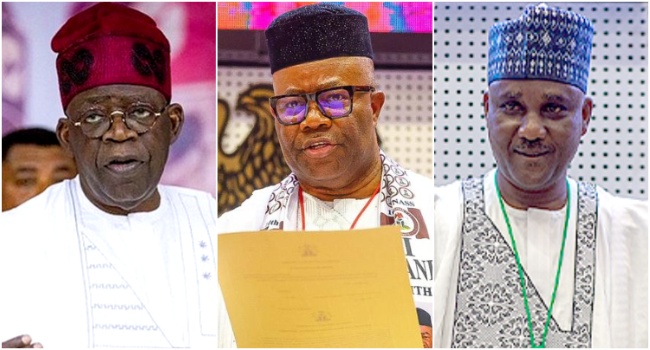
The deliberations will be presided over by President Tinubu and will feature Vice President Kashim Shettima, Senate President Godswill Akpabio, Speaker, House of Representatives, Tajudeen Abbas, and members of the Progressive Governors Forum (PGF), led by Hope Uzodimma of Imo State.
Others expected include APC former governors, state chapter chairmen, and all NWC members. Many in the NWC are reportedly anxious, fearing the chairmanship shake-up may cascade into a broader leadership overhaul, just as it did in 2020 when the Adams Oshiomhole-led committee was abruptly dissolved.
While the official agenda centres on replacing Ganduje, who resigned suddenly last month citing health reasons, sources said a more far-reaching reconfiguration of party leadership and strategy may be on the table.
Zoning flashpoint: North-West or North-Central?
CENTRAL to the drama is the zoning dilemma: should the chairmanship remain in the North-West, Ganduje’s zone, or return to the North-Central, where it was originally assigned before the 2022 adjustment?
The argument for reverting to North-Central has gained traction, with several political blocs insisting on historical fairness and internal balance. Top contenders from the zone include former Nasarawa State governor and ex-Congress for Progressive Change (CPC) chairman, Senator Tanko Al-Makura; former Kogi governor, Yahaya Bello; Plateau’s former governor, Joshua Dariye, and the Minister of Poverty and Humanitarian Affairs, Dr Nentawe Yilwatda.
Other prominent names in contention are Senators Sani Musa (Niger) and Salihu Mustapha (Kwara), both seen as technocratic and less factional. Senator Abu Ibrahim from Katsina, a long-standing ally of President Tinubu since their days in the National Assembly during the aborted Third Republic, is also believed to be under consideration, if Tinubu decides to keep the position in the North-West.
Al-Makura and CPC legacy
AL-MAKURA’S supporters have intensified lobbying, reminding the APC that the defunct Congress for Progressive Change (CPC), which he once led, delivered the core northern votes that powered the APC to national victory in 2015. They argue that since the defunct Action Congress of Nigeria (ACN) bloc has produced the president and dominates the executive, it is only fair to compensate the CPC wing with the chairmanship.
They also point to Al-Makura’s history of party loyalty and his insistence on unity. “It would be a win-win for the North-Central and the CPC legacy, which has been increasingly sidelined since 2023,” one party strategist said.
Musa as consensus candidate?
PERHAPS the strongest momentum in recent weeks has been built around Senator Sani Musa of Niger State. A coalition of party groups under the umbrella North Central APC Accord, led by Rev. Matthias Ikani, described him as “a bridge builder and stabilising force.” “This is a matter of equity and justice. Our region has never produced a substantive APC national chairman,” said Ikani.
“Senator Musa has no baggage, no history of betrayal, no record of factional backroom deals. We’ve watched him on the Senate floor, in his constituency, and in party matters. He exudes discipline, strategic calm, and humility.”
Musa’s allies believe he can deliver calm amid the chaos of succession and offer policy direction that will rebrand the APC beyond Tinubu’s personality cult.
Some opponents of the North-Central lobby argue that the region already occupies a powerful federal position, the Secretary to the Government of the Federation (SGF), currently held by Senator George Akume. But this has been dismissed by regional APC forums. Chairman of the North Central APC Forum, Saleh Zazzaga, said comparing the SGF to the chairmanship is disingenuous. “One is an executive appointment, the other is the party’s engine room. They serve different roles,” he stated.
Zazzaga reminded the party that the North-Central zone delivered 1,760,993 votes to Tinubu in the 2023 election, more than Labour Party’s Peter Obi and PDP’s Atiku Abubakar in the zone,and currently controls five of the six states in the region.
“Returning the position of national chairman to us is not a favour. It is a rightful return, consistent with the party’s zoning principles,” he stressed.
The sudden visit by a chieftain of the party, Sen. Barnabas Gemade, to the party Secretariat last week Thursday further deepened speculation that he might be the preferred choice of President Tinubu and the top echelon of the party. The former national chairman of the Peoples Democratic Party (PDP), when former President Olusegun Obasanjo held sway, took a walk around the precinct of the secretariat, including the media centre, to see things for himself.
However, a party official who spoke on condition of anonymity explained that the visit by Gemade may not be unconnected with the ongoing effort to reconcile the pro-Akume and Governor Hyacinth Alia groups, who have been at daggers drawn with each other over control of Benue state for the past two years.
The Kwankwaso wild card
YET, the most explosive possibility, and the one generating the most intense chatter within APC circles, is the rumoured defection of Senator Rabiu Musa Kwankwaso of the New Nigeria Peoples Party (NNPP), and the suggestion that he may be offered the APC national chairmanship as an incentive. Kwankwaso, the NNPP’s 2023 presidential candidate and former governor of Kano, shares a long-standing rapport with President Tinubu.
They worked closely during their time as governors and reportedly maintained a communication channel throughout the 2023 campaign cycle. Sources say that with Ganduje, Kwankwaso’s long-time rival, now out of the picture, the door is wide open for the NNPP leader’s return. This prospect has raised both hope and alarm in the APC ranks.


One of Kwankwaso’s close supporters, Alhaji Goni Mustapha, said the party would be foolish to ignore the former Defence Minister. “Kano has over five million registered voters. The fact that Kwankwaso took it from APC in 2023 with a new party should serve as a wake-up call. If he rejoins APC, the entire North-West could tilt back decisively.”
He added, “This is not the time to allow ego or grudges from 2019 and 2023 to blind the party’s long-term interest. Tinubu himself is a master of coalition-building. Just like he aligned with ex-rivals to build the APC in 2013, he can do so again.” Mustapha also noted that if the APC hopes to neutralise any northern opposition bloc before 2027, it must bring heavyweights like Kwankwaso back into the fold.
For President Tinubu, who handpicked Ganduje in August last year, the choice of the party’s next national chairman will be the second major internal test of his political management since taking office.
Observers say the outcome will reveal whether he prioritises consolidation, inclusivity, or loyalty.
Some analysts argue that giving the role to a loyalist from the South or retaining it in the North-West could spark outrage from other regions. Others believe Tinubu may opt for a surprise choice, perhaps someone with broad acceptability across CPC, ACN, and new entrants like NNPP.
As the party’s elite converge on Abuja in two days’ time, the NEC and Caucus meetings are shaping up not just as routine procedural gatherings, but as defining moments for the APC’s survival and Tinubu’s legacy.
NEC to deliberate on ADC coalition threat
BEYOND the tussle over who becomes national chairman, the APC’s upcoming NEC meeting is expected to deliberate on the emergence of a new African Democratic Congress (ADC) coalition that is already unsettling the ruling party.
The coalition, reportedly backed by political heavyweights including Atiku Abubakar, Peter Obi, David Mark, Rauf Aregbesola, Rotimi Amaechi, and Nasir el-Rufai, is expected to dominate discussions at the meeting.
While the presidency has dismissed the group as a coalition of “spent forces” driven solely by anti-Tinubu sentiment, analysts argue it has rattled the APC, evoking memories of the 2015 alliance that unseated former President Goodluck Jonathan.
However, APC chieftain, DrDominic Alancha, downplayed concerns. “Credible opposition keeps us on our toes. We’ll present our scorecard and let Nigerians decide in 2027,” he said.
Also on the agenda is the planned National Convention, the leadership vacuum following Abdullahi Ganduje’s resignation, and the possibility of appointing a caretaker committee to steer the party. There are also calls for other NWC members to step down in the spirit of reform.
“There’s a need for accountability at both national and state levels,” Alancha added, noting that several APC-controlled states are underperforming despite increased federal allocations.
Whether the APC emerges stronger or more divided after Thursday’s NEC meeting will hinge on decisions from these high-stakes, closed-door deliberations, particularly on who becomes chairman and how far internal restructuring goes.