

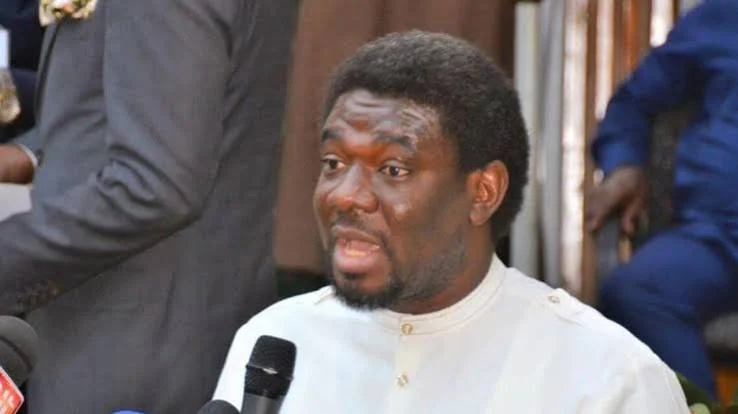

The Petroleum and Natural Gas Senior Staff Association of Nigeria has adopted a new succession model designed to prevent rancour, factionalisation and prolonged disputes during leadership transitions, its President, Festus Osifo, has said.
Osifo disclosed this on Saturday in Abuja at a day of tributes organised by the association in honour of its late former president, Francis Johnson.
Johnson, who served as PENGASSAN president from June 2014 to May 31, 2019, died on May 31, 2019, at the National Hospital, Abuja, after a brief illness.
The memory of Johnson’s sudden death and the leadership vacuum it created has also shaped the union’s approach to succession, with PENGASSAN now seeking to institutionalise a smoother transition process and minimise the internal disputes that have often accompanied changes in leadership.
The PENGASSAN president said the union had amended its constitution to adopt a succession arrangement similar to that of the Institute of Chartered Accountants of Nigeria, under which the elected deputy president would automatically succeed the president.
He said the arrangement was intended to remove the intense competition for the office of president and ensure a smoother transfer of power.
According to him, the new model was introduced after the union reviewed the challenges that had historically accompanied leadership transitions in the association.
Osifo said the union’s constitutional amendment, which was unanimously passed in August 2025, was inspired by a review of succession models used by other professional and membership organisations.
He said the association examined the succession systems of organisations including the Nigerian Bar Association and ICAN before settling on a model it considered more suitable for PENGASSAN.
He added, “In fact, we did a constitutional amendment that was unanimously passed in August last year, where we looked at it: what is the best model that we have in our country in terms of succession? We looked at the Nigerian Bar Association and said no, that is not the best model. We looked at ICAN, for example.
“We said, yes, I think there is something there. If you look at ICAN, they don’t contest the election into the president, but they contest the election into the vice because the president is already known. Because he is known, the senior or the first vice-president will transit to become the president. So, that balances and smoothens whatever they were doing. And we have imbibed that in PENGASSAN.
“In PENGASSAN, whoever is the deputy president elected is going to automatically become the president. So, there is no contestation again in the office of the president. So, that is known. So, because that is known, it reduces the tension that normally comes. And I will tell you, our transition is going to be in August. Normally, two years before transition in PENGASSAN, you will see problems everywhere.
“But I will tell you, 100 per cent stability. The National Executive Council and the Central Working Committee, we are intact. The transition is going smoothly. There is no issue as of today whatsoever. And that is one thing that we are proud of. That is one of the legacies to bequeath to this institution that has been founded since 1978.”
The union is scheduled to hold its delegates conference on August 22, 2026, when the transition process will take place.
Osifo said the new system would ensure that the union remained focused on its core responsibilities, rather than being consumed by internal battles over leadership.
