

Angela Onwuzoo
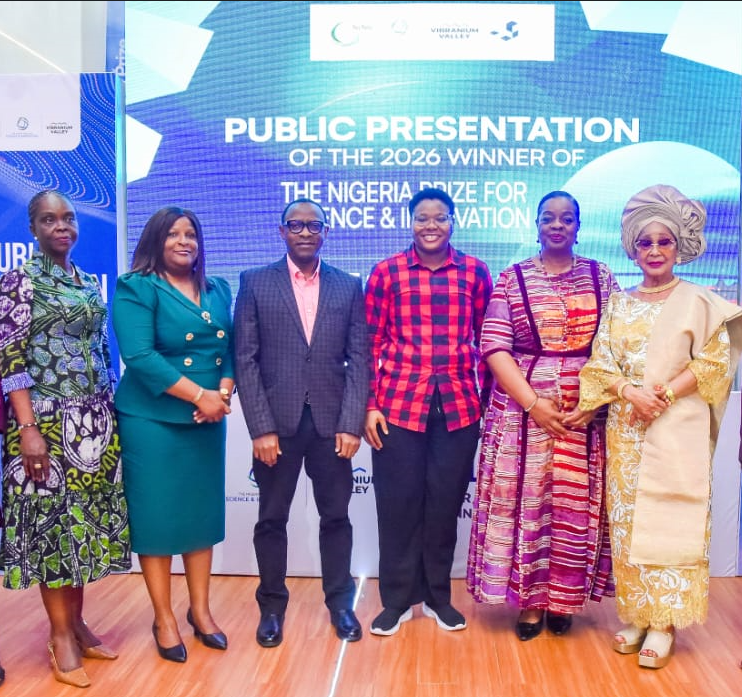
Winner of the 2026 Nigeria Prize for Science and Innovation, Mary-Brenda Akoda, on Tuesday demonstrated her groundbreaking innovation, GenScanAI (GenMRI/C-MORE), an artificial intelligence-powered medical imaging solution that reduces magnetic resonance imaging scan times by up to 90 per cent.
Speaking at the public presentation of her award-winning innovation at Vibranium Valley, Ikeja, Lagos, Akoda highlighted GenScanAI’s potential to improve image quality and healthcare delivery.
She said the innovation uses the C-MORE algorithm to reconstruct MRI images through a one-step framework, potentially cutting scan acquisition times by up to 90 per cent without requiring new MRI hardware.
Akoda, who won the $100,000 prize, said the technology could save millions of lives by removing diagnostic delays and enabling Nigerians and millions worldwide to receive timely diagnoses.
“No one should suffer or die because of delayed diagnosis,” she said.
According to her, the development of the innovation began in 2024, and 8,800 scans were conducted to validate the technology.
Akoda, who became the first millennial and first woman to win the prize as an individual recipient, told the gathering that the technology uses artificial intelligence to reconstruct diagnostic-quality MRI images from significantly fewer data acquisitions.
She explained that the innovation could reduce a 20-minute MRI scan to about two minutes and an hour-long scan to approximately six minutes.
The public presentation brought together medical practitioners, healthcare professionals, researchers, academics, students and technology stakeholders to explore the science behind GenScanAI, its potential applications and its contribution to addressing challenges in medical imaging and diagnostic services.
GenScanAI applies artificial intelligence and advanced computing techniques to MRI image reconstruction, with the potential to significantly reduce the time required to acquire MRI scans while maintaining or improving image quality.
By shortening scan times, the innovation could enable hospitals and diagnostic centres to examine more patients using existing MRI infrastructure, improve equipment utilisation, reduce waiting times and support more timely diagnosis and treatment.
Akoda, a first-class graduate of Computer Science from the University of London, explained the problem that inspired the innovation, the technology behind its development and its potential applications in healthcare.
The engagement also provided an opportunity for medical practitioners and researchers to examine its possible practical uses, while students gained insights into how scientific research and technological innovation can address real-world challenges.
Akoda holds a Master of Research with Distinction in AI and Machine Learning from Imperial College London, where she was a Google DeepMind Scholar.
Established in 2004 by the Nigeria Liquefied Natural Gas, Nigeria Prize for Science, now rebranded as the Nigeria Prize for Science and Innovation, has honoured ground-breaking work addressing national priorities.
In her speech, NLNG’s General Manager, External Relations and Sustainable Development, Sophia Horsfall, said the innovation addressed an important healthcare need, particularly in a country where population growth places increasing demands on diagnostic services.
“Medical imaging plays a critical role in diagnosis and treatment, but the time required for MRI examinations can create delays for patients and limit the number of people healthcare facilities can serve.
“Innovations such as GenScanAI demonstrate how advances in artificial intelligence and computing can be applied to address practical healthcare challenges and improve the efficiency of existing medical infrastructure,” Horsfall said.
She added that the public presentation was an important opportunity to take the winning innovation beyond the Prize adjudication process and encourage engagement with the medical and research communities.
“This presentation allows healthcare professionals, researchers and students to engage directly with Mary-Brenda’s work, understand its potential and consider how it could contribute to healthcare delivery.
The Nigeria Prize for Science and Innovation recognises scientific excellence and encourages solutions to national challenges. Creating opportunities for wider engagement with winning innovations is an important part of bringing their potential benefits to public attention,” she said.
GenScanAI’s potential to reduce MRI acquisition time by up to 90 percent could be particularly beneficial to hospitals and diagnostic centres managing high patient volumes.
Faster examinations could improve patient throughput and reduce waiting times without the immediate need for additional MRI equipment. Its potential to accommodate patient motion and improve image quality could also support more effective imaging, subject to appropriate clinical evaluation and validation.
Akoda emerged as the winner of The Nigeria Prize for Science and Innovation following a rigorous evaluation of more than 230 entries. The 2026 edition of the Prize focused on
“Innovations in Artificial Intelligence or ICT or Digital Technologies for Development,” reflecting the growing role of digital technologies in addressing societal challenges and advancing national development.
Copyright PUNCH
All rights reserved. This material, and other digital content on this website, may not be reproduced, published, broadcast, rewritten or redistributed in whole or in part without prior express written permission from PUNCH.
Contact: [email protected]
