

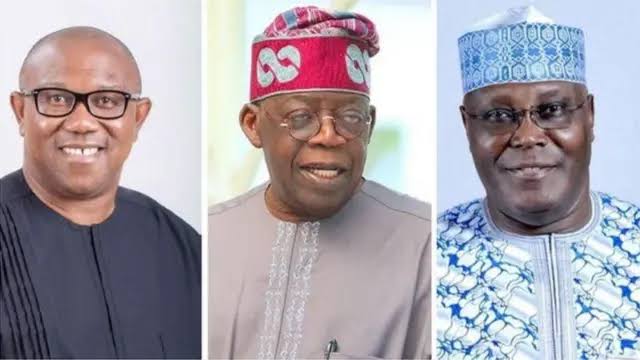
Incumbency. Coalition. Movement. Revolution. Analysing the contenders ahead of the polls
On January 16, 2027, Nigerians return to the polls in what’s already shaping up to be one of the most fractured, and most consequential, presidential races since 1999. The election was moved up after the repeal of the 2022 Electoral Act and the enactment of the 2026 Electoral Act, bringing the vote forward from the original February date.
The field has shifted dramatically since 2023. Old alliances have collapsed, new coalitions have formed, and two of the three men who dominated the last election have swapped parties entirely.
This carousel profiles the four candidates most likely to define the national conversation: an incumbent defending a brutal economic gamble, a seven-time contender making his boldest coalition play yet, a reformist riding a youth movement into a new alliance, and a revolutionary refusing to play the coalition game at all.
Bola Ahmed Tinubu spent three decades building the machine that led to his victory as president in 2023.
Before politics, he worked in accounting and finance in the U.S. and later at Mobil Oil Nigeria as a treasurer, giving him a technocratic edge most Nigerian politicians didn’t have.
He entered the Senate in 1992, was forced into exile after backing National Democratic Coalition (NADECO’s) pro-democracy resistance to military rule, and returned in 1999 to win the Lagos governorship, twice.
Tinubu’s Lagos governorship laid the foundation for his entire rise. Facing Obasanjo’s funding blockade, he overhauled the state’s revenue, created LCDAs, modernized civil service, and launched defining infrastructure like the BRT and Eko Atlantic, insulating Lagos from federal control. After stepping down in 2007, he retained power through handpicked successors, engineered the 2013 APC merger that brought Buhari to office in 2015, and ultimately leveraged that political capital to claim the presidency in 2023.
Tinubu’s first act as president was the riskiest economic move from a president, removing the fuel subsidy on day one and floating the naira. The International Monetary Fund and World Bank praised the fiscal discipline but Nigerians felt the inflation immediately and are still feeling it.
But the numbers his administration points to are real. Federal tax collections jumped from ₦19.9 trillion in 2023 to ₦28.3 trillion, pushing monthly FAAC disbursements to states past ₦2 trillion.
Foreign capital inflows rose 90% to $23.22 billion, and external reserves hit a 13-year high near $50 billion after CBN tightening.
NELFUND has disbursed collateral-free loans to over 500,000 students, and the Nigerian Exchange’s All-Share Index went from roughly 55,000 in mid-2023 to past 250,000. The CNG rollout is his bet on cheaper public transport fuel long-term.
However, the gap between these macro wins and the lived reality of cost-of-living pain is the central tension of his re-election pitch.
Under Tinubu, insecurity remains a major problem. Despite new military leaders and equipment, banditry, kidnapping, and insurgent attacks continue in the North and are spreading to new areas. That’s a governance failure his opponents hammer constantly.
Then there’s the personal scrutiny that has trailed him for decades: questions over his wealth, past U.S. civil asset forfeiture cases from the 1990s, and, most persistently, unresolved controversy over his Chicago State University academic records. It’s a vulnerability his rivals, particularly Peter Obi, have used to draw sharp contrasts on transparency.
Politically, though, Tinubu remains the man to beat. He heads into 2027 as the APC’s confirmed flagbearer, backed by a party that governs the overwhelming majority of Nigeria’s 36 states. His strategists are betting the economic pain peaks before the vote and that a fractured opposition simply can’t unite in time to stop him.
Tinubu’s re-election plan relies on one key idea which is the assumption that power and a strong party machine will beat a split opposition, even if voters are angry.
Read Also: EFCC Has Forfeited Trillions Of Naira Over The Years BUT Where Does The Money Actually Go?
The APC’s structural advantage (governorships, local government control, federal patronage) is historically difficult to overcome in Nigerian elections.
His campaign will likely lean hard into “stay the course” with the argument that the painful reforms of 2023–2025 are now bearing fruit, and that switching leadership mid-turnaround would waste the sacrifice millions of Nigerians already made. Whether voters buy that framing, or punish him for the hardship regardless, is the single biggest question of this election.
Atiku Abubakar’s story starts far from State House. Orphaned young, born in Jada, Adamawa State, he built himself up through 20 years in the Nigeria Customs Service, retiring in 1989 as Deputy Director.
From there, he built a genuine business empire: INTELS Nigeria (oil logistics), Adama Beverages, real estate, agriculture, and the American University of Nigeria in Yola, which he founded.
He served two terms as Vice President under Obasanjo (1999–2007), chairing the National Council on Privatisation which us the body that deregulated Nigerian telecoms and effectively birthed the GSM boom.
He also helped assemble the “Economic Team” that steered Nigeria’s 2000s debt relief and banking consolidation.
That partnership ended in one of Nigerian politics’ most public fallouts, over Obasanjo’s alleged third-term ambitions, which triggered years of legal battles over Atiku’s own eligibility to run.
2027 will be Atiku’s seventh presidential bid: 1993, 2007, 2011, 2015, 2019, 2023, and now this one. After decades in the PDP, he made his biggest structural move yet: defecting to the African Democratic Congress (ADC) as the party consolidated into the main opposition coalition, alongside figures like David Mark and Rauf Aregbesola.
Atiku won the ADC’s presidential primary in May 2026 with 1,846,370 votes, defeating former Rivers governor Rotimi Amaechi (504,117 votes) and businessman Mohammed Hayatu-Deen (177,120 votes), out of roughly 2.5 million votes cast.
Both Amaechi and Hayatu-Deen at first rejected the results, claiming the process was flawed. While that rocky start for opposition unity has mostly calmed down in public, tension still lingers under the surface.
Atiku’s 2027 campaign is built on two pillars: exposing fiscal recklessness and promising an anti-corruption crackdown. He has publicly flagged over ₦210 billion in duplicated allocations inside the 2026 federal budget and accused the Tinubu government of breaching constitutional borrowing limits.
He’s also hired Washington D.C. lobbyists to build international credibility ahead of the vote in a move meant to project statesmanship on the global stage.
However, his biggest liability is age because by election day, he’ll be 81. Critics, especially younger voters, question whether that’s the generational shift Nigeria needs, or more of the same names recycled since the 1990s. Opponents also brand him the “perpetual candidate,” arguing seven attempts reflect personal ambition more than a governing vision.
Atiku’s entire path to State House runs through opposition unity and that’s exactly what’s fracturing around him.
Since winning the ADC ticket, both Peter Obi and his running-mate pick Rabiu Kwankwaso have left the ADC entirely, citing internal disagreements and legal disputes, and moved to a rival platform. That’s the opposition’s oldest curse repeating itself: coalitions that look powerful on paper and split the moment real power is on the table.
If Atiku can’t pull Obi’s and Kwankwaso’s voters back under one tent before January 2027, he risks splitting the anti-APC vote three ways, which, ironically, is exactly the outcome that helps Tinubu most.
Peter Obi built his national brand on one thing most Nigerian politicians avoid: radical austerity.
Born in Onitsha, he earned a philosophy degree from the University of Nigeria, Nsukka in 1984, and in August 2026, INEC published his full educational records for public verification in a transparency move that exposed Tinubu’s unresolved academic controversy.
Before politics, Obi became the youngest chairman of Fidelity Bank and built a career in corporate finance and asset management.
As Anambra governor (2006–2014), he became notorious for slashing governance overhead, refusing executive extravagance, and leaving billions of naira in savings for his successor. Under his watch, Anambra rose to number one nationally in NECO and WASSCE results, partly by returning missionary-run schools to their original owners.
Obi’s 2023 run broke Nigeria’s traditional two-party grip. Running on the Labour Party after a brief stint as Atiku’s running mate in 2019, his “Obidient Movement” mobilized young, urban voters and pulled over 6.1 million votes, including wins in Lagos and Abuja, unprecedented for a third-force candidate.
But by 2026, that momentum needed a new vehicle and Obi first moved toward the ADC coalition alongside Atiku, but internal divisions and legal disputes pushed him out.
In May 2026, he was declared the presidential candidate of the Nigeria Democratic Congress (NDC) and immediately named former Kano governor Rabiu Kwankwaso, his 2023 rival on the NNPP platform, as his running mate. It’s a ticket years in the making as Kwankwaso had publicly floated deputizing for Obi as far back as late 2025, on the condition that trust was established between the two camps.
The Obi-Kwankwaso ticket fixes Obi’s main 2023 weakness of low support in the North with Kwankwaso bringing a strong northern base, paired with Obi’s popularity with southern youth.
On policy, Obi’s central argument is that Nigeria’s debt is being spent on consumption, not production, and that leadership integrity should be the baseline for holding office.
He has pledged to withdraw from the race himself if credible evidence of unfitness is presented against him and has pushed INEC to rigorously scrutinize every candidate’s credentials in a not-so-subtle jab at Tinubu. He’s also pledged to serve only a single four-year term, framing it as a rescue mission rather than a personal power project.
Obi’s critics argue that fiscal discipline and philosophical rigor don’t automatically translate into managing a complex, multi-ethnic federation under real security and economic pressure.
His hyper-scrutinized, “moral high ground” image also leaves almost no room for error as any perceived compromise with establishment politics risks alienating the idealistic base that got him this far.
Compounding this, Obi has yet to release a detailed policy manifesto, leaving critics to argue that his campaign is long on integrity rhetoric but short on the concrete governing blueprint voters need to evaluate him against.
The Kwankwaso alliance is his boldest attempt yet to solve his structural weakness in the North. Whether that marriage of movements holds through a full campaign cycle, especially with Atiku’s ADC now positioned as a direct rival for the same opposition vote, is one of the defining subplots of 2027.
Omoyele Sowore’s path to 2027 ran through newsrooms and protest lines.
Born in Ondo State, his activism as University of Lagos student union president delayed his own degree by two years after politically motivated arrests, detention, and expulsions under the Babangida and Abacha military governments. In 1999, facing continued threats, he relocated to the United States, later earning a Master’s in Public Administration from Columbia University and eventually becoming a US permanent resident, building a life with his family in New Jersey.
In 2006, he founded Sahara Reporters, the New York-based platform that became one of Nigeria’s most consequential whistleblowing outlets, exposing corruption and abuse across administrations.
In 2019, he launched the #RevolutionNow movement. The Buhari government responded harshly, charging him with treason, detaining him repeatedly, and even attacking him in court. This brutal crackdown cemented his reputation as the government’s most stubborn critic.
Sowore secured the African Action Congress presidential ticket for a third consecutive time in May 2026, emerging unopposed at the party’s primary in Abuja. He polled 33,953 votes in 2019 (fifth place) and 14,608 votes in 2023. These are modest numbers, but consistent proof of a loyal, ideologically committed base built without elite financing. He stepped down as AAC national chairman hours after securing the ticket, handing the role to Samuel Ajeigbe.
Unlike Tinubu, Atiku, and Obi, Sowore has never held executive office. His entire candidacy is a bet that Nigerians are done trusting anyone who’s already been inside the system including the “opposition” establishment.
Sowore has graded the Tinubu administration an “F9” pointing to the strained national grid and rising extreme poverty. He is also campaigning hard against the newly enacted 2026 Electoral Act, arguing it was engineered to protect incumbents and narrow the grounds for legitimate election petitions.
That criticism has come at a real cost as he is currently locked in a legal battle with the DSS, alongside Meta and X Corp, over cyberstalking and defamation charges tied to calling Tinubu a “criminal” online. Meta and X Corp were later struck out of the case.
After a brief detention, he was granted ₦200 million bail and countersued, arguing the state’s attempt to remove his social media commentary amounts to unconstitutional censorship.
Sowore has refused to join forces with Atiku or Obi. He views their coalitions as just more of the same corrupt establishment and openly criticizes both men as part of the old system.
It’s a principled stance, but a risky strategy. By refusing alliances, he is forced to fight the APC and other opposition groups completely alone.
Historically, his biggest challenge is turning deep credibility into actual votes.
The question for 2027 is whether growing public frustration finally translates his moral authority into real ballot-box numbers, or whether his refusal to join forces keeps him a consistent fifth-place finisher.
Four men offering four different paths for Nigeria. One asks for a second term, saying painful reforms are starting to work. One relies on experience and political alliances to finally win after 34 years. One aims to build something new through discipline and a strong northern alliance. One wants to tear down the entire system from the outside.
Yet the opposition’s biggest threat isn’t Tinubu but their own division. With competing coalitions splitting the same voters, failing to unite before January 16, 2027, could hand Tinubu an easy victory.
But there is an even bigger threat than a split opposition: voter apathy. In 2023, only 27% of registered voters showed up. Tinubu won with under 9 million votes, meaning the 68 million people who stayed home vastly outnumbered all the voters combined.
This means the largest group in the 2027 election isn’t aligned with any politician and they are the people who don’t vote. By either voting or staying home, they will decide the outcome. So get your PVC ready, find your polling station, and make sure you show up on January 16.
