

Abuja’s domestic debt jumped from ₦88.5bn to ₦389.9bn in under three years. A look into the structural gap in Abuja’s governance that makes the question harder to answer than it looks.
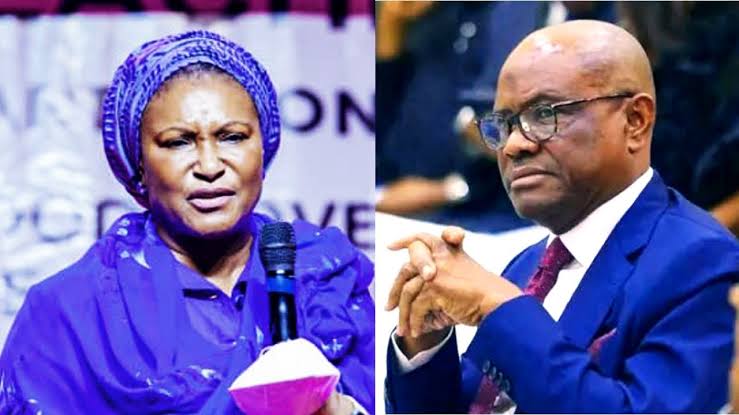
Speaking on Channels Television’s Political Paradigm in late August 2026, FCT senator Ireti Kingibe made a pointed allegation that FCT minister Nyesom Wike has been taking loans for Abuja without National Assembly approval.
She says the claim is grounded in Debt Management Office (DMO) records she personally reviewed, covering August 2023, when Wike took office, through March 2026.
She discussed it alongside two other running themes: the Abuja Master Plan and the National Assembly’s oversight role over the territory generally. Wike’s camp responded, but so far without a documentary rebuttal.
The Allegation, In Her Own Words
• Standard Process: FCT budgets must go through the Senate FCT Committee for review before the full Senate votes to approve them.
• Core Claim: She states that Wike has never actually come before the full Senate to ask for approval on any matter.
• Key Difference: While Wike did meet with the FCT Committee once, she says he never brought his loan requests to the full Senate floor, which is required by law.
• Proof: She bases her claim on official Debt Management Office (DMO) records from August 2023 to March 2026, which she reviewed personally.
• The Challenge: She dares critics to prove her wrong by showing the official Senate records (Votes and Proceedings) from the day Wike allegedly requested approval.
• Constitutional Argument: Even President Tinubu must get Senate approval for loans and appointments. She argues that Wike, as a minister, cannot bypass rules that even the President has to follow.
The FCT Debt Trail, 2023-2026 (DMO data)
FCT’s domestic debt, quarter by quarter:
• Sep 2023: ₦88.51bn — ranked 29th of 37 (states + FCT), making it the 9th-lowest subnational debtor in the country
• Mar 2024: ₦94.01bn (+6.2%)
• Sep 2024: ₦53.43bn — a sharp drop (likely reflecting repayment or debt restructuring within that window, though the DMO report doesn’t itemize the cause)
• Sep 2025: ₦78.93bn — climbing back up
• Dec 2025: ₦188.86bn — a 139% jump in one quarter
• Mar 2026: ₦389.88bn — now the 2nd-highest domestic debtor among all 36 states and FCT combined
The FCT’s debt surged by ₦301.37 billion (about 340.5%) in just two and a half years, driven mainly by a massive ₦201 billion spike packed into a single three-month window between December 2025 and March 2026. Because the Debt Management Office only released these figures on June 30, 2026, the public learned of the dramatic increase less than two months before Kingibe raised the alarm. This rapid accumulation of debt is striking on its own, but it looks even more unusual when measured against Nigeria’s broader borrowing trends.
Nigeria’s total public debt stood at ₦159.35tn ($114.95bn) as of March 31, 2026, up from ₦149.39tn a year earlier, a 6.7% year-on-year rise. Of that:
• ₦87.4tn is domestic debt (54.85% of the total)
• ₦71.95tn is external debt (45.15%)
• The Federal Government alone holds ₦82.88tn of the domestic figure
• All 36 states plus FCT combined hold just ₦4.52tn domestically
The biggest takeaway is that the FCT’s ₦389.88 billion debt makes up nearly 8.6% of all domestic debt owed by Nigeria’s 36 states and the capital combined, meaning a single territory holds almost a tenth of the total subnational debt.
At the same time, the International Monetary Fund (IMF) projects that Nigeria’s overall debt relative to its economy (debt-to-GDP) is actually dropping, from 35.5% in 2025 to 32.3% in 2026. This shows that the sudden borrowing spike is heavily concentrated in just one uniquely governed area.
Unlike Nigeria’s 36 states, the FCT has no governor and no local State House of Assembly. Because of this, the National Assembly is legally required to act as the capital’s legislature.
Under the Fiscal Responsibility Act of 2007, any new government loan for major projects must get legislative approval. For the FCT, that oversight falls directly on the federal National Assembly. This is a body that must handle local capital matters alongside running the entire country.
That arrangement is the core of Kingibe’s argument: the National Assembly is supposed to act as the ultimate check on borrowing, but that check only works if lawmakers are actually asked to review and approve each loan.
Budget Approval Isn’t The Same As Loan Approval
The National Assembly did approve the FCT’s 2026 budget of ₦2.285 trillion. About 76% (₦1.7 trillion) of that money was set aside for major projects, including ₦758.15 billion for engineering, ₦212.74 billion for satellite towns, and ₦162 billion for education. That budget approval is an official, public record.
But compare it to how the Federal Government’s own external borrowing is handled: Tinubu’s $6bn external borrowing request went to NASS as a distinct submission on March 31, 2026, backed explicitly by Sections 21(1) and 27(1) of the DMO (Establishment) Act 2003 which was reviewed by committee, then separately voted on in plenary. That’s a trackable approval event for a specific loan.
Read Also: How Nigeria’s Terrorist Financiers Are Turning Women’s Bank Accounts Into Invisible Cash Pipelines — NFIU 2025 Report
Kingibe’s core point is that passing an annual budget is not the same as approving a specific loan. She argues that every new debt requires its own separate vote by lawmakers, which hasn’t been happening.
In mid-2026, SEC Director-General Emomotimi Agama advised the FCT to move beyond budget funds, urging it toward capital-market tools (infrastructure bonds, green bonds, REITs) backed by steady revenue from ground rents, tenement rates, tolls and parking fees.
Here’s why that specific menu matters: bonds, green bonds and Real Estate Investment Trust (REITs) are SEC-registered instruments that legally require public disclosure and audited reporting. That stands in stark contrast to Kingibe’s account of bank loans and informal FCT borrowing that lacked proper disclosure and approval. Essentially, Nigeria’s capital markets regulator is pushing the FCT to adopt transparent, offical borrowing which is something critics say hasn’t been happening.
The recently passed Investments and Securities Act 2025 was created to force local governments to be more transparent about their borrowing. In short, the financial fixes being pushed for the future address the very same lack of transparency that Kingibe claims was happening all along.
Follow The Money: What’s Being Built
Whatever financed it, construction has been substantial and visible:
• Katampe Collector Road CN2 (renamed Emmanuel Ogala Boulevard) which is a 3.9km six-lane dual carriageway linking Katampe and Mabushi, contract awarded November 2025, commissioned by President Tinubu in June 2026, complete with underground stormwater drainage, solar streetlights and landscaped walkways.
• The Jahi–Gwarinpa Interchange and Arterial Road N16 (Shehu Shagari Way), linking Maitama, Katampe, Jahi, Gishiri, Mabushi and Gwarinpa.
• Airport Road–Kuje Junction, handled by Arab Contractors.
• Kuje–Gwagwalada Road, built by Gilmor Engineering.
• Bill Clinton Drive–Tungan Madaki Access Road, and the Gomani–Dafa–Yangoji Road in Kwali Area Council.
• Water treatment plants in Bwari and Ushafa, plus the Abuja City Water Supply Project and Greater Abuja Water Scheme.
• The City Gate redevelopment, featuring AI-enabled surveillance and 24-hour monitoring.
At scale: roughly 317km of roads awarded across three years, with about 221km completed. FCT officials have stated that around 60% of executed projects were contracts originally awarded 15–16 years earlier and left abandoned before this administration revived them.
Wike’s own framing has been consistent, noting that “Development starts with infrastructure… you cannot develop without roads.” He’s pointed to water, education and healthcare investment alongside the road projects to argue this isn’t a one-dimensional infrastructure push.
The Abuja Original Inhabitants Youth Empowerment Organisation (AOIYEO) made a similar case publicly in August 2026, explicitly acknowledging the media and public’s right to scrutinize borrowing, while arguing that “any fair assessment… must equally examine what the resources are being used to achieve.”
A key shift helped is the that the Treasury Single Account (TSA), created in 2015, sent all government revenue into one central account for tracking. In October 2023, President Tinubu exempted the FCT and Wike says this let the FCTA use its revenue directly to pay contractors without federal red tape, speeding up projects.
The FCT’s monthly local revenue also quadrupled, jumping from about ₦9 billion to over ₦40 billion since 2023. This shows that new debt isn’t the only money funding the ongoing construction boom.
That offers a solid defense of the results, showing that money is actually being put to work. However, it focuses on the outcome, leaving Kingibe’s specific legal question about the approval process unanswered.
Wike’s spokesman, Lere Olayinka, responded by telling journalists to verify Kingibe’s claim directly with the Senate and House FCT committees. He also pointedly noted that Kingibe isn’t a member of either committee, which he implies weakens her standing to make the claim.
This conflict is part of a long-running feud between the two:
• 2024 (Curfew Clash): Kingibe publicly criticized Wike for imposing an election curfew without consulting local leaders.
• 2024 (Senate Support): Senate President Godswill Akpabio openly backed Wike at a public event, telling him to ignore Kingibe’s criticisms.
• 2025 (Land Scandal Allegations): Kingibe accused Wike of allocating FCT land to his sons and then slashing the land title fees on those allocations from ₦200 million to ₦2 million within 48 hours.
That history explains why this feud is so heated, but it doesn’t solve the core issue. Olayinka’s response attacks her position and track record, but still fails to answer whether the Senate actually voted to approve those specific loans.
Verified Vs Unresolved
Verified and on the record:
• The DMO’s published sub-national debt figures showing the ₦301.37bn increase.
• FCT’s lack of a state assembly, confirmed on the record by NASS’s Media Committee chairman.
• NASS’s passage of FCT’s annual appropriation act, including the 2026 budget.
• The SEC’s active 2026 push for FCT to adopt more disclosed capital-market financing going forward.
Still unresolved:
• Whether individual FCT domestic loan facilities require a distinct, separately votable NASS approval beyond the annual budget.
• Whether such a distinct approval process happened for the loans behind this specific debt increase.
• Kingibe bases her claim on DMO records she checked, but she hasn’t released the Senate logs she challenges others to show. At the same time, Wike’s team hasn’t shared any committee documents showing approval either.
Neither side has provided official paperwork to prove their point. A quick look at basic government rules makes it clear how the process is actually supposed to work.
Here is how the loan approval process works and where the FCT’s situation breaks down:
• State Governments: Must get approval from their own local State House of Assembly.
• Federal Government: Must get approval from the National Assembly through an explicit vote, just like when President Tinubu requested $6 billion on March 31, 2026.
• The FCT: Has no local State Assembly to check its borrowing, and no public record shows that the National Assembly ever held a separate vote for these specific loans.
Did you know FCT is the only federating unit in Nigeria without its own dedicated state-level legislature? That single structural fact is the hinge the entire allegation turns on, therefore, this is a dispute about which institution was ever supposed to check them.
What It Means For Abuja Residents.
Since 2023, the FCT’s monthly local revenue has jumped from ₦9 billion to over ₦40 billion. This boost came mostly from cracking down on unpaid ground rents and land fees, which recovered ₦6.96 billion from thousands of property owners who owed money. This increased revenue is currently being used to pay off local debts, and it is the exact same money the SEC wants pledged to cover future bond repayments using tools like tolls and property taxes.
Here is the breakdown of what that debt means in simple terms:
• The Debt Per Person: The FCT owes ₦389.88 billion in local debt. For a population of roughly 3.07 million, that equals about ₦127,000 in debt for every single resident.
• What’s Excluded: That number doesn’t even include international debt, federal debt, or upcoming debt increases.
Every naira spent paying off this debt is money taken directly away from future schools, clinics, and water projects. This directly impacts how local money gets spent.
If the National Assembly actually voted to approve these FCT loans, an official paper trail would exist, such as a meeting record or a committee report. Kingibe publicly challenged anyone to produce that proof. Six days later, no one has shown it.
And here’s the question: Should FCT’s domestic loans require their own standalone National Assembly vote, separate from the annual appropriation or does passing the yearly budget already cover it? Drop your thoughts in the comments section.
