

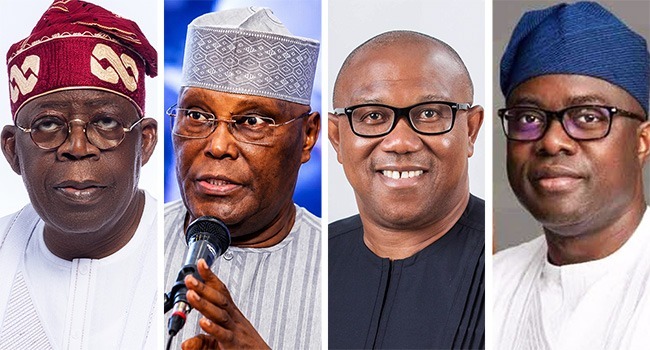
As Tinubu’s 2027 campaign council brings together figures from the APC, PDP, APGA and Accord, the alliances raise questions about political loyalty, electoral strategy and why ordinary Nigerians remain divided over the same politicians.
President Tinubu recently launched the All Progressives Congress (APCk Presidential Campaign Council alongside governors and opposition figures. Tinubu chairs the council, with Vice President Shettima and APC Chairman Yilwatda as vice chairmen.
However, three appointments raised eyebrows as opposition figures Nyesom Wike (Rivers/FCT), Chukwuma Soludo (Anambra), and Ademola Adeleke (Osun) were named campaign coordinators.
Critics often dismiss partisan rivalry as political theater, claiming the elite always stick together. Let’s test that assumption by exploring three core questions:
1. Why do political elites align despite party differences?
2. Why do the citizens fight partisan battles for them?
3. What can you actually do about it?
Who Are The Three?
Party labels don’t tell the whole story, so here is what’s really happening.
• Wike: He remains a Peoples Democratic Party (PDP) member, but the party is split while he serves as a minister in an APC-led government.
• Soludo: He said All Progressives Grand Alliance (APGA) adopted Tinubu as its presidential candidate and cited shared “progressivism” with the APC.
• Adeleke: He left the PDP in December 2025 and joined the Accord Party. His reported move into the APC was blocked by party chieftains in Osun. His Accord Party then adopted Tinubu as its presidential candidate.
Each case has a different story and that brings us to Osun.
On August 15, 2026, Ademola Adeleke of the Accord Party won re-election as Osun governor, defeating APC candidate Bola Oyebamiji by 66,252 votes. INEC declared Adeleke the winner with 511,067 votes against Oyebamiji’s 444,815.
The result was a direct electoral contest between Adeleke’s party and the APC. Yet, less than two months later, Adeleke was named the APC presidential campaign coordinator for Osun.
The contrast is significant, but it does not prove that the governorship election was staged or that the candidates were secretly working towards the same outcome. They competed for different political objectives at different levels of government.
Adeleke’s state-level mandate and his support for Tinubu’s national ambition can coexist, even if the arrangement raises questions about party identity and political accountability.
The bigger question is what these alliances offer the politicians involved, and whether their supporters share the same interests.
Part of the answer comes down to numbers as the opposition is rapidly shrinking.
Read Also: Nigeria Is About To Track Every Phone In The Country
In 2019, the PDP held 16 governorships. By late 2025, that number plummeted to just 6, as nine governors defected to the ruling party. Today, the APC controls over 30 of Nigeria’s 36 states, raising fears that the country is drifting toward a one-party state.
However, APC leaders dismiss these concerns, arguing that complete one-party control is impossible but there is a key catch: controlling state governors doesn’t guarantee winning presidential elections. In 2023, for example, several governors failed to deliver their states for their presidential candidates.
The key lesson: Political alliances look powerful, but they aren’t foolproof. Still, for the politicians involved, the incentives to align with power are hard to resist.
Incentive One, The Money
States rely heavily on money from the federal account, and that payout pool is growing fast:
• The payouts are soaring: The federal allocation committee (FAAC) recorded ₦18.72 trillion in gross revenue during the first half of 2026 alone, disbursing ₦12.59 trillion across all tiers of government.
• States are getting more naira: Between January and May 2026, the 36 states received ₦4.14 trillion. This is a 21.6% jump compared to 2025. July’s payout grew another 17.9% over June.
• Inflation changes the picture: While revenue numbers look huge, with H1 2026 beating full-year totals from 2021 to 2023, much of that growth comes from inflation and a weaker naira. Even though inflation slowed to 15.39% in August 2026, slower price growth still means high costs, not actual price drops.
• The key lesson: As the federal revenue pool grows, states have much bigger financial stakes. Staying on good terms with Abuja is simply good business for governors.
Incentive Two, Security Votes
Governors also control vast amounts of money with very little public accountability:
• Unchecked “security votes”: Rights group Socio-Economic Rights and Accountability Project (SERAP) sued all 36 governors and the FCT Minister Nyewom Wike, demanding transparency over untracked security vote spending. Over ₦400 billion is set aside yearly in these funds, with just ten governors budgeting ₦140 billion for 2026 alone.
• Flexibility vs. abuse: While critics acknowledge that leaders need flexible funds for emergency security needs, many argue that governors treat these billions as personal slush funds with zero oversight.
• It happens across all parties: Governors from the APC, PDP, and other parties all collect these funds under the same system.
• The key lesson: Regardless of party affiliation, every governor benefits from this lack of oversight. For citizens demanding accountability, the underlying system matters far more than political party labels.
Incentive Three, Electoral Math
Beyond elite unity, cross-party deals are built on simple political math:
• Wike’s cross-party strategy: Nyesom Wike openly boasted on October 12 that he helped the APC defeat his own party (the PDP) in Edo State in 2024, and he plans to use that same playbook for the 2027 presidential race.
• Tension inside the APC: APC insiders worry that bringing opposition leaders into campaign leadership could hurt APC candidates running for local and legislative seats on the same ballot.
• Unanswered questions: Reports note that no formal agreements clarify if Wike’s broader PDP faction officially supports his stance, or what Soludo’s and Adeleke’s parties will instruct voters to do on election day. Meanwhile, the Bayelsa State PDP chapter is already preparing to endorse President Tinubu.
• Key Election Dates: The Independent National Electoral Commission (INEC) set the presidential and National Assembly elections for January 16, 2027, followed by governorship elections on February 6, 2027.
• The key lesson: Political deals don’t automatically guarantee party-wide loyalty. Navigating these alliances is a delicate balancing act that risks splitting local voter bases.
So Is “No Enmity” True?
Claims that partisan politics is completely fake are oversimplified. The real picture is more balanced:
What holds true: Political loyalties are fluid, defections are frequent, and former rivals often join forces. The APC itself was born in 2013 from a coalition of rival parties.
What is exaggerated:
• Elections can still be violent fights: Osun’s August 2026 election saw intense conflict, not just political theatre.
• The opposition faces its own infighting: Opposition figures form alliances like the 2025 African Democratic Congress (ADC) coalition around Atiku, Obi, and Amaechi, but internal rivalries over campaign tickets run deep.
• Rivalries are still elite-driven: Conflict still exists within the political elite itself.
• The key lesson: Political elites unite when their interests align and fight when they diverge. They aren’t permanent enemies, nor are they a unified fraternity. In a nutshell, their relationships are purely transactional.
Now, let’s look at how this impacts the citizens.
When ordinary citizens vent their frustration on neighbors instead of political leaders, it’s called horizontal hostility. This is a pattern where people in the same struggle fight each other over political differences while ignoring those in power.
Instead of holding leaders accountable, citizens unleash their wrath at those who voted differently.
Here is what data reveals about the media environment fueling this divide:
• Social media rules the news: A July 2026 SBM Intelligence report showed that 52.1% of Nigerians get most of their news from social platforms, led primarily by WhatsApp.
• Deep fear of AI manipulation: Over 66% of Nigerians fear AI-generated misinformation could disrupt the 2027 elections. While INEC held an AI workshop in March 2026, critics noted it fell short of a binding regulatory framework.
• Online commentary fuels offline hate: Studies by VOX-Pol show how quick discussions about political violence morph into ethnic and identity-based polarization across X, Facebook, and WhatsApp.
• The key lesson: Misinformation and online outrage manipulate public pain, turning citizens against each other while keeping those in power out of the spotlight.
Do Algorithms Cause This?
Blaming social media algorithms for public outrage makes sense, but it doesn’t tell the full story in Nigeria:
WhatsApp spreads news through trust, not algorithms: Nigeria’s biggest news platform is WhatsApp, where content moves through private messages rather than automated feeds. Hostility spreads through personal networks and trusted relationships, not just recommendation systems.
Content moderation is uneven across platforms:
• A Gatefield/Luminate survey highlighted X (formerly Twitter) as a major driver of online harm, with 34% of respondents reporting negative experiences and most feeling reports go ignored.
• In contrast, TikTok took aggressive action, deleting over 4 million Nigerian videos in late 2025, with 98.4% removed within 24 hours.
Platform design isn’t the only culprit: While apps are built to boost dramatic content, tech platforms alone don’t force individuals to bully, harass, or expose others online.
The key lesson: Social media features can make hostility easier to spread, but personal choices and group trust are what ultimately drive division.
Claims that social media payouts directly reward political hostility are only partly supported by the evidence.
While commentators argue that platform monetization fuels tribal conflict and disinformation, these claims remain largely opinion-driven rather than proven fact.
A key detail worth noting is X’s March 2026 update, which adjusted revenue sharing to give higher payout weights to local views. While this change incentivizes creators to target Nigerian audiences, no study has yet proven that it directly increases political toxicity.
Furthermore, unverified claims about state-sponsored bot networks or monetized harassment campaigns should be treated with caution until hard evidence emerges.
• The key lesson: Online toxicity is never caused by a single factor. Hardships like poverty, insecurity, and deep-seated ethnic distrust all interact with platform mechanics to drive public hostility.
Nigeria’s history of elite political bargains runs deep, though some common claims don’t hold up under scrutiny:
• The 1999 transition rush: Following the deaths of Sani Abacha and M.K.O. Abiola in 1998, General Abdulsalami Abubakar led a rapid return to democracy. Major parties like the PDP, All People’s Party (APP), and Alliance For Democracy (AD) were formed almost overnight, leading to Olusegun Obasanjo’s election and the May 1999 handover.
• The Obasanjo nuance: One important detail is often lost in simplified accounts of the transition: Olusegun Obasanjo, elected president in 1999, had himself been a military head of state between 1976 and 1979. However, he was imprisoned in 1995 under Abacha’s government after being convicted of involvement in an alleged coup plot. He was released after Abacha’s death. Obasanjo’s military background therefore did not mean that he was simply an ally of Abacha’s regime. His political history included both service as a former military ruler and imprisonment under a later military government.
• Power-sharing rules: This rapid transition established informal rules around political zoning and rotating power among regions.
• Setting the record straight: Claims that foreign think tanks like the Council on Foreign Relations designed Nigeria’s political pact are completely unsupported and false.
The key lesson: Because Nigeria’s political parties were rushed together without firm ideological foundations, jumping from one party to another remains easy for politicians today.
What You Can Do
5 practical ways citizens can navigate and counter political toxicity:
1. Verify before you share: When a political claim reaches your WhatsApp group or social media feed, check the original statement, official records and credible reporting before forwarding it.
2. Challenge policies, not fellow citizens: You can strongly disagree with another Nigerian’s political choices without insulting, threatening or exposing that person. Ask what the candidate has promised, what the government has delivered and what evidence supports the claim.
3. Connect politics to your life: Whether you voted for Tinubu, an opposition candidate or did not vote at all, you still have a stake in electricity costs, food prices, jobs, education, healthcare and public safety. These issues deserve scrutiny regardless of party affiliation.
4. Demand transparent public spending: Follow credible investigations, court cases, legislative oversight and budget disclosures. Ask your representatives to explain how public money is spent and what measurable results it produces.
5. Hold every party to the same standard: Apply the same questions to politicians you support and those you oppose. An allegation should not become a fact simply because it targets a political rival, and a leader should not escape scrutiny because you voted for them.
• The key lesson: Real change happens when citizens stop fighting each other over party politics and start holding leaders accountable for shared realities.
Why do citizens fight each other over politicians who can later become allies? Drop your thoughts in the comments section.
