







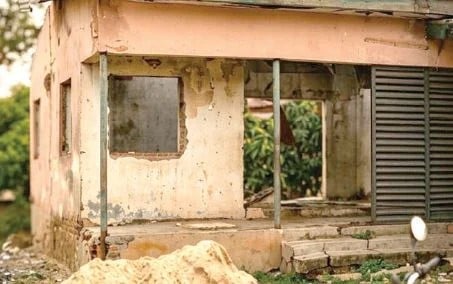
Once a leading tuberculosis and leprosy treatment centre in Northern Nigeria, the Tuberculosis and Leprosy Health Centre, located in Narayi, Chikun Local Government Area of Kaduna State, now lies abandoned and partly washed away by erosion. PUNCH Healthwise investigation reveals how the collapse of the once-busy public hospital has forced TB patients to receive treatment under trees, exposing them to stigma, neglect, and discrimination, DEBORAH TOLU-KOLAWOLE reports
Each time 42-year-old Musa Ibrahim visits the Narayi Primary Health Care Centre to collect his tuberculosis drugs, he wraps his turban tightly around his face before stepping down from the motorcycle that brings him there.
The PHC was never designed to cater to TB patients.
Since the collapse and abandonment of the Tuberculosis and Leprosy Health Centre, Ibrahim and many other TB patients in the state have been forced to seek treatment at the PHC, where they gather in open spaces — mostly under trees — to receive their drugs amid fear, stigma, and discrimination from other patients.
To avoid being recognised, Ibrahim, a farmer, keeps his head lowered and walks quickly toward the corner of the facility where TB patients now receive treatment before quietly leaving for home.
“Before the Tuberculosis and Leprosy Health Centre crumbled, you could enter inside and nobody outside would know why you came,” he said quietly, adjusting the edge of the brown turban covering half of his face.
“Now, even children point fingers at you and say you have TB.”
TB patients avoid treatment over stigma
A few metres away, pregnant women sat with crying babies waiting for immunisation. Some glanced briefly in Ibrahim’s direction before moving away. Others kept a noticeable distance.


“When people know you have tuberculosis, they begin to avoid you,” he added softly.
“Some people won’t even sit close to you.”
He paused briefly and stared at the dusty ground beneath him.
For Ibrahim, the disease is no longer the hardest part; it is the shame.
After receiving his drugs, he quietly adjusted his turban again before leaving the health centre. He glanced around cautiously before walking away.
The tragedy of the Tuberculosis and Leprosy Health Centre is not merely that a hospital was abandoned.
It is that the people who still need it most now suffer silently — exposed not only to disease, but also to stigma, fear, and neglect.
TB treatment centre in a shambles
A few metres away from the Narayi Primary Healthcare Centre stand the remains of what was once one of Northern Nigeria’s most important tuberculosis and leprosy treatment centres.
A PUNCH Healthwise investigation revealed that the dilapidated Tuberculosis and Leprosy Health Centre in Narayi, Chikun Local Government Area of Kaduna State, now lies abandoned, with cracked walls collapsing under years of neglect and rusted roofs hanging loosely above empty wards that once sheltered patients fighting for survival.


According to the World Health Organisation, tuberculosis, popularly known as TB, is an infectious disease caused by bacteria that most often affects the lungs.
It spreads through the air when infected persons cough, sneeze, or spit.
Several visits to the centre by our correspondent showed that what remains today is a haunting shell of a hospital slowly disappearing into silence.
Findings by PUNCH Healthwise indicated that not long ago, the facility was one of Kaduna State’s major centres for tuberculosis treatment.
Our correspondent gathered that medical students from Ahmadu Bello University once passed through its corridors for practical training.
TB patients also travelled from different parts of Kaduna State and neighbouring communities to seek treatment, recovery, and hope at the hospital.
Nurses moved through the wards during sleepless nights while health workers monitored weak patients struggling to breathe through severe coughing fits.
Today, the scene is painfully different.
During several visits to the facility, our correspondent observed goats wandering through overgrown paths as tall grasses pushed through cracked concrete.
Empty windows stared into abandoned corridors
Deep erosion channels cut dangerously behind the hospital buildings, threatening to swallow sections of the already collapsing facility.


But health workers at the neighboring Narayi PHC insist that TB patients still come around, even from neighboring places where they receive treatment sometimes under the solar panels and trees in front of the PHC.
PUNCH Healthwise found that for many patients, public exposure carries a deeper wound than the disease itself.
Established in 1967, the Tuberculosis and Leprosy Health Centre was created to help curb the spread of infectious diseases at a time when tuberculosis and leprosy carried enormous fear and stigma across communities.
Now, even in abandonment, the hospital still attracts people battling tuberculosis, one of the world’s deadliest infectious diseases.
But the dignity that once came with seeking treatment inside hospital walls is slowly disappearing.
Health workers lament
“Some patients stopped coming entirely,” says Chibi Gandu, who has spent years working at the centre.
As she walks slowly through the deteriorating structures, her voice carries both exhaustion and heartbreak.
Sharing her frustration with PUNCH Healthwise, she said, “The hospital has been completely abandoned.
“Most of the workers who used to work here have been transferred and dispersed to other hospitals, while the facility itself has been left to deteriorate.”
She paused briefly beside one of the collapsing buildings and looked toward the now-empty wards, which used to be buzzing with activity.
“When I was first posted here, the hospital was functioning very well,” she recalled.
“Medical students from Zaria used to come here for lectures and practicals because this place was recognised as an important centre for tuberculosis care.”
The health worker told our correspondent that she had no choice but to continue treating patients in the open and under the trees at the neighbouring Narayi Primary Health Care Centre because the old hospital environment has become unsafe.
“I now treat some of the patients outside because there is no proper space and the environment is no longer safe for both staff and patients,” she lamented.
The situation, she explained, has worsened the stigma many tuberculosis patients already face daily.
“Some of the patients stopped coming entirely because of stigmatization,” Gandu noted.
“Many of them do not feel comfortable receiving treatment outside, where people can easily identify them as tuberculosis patients.
“You watch patients trying to hide their faces before collecting drugs,” she said quietly.
“You see fear in them.”
Some TB patients stop showing up
According to her, some patients now deliberately come very early in the morning or late in the evening just to avoid being recognised by neighbours or relatives.
Others stop showing up completely.
For health workers like Gandu, the emotional burden has become increasingly difficult to ignore.
“You begin to worry about the ones who stop coming. Tuberculosis treatment is not something you should interrupt”, she added.
She said the hospital still struggles to provide basic services despite the terrible conditions.
“We still try to provide immunisation, maternal care and tuberculosis treatment,” she said.
“But honestly, this place needs urgent intervention.”
PUNCH Heathwise also observed that at the nearby Narayi Primary Health Care Centre, where tuberculosis patients now receive treatment due to the collapse of the Tuberculosis and Leprosy Health Centre, ordinary patients seeking maternal care, malaria treatment, or immunisation often become uncomfortable when they see tuberculosis patients openly receiving drugs nearby.
The Officer in Charge of the Narayi PHC, Phoebe Joseph, told our correspondent that the arrangement had affected the PHC deeply.
“The Tuberculosis and Leprosy Health Centre at Narayi has been destroyed, so the facility is no longer giving services, and they now come to Narayi Primary Care Facility to get their drugs.”
According to her, fear and misunderstanding surrounding tuberculosis have started affecting other healthcare services provided at the facility.
“It has been affecting our regular patients because once people come and see those taking drugs for tuberculosis, it affects our output of patients,” she explained.
“Some of our patients have stopped coming to our facility because of those tuberculosis services.”
Joseph said the TB patients no longer even have a proper consultation area.
“She doesn’t even have space to see her patients,” she said, referring to Gandu.
“She just gets a space where the solar panel was mounted to give them drugs there.”
Her voice tightened with frustration as she described the daily reality.
“Once anybody who comes to the facility sees them receiving their drugs, it discourages them,” she said.
“Some people will say they don’t want to come to Narayi Primary Care because they are afraid of being affected by tuberculosis.”
The facility, she said, now relies heavily on community sensitisation campaigns just to reassure ordinary patients that they can still safely access healthcare services.
“It has been a great challenge for us,” she added.
“My appeal is that the government should help renovate the tuberculosis clinic so that their services can return there specifically for tuberculosis treatment”, she told PUNCH Healthwise.
Nigeria’s silent tuberculosis crisis
The tragedy unfolding in Narayi reflects a much larger public health crisis in Nigeria.
Nigeria, according to the WHO, remains among the world’s 30 high-burden tuberculosis countries and accounts for one of the highest numbers of tuberculosis cases in Africa.
In March 2025, the Federal Ministry of Health disclosed that Nigeria recorded more than 400,000 tuberculosis cases in 2024, the highest ever documented in the country.
Health officials estimated that about 506,000 Nigerians were living with tuberculosis during the period.
Globally, tuberculosis reclaimed its position as the world’s deadliest infectious disease after surpassing COVID-19 in mortality.
The disease spreads through the air when infected persons cough, sneeze or speak. Poverty, overcrowding, poor nutrition, and weak healthcare systems continue to fuel transmission across many Nigerian communities.
Yet despite the enormous disease burden, experts say stigma remains one of the greatest barriers to treatment.
Many Nigerians still wrongly associate TB with death, dirtiness or personal failure. In some communities, patients are isolated, mocked or avoided entirely.
Children of TB patients are sometimes ridiculed in schools. Workers conceal symptoms until they become critically ill. Women diagnosed with tuberculosis often face discrimination in marriages and relationships.
Public health experts warn that stigma delays diagnosis and increases transmission because patients avoid hospitals or discontinue treatment midway.
In Narayi TB centre, that reality plays out every day.
Patients who once quietly received care inside hospital wards must now collect drugs in public view.
And some would rather stay home than risk humiliation.
A hospital swallowed slowly by erosion
PUNCH Healthwise investigation further revealed that beyond neglect and stigma lies another danger: the land itself is collapsing.
Our correspondent discovered that behind the Tuberculosis and Leprosy Health Centre, deep erosion channels have eaten dangerously into the earth, creating unstable ground that threatens both buildings and lives.
The destruction is so severe that even health workers fear for their safety.
Gandu recounted one terrifying incident that still unsettles her.
“I even took pictures after my son fell inside the eroded area,” she said.
“He sustained injuries, though we thank God it was not worse than that.”
The erosion has transformed sections of the hospital grounds into dangerous traps hidden beneath grass and loose soil.
Children now avoid parts of the abandoned facility.
Parents constantly warn them not to wander too close to the collapsing edges.
At night, residents told our correspondent that the area becomes frighteningly deserted.
For a hospital already struggling to survive, the environmental destruction feels symbolic as though nature itself is consuming what the government neglect left behind.
‘Our parents sacrificed to bring this hospital here.’
The Village Head of Narayi, Sule Sarki Garba, still remembers when the hospital brought life to the community.


The community leader told PUNCH Healthwise that for years, government officials have visited the community promising rehabilitation of the facility.
According to him, photographs are taken, promises are made, but nothing changes.
“We gave the facility to the government so it could be rebuilt for the benefit of the people, but since then, no real help has come,” he lamented.
“Government officials come here, snap pictures, make promises, and assure us they will return to rehabilitate the hospital, but nothing eventually happens.”
The traditional ruler said the community accepted the hospital decades ago, at a time when many communities rejected such facilities because of the fear surrounding tuberculosis and leprosy.
“Our parents and elders sacrificed a lot to bring this hospital here at a time when many communities were running away from such a facility,” Garba said.
“Now that people have seen its importance and value, they want to move it elsewhere.”
His voice rose slightly as he spoke about rumours that the hospital may be relocated.
“We strongly disagree with that,” he said firmly.
“We still have enough land and space for expansion and redevelopment here in Narayi.”
For Garba, the hospital is not just a building.
It is memory. It is history.
It is proof that people once found healing here.
“This hospital has served many people suffering from tuberculosis and related illnesses,” he said.
“Patients came from far and near to receive treatment here. Many were admitted and successfully recovered.”
He believes the hospital’s collapse has already begun costing lives.
“Because the hospital is no longer functioning properly, many people are suffering, and some patients are dying due to a lack of adequate treatment,” he said quietly.
He appealed directly to Kaduna State Governor Uba Sani.
“If he sees what is happening here himself, I believe he will act,” he said.
“We want the governor to help revive this hospital so people can once again benefit from the services it used to provide.”
Experts warn against failing treatment systems
Public health experts say specialised tuberculosis treatment centres remain critical in countries like Nigeria, where stigma, delayed diagnosis, and overcrowded public hospitals continue to complicate treatment efforts.
The Executive Secretary of Stop TB Partnership Nigeria, Mayowa Joel, warned during the 66th National Council on Health in Calabar in November 2025 that stigma and weak healthcare access continue to fuel the spread of tuberculosis despite free treatment services being available nationwide.
“The disease remained both preventable and curable, yet continued spreading due to stigma, misinformation and delayed health-seeking behaviours,” Joel said.
Health advocates say dedicated treatment centres help reduce delays because they provide patients with privacy, continuity of care, counselling and proper monitoring throughout the lengthy treatment process.
Global tuberculosis experts have also repeatedly stressed the importance of strengthening treatment infrastructure in high-burden countries like Nigeria.
Speaking during the 38th Stop TB Partnership Board Meeting held in Abuja in 2024, the Executive Director of the global Stop TB Partnership, Dr Lucica Ditiu, said countries must “construct systems that endure” and keep tuberculosis “on the front burner at all times” if the disease is to be eliminated by 2030.
Similarly, the Chair of the Stop TB Partnership Board and the Philippines Health Secretary, Teodoro Herbosa, described tuberculosis as “more than a health concern but a development challenge for many nations,” urging governments to sustain investment in testing, detection, and treatment infrastructure.
The WHO has also repeatedly stressed that early diagnosis and uninterrupted treatment remain central to reducing tuberculosis deaths globally.
In its March 2026 report on Nigeria’s tuberculosis response, WHO noted that improved access to testing and treatment had contributed to rising case detection nationwide.
The organisation warned that untreated tuberculosis patients could infect between 12 and 15 people yearly, underscoring why functioning treatment centres remain vital public health safeguards.
The forgotten history of leprosy and rejection
Long before modern public health campaigns, tuberculosis and leprosy carried enormous social shame in Nigeria.
For decades, people diagnosed with leprosy were isolated in settlements far away from society. Families sometimes abandon relatives diagnosed with the disease.
Though medical advances have made leprosy curable, discrimination still lingers.
According to the WHO, more than 172,000 new leprosy cases were recorded globally in 2024, with many occurring in African and Asian countries.
Historically, specialised tuberculosis and leprosy hospitals were created because both diseases carried enormous fear and stigma.
These facilities became not just treatment centres, but places of refuge for patients rejected elsewhere.
The Tuberculosis and Leprosy Health Centre in Narayi was one such institution.
Community leaders said it was the first tuberculosis treatment centre established in Kaduna State before the one in Zaria.
At its peak, it served as a referral centre for patients from across Northern Nigeria.
Now, its collapse represents more than failing infrastructure.
It represents the slow disappearance of an institution built for society’s most vulnerable patients.
A silence filled with suffering
Late in the evening, the hospital grounds fall silent again.
Wind whistles through broken windows.
Tall grasses sway through abandoned corridors where patients once fought for survival.
Govt keeps mum
When contacted, the Public Relations Officer of the Kaduna State Primary Health Care Board, Mariam Mohammed, said she would revert, but had yet to respond to calls and messages sent to her via WhatsApp and direct network service providers as of the time of filing this report.
Efforts to get an official to speak at the state ministry of health also proved abortive as our correspondent was denied responses despite several efforts.
Additional reporting by Israel Bulus
Copyright PUNCH
All rights reserved. This material, and other digital content on this website, may not be reproduced, published, broadcast, rewritten, or redistributed in whole or in part without prior express written permission from PUNCH.
Contact: [email protected]


