




Chima Azubuike
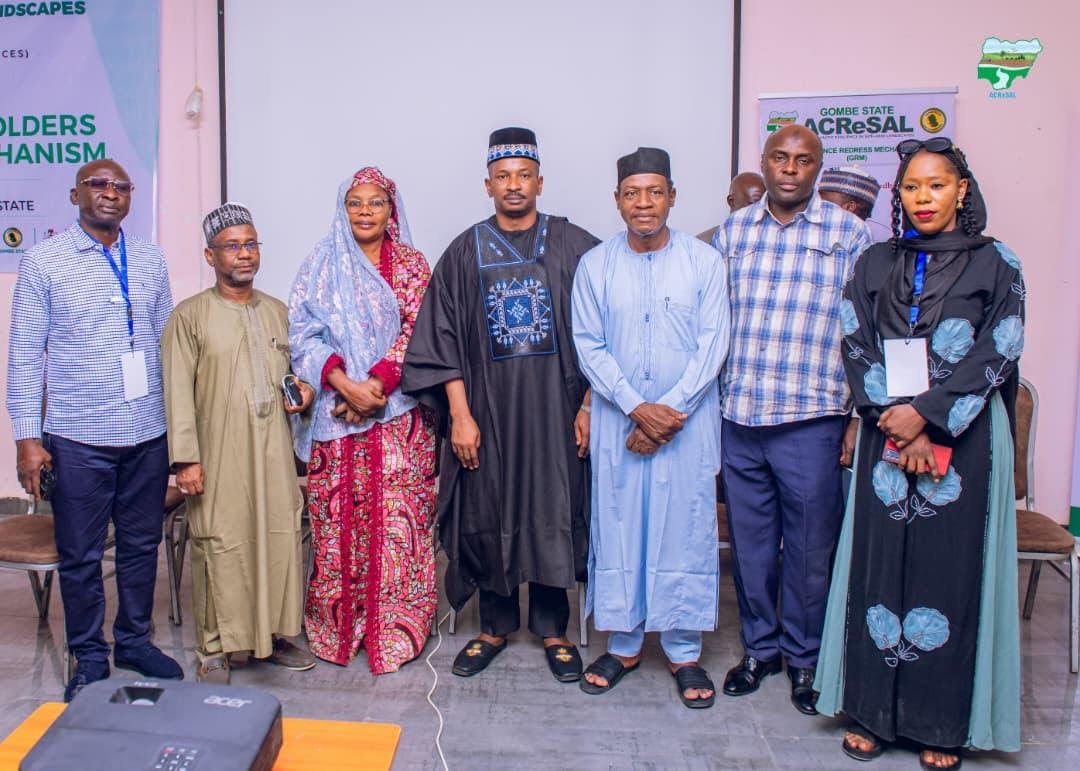
About 200 stakeholders involved in the ACReSAL project have been urged to strengthen the implementation of the Grievance Redress Mechanism to ensure transparency, accountability and smooth project execution.
The call was made on Sunday during a five-day training on GRM for stakeholders, including community and religious leaders as well as security agencies.
PUNCH Healthwise reports that ACReSAL project is a six-year World Bank-assisted initiative in Nigeria aimed at combating desertification, restoring one million hectares of degraded land by 2028, and boosting rural livelihoods across 19 northern states and the Federal Capital Territory. It focuses on sustainable landscape management, watershed rehabilitation and climate resilience.
Speaking during the session, Barrister Naomi Mwalin-Abdu outlined key escalation triggers within the grievance process.
“Escalation triggers include if the grievance is not resolved within the designated time frame at any level. High-risk issues such as safety, legal violations, or public health concerns require immediate escalation. If the current level does not have the resources or expertise to resolve the grievance, or if the grievant demands that their issue be escalated to a higher authority,” she said.
She added that the framework provides a clear and structured process for managing complaints.
“The GRM Framework provides a structured process for managing and resolving grievances effectively. It ensures transparency and accountability by defining clear procedures and roles for all stakeholders. Timely resolution of grievances, through the framework, supports smoother project implementation and fosters community trust,” she stated.
On his part, Dr. Adamu Jibir said the main objective of the GRM was to address grievances promptly, transparently and in a lasting manner.
“To address grievances promptly, transparently in an effective and lasting way as main objectives,” he said.
Jibir further explained, “To provide a grievance process that respects local culture and traditions, ensuring accessibility for all parties. To build trust as part of community relations activities within the project. To identify emerging issues early to allow for corrective actions and proactive engagement. To reduce lengthy litigation that could hinder the project’s progress.”
He emphasised the need to protect the privacy of complaints and ensure fairness in handling cases.
“Treat grievances confidentially. Limit information collection and use to needs of resolution process. If required, obtain consent before disclosure. Avoid restricting access to other redress mechanisms. Due process means right of person to present, heard (so give notice) in fairness, by a duly constituted body formed to address grievances,” he added.
Dr. Umar Inuwa, while speaking on stakeholder engagement, described it as, “A structured process of informing, consulting, and involving stakeholders in project decisions and grievance handling processes.”
He noted that in the GRM context, stakeholder engagement ensures communities understand their rights, complaint channels are known, trust is built and conflicts are prevented early.
Adamu Shehu, who spoke on community participation in GRM, highlighted the importance of acknowledging grievances and responding transparently.
“Recognition of their problem. Honest and transparent responses. Apologies or acknowledgement where appropriate. Support services or assistance. Compensation for losses,” he said.
He disclosed that the Grievance Redress Committee (GRC) at the community level is responsible for communicating with Affected Persons (APs) and evaluating entitlements.
“Publicising AP lists and the grievance procedure within communities. Recommending solutions to the Social Officer of PMU. Communicating decisions to APs. Acknowledging and reviewing appeals from disputed claims,” he added.
Shehu also listed conditions for escalation of cases.
“No agreement is reached. Case involves large compensation. There is political sensitivity. Allegations of misconduct or corruption. Serious land/RAP disputes,” he said.
The State Project Coordinator, Dr Sani Adamu-Jauro, lauded participants for their attentiveness, stressing that victimisation is against the policy thrust of the project.
He explained that the project prioritises alternative dispute resolution in order to avoid litigation.
“We are a project that stays away from courts. Once you go into litigation, the World Bank will naturally stop implementation and investigate the root cause. That is why the governor insists we keep in touch with communities to ensure no group is disenfranchised,” he stated.
Describing the training as a refresher course, Jauro said it was aimed at strengthening stakeholders’ knowledge of grievance redress in line with international best practices.
“In any setting where you have more than one person, there will be divergent views. This training is to ensure we manage grievances in a way that produces a win-win outcome; no victor, no vanquished, while achieving project results,” he said.
He added that the level of engagement by participants indicated that the objectives were being achieved.
“You can see from the feedback and the questions being asked that participants are engaging deeply. That is a clear signal we are achieving the desired result,” he said.
Also speaking, the Permanent Secretary, Ministry of Water, Environment and Forest Resources, Mohammed Abubakar, described the workshop as satisfactory and impactful.
“I can describe the workshop as very satisfactory because everybody understands what they are doing and saying,” he said.
Abubakar expressed optimism that the training would improve project activities, especially in erosion control.
“As the Ministry of Environment, we are custodians of erosion control. This will impact us seriously because they are doing much on erosion control,” he noted.
He said grievances in the sector were minimal and largely resolved through dialogue.
“The mechanism we apply is dialogue with host communities, elders, traditional rulers and the experts in the ACReSAL project. We are resolving about 80 to 90 per cent of the grievances,” he said.
In his remarks, the District Head of Butake in Dukku Emirate, Abubakar Rashid, lauded the organisers and pledged that traditional rulers would use the knowledge gained to promote peace.
“We as community leaders are very close to the people. We will leverage on the training on grievance redress mechanism to ensure peace. We will also cascade the knowledge to those who are not here,” he assured.
Copyright PUNCH
All rights reserved. This material, and other digital content on this website, may not be reproduced, published, broadcast, rewritten, or redistributed in whole or in part without prior express written permission from PUNCH.
Contact: [email protected]