


In this special report, ABIODUN ADEWALE x-rays a silent but deadly crisis in Nigerian grassroots football, exposing the recurring, preventable deaths of young players and the systemic failures in healthcare, safety protocols, and emergency response that continue to turn the pitch into a place of tragedy
On Saturday, February 7, 2026, the shivers of death travelled from Halstead, Essex, in England, to Nigeria, following the death of Saburi Adeniji, a non-league footballer with Kings Park Rangers FC.
He was reported to have suffered a brainstem injury three weeks earlier and was admitted to intensive care at Queen’s Hospital in the UK. Unfortunately, his condition deteriorated, and he was considered to be imminently dying.
After holding on for 20 days, he passed away on February 6, 2026, a day before his wife, Taiwo Oyindamola, and his four-year-old daughter arrived in the United Kingdom to be at his bedside and say goodbye.
NeuLife Rehabilitation – a US-based residential post-acute rehabilitation facility – describes brainstem as a neural pathway responsible for controlling the body’s subconscious functions like breathing, heart rate, and blood pressure, consciousness, sleep, tear production, balance or equilibrium, motor commands, such as eye movement, facial expressions, swallowing, and chewing. It also controls reflexive actions, like sneezing, coughing, and vomiting.
Adeniji was relatively unknown to many back home in Nigeria. Still, his passing was a shocking reminder of how Nigerian non-league footballers, and even professional footballers, die in their boots, amid a poor health infrastructure and unhealthy playing conditions.
A pattern of preventable tragedies
Adeniji’s case is not isolated. Across Nigeria, a troubling pattern has emerged with young, often promising footballers collapsing and dying during or shortly after matches.
Most of the victims are up-and-coming footballers with the dream of going pro, while some just play football for fun.
Barely two weeks after Adeniji’s death, on Thursday, February 19, 2026, the ugly trend reared its head again in Lagos with a teenage footballer of Bright Future Football Academy, Quadri Dada, who passed away after a local football match.
“He wasn’t with the academy during that game. He went for a game, and we heard that immediately after the game, he slumped. They tried to take him to the hospital, but he didn’t make it,” Bright Future Football Academy owner and coach, Kareem Yusuf, narrated the incident to The PUNCH.
“He is a humble and dedicated player that we are looking forward to his prospects in the near future, but we just had to accept fate. He was a utility player, very composed and dynamic as well.”
Another one occurred in December 2025 in Ezinifite, Aguata Local Government Area, Anambra State, where a promising footballer, identified as Chisom, also passed away during a local football tournament organised to mark the end of the year. What ought to have been a celebration of the crossover into the new year ended up being the end of the promising talent.
In a video shared on Facebook by Amarachi Ezeabasili, a football coach and CEO of Lily Legends Football Academy, Ajao Estate, Oshodi, Lagos, who was on holiday in the village when the sad incident happened, players of St. Glory Pillars FC, whom Chisom played for, and their opponents could only wail in the dormitory of a hospitable, as his body laid helplessly on a metal chair at the reception. He must have been pronounced dead on arrival by the hospital management.
Chisom died in his boots on December 26, 2025. He was buried the following day, and sadly, the tournament continued on December 28, 2025.
That incident reshaped Ezeabasili’s belief about safety, prompting her to organise cardiopulmonary resuscitation training, also known as CPR, for her young players in the academy as soon as she returned to Lagos.
“Though I have always planned to get that done, after the incident that happened in my village, where a young talent just slumped and died, it was devastating,” Ezeabasili told The PUNCH.
“Around here, we do not understand the importance of these things, and it’s really affecting us. In recent times, on social media platforms, I have seen several pictures of players who were said to be playing and then slumped and died.
“I always feel there ought to be something that could be done if we have the knowledge of performing CPR. In most cases, you will see people carrying water and start giving it to the person.”


“It’s to manually help the heart to keep circulating oxygenated blood to the vital organs, the brain, and others till help arrives. From there, we can proceed to the hospital,” she explained.
“Interlock your fingers for an adult and use the heel of your palms then start compressing on the chest. The thrust should go about two inches, that is about five centimetres. You keep doing that and give 30 pumps.”
While surfing social media for other cases, a TikTok user with the name ‘BMW gadget guy’ shared a video of another incident that took the life of his friend at Bishop Aggey Field, Mushin, Lagos, on September 20, 2025.
In the video, the player was unmarked on the right side of the pitch, just in front of the dilapidated structure of the Bishop Aggey Field. He then received a pass and seemed like he wanted to pull a cross before falling in the process. Everyone stood still for a few seconds, expecting him to get up, but they all rushed as soon as the first responder signalled something serious had happened.
The TikTok post suggested he died on the spot.
“While my team was leading 9-0, the referee made an announcement that the match would end in the next five minutes, and suddenly, my friend fell down and passed away immediately after the ball was passed to him.”
Other victims in the last two years include: Salami Oniru, a player who featured at the first edition of the Lagos Liga in December 2024. He passed away on the field on November 2, 2025.
This pattern doesn’t respect class as renowned sports administrator, Deji Tinubu, also tragically passed away in similar circumstances in 2018. The former Chairman of the Lagos State Sports Commission was playing football with his friends.
In April 2024, popular journalist Ayo Adams also slumped and died while playing football in Abuja. It was also during Ramadan.
Popular Yoruba vlogger and businessman, Oluwagbenga Korede, also known as Afobaje, died on August 3, 2024, after reportedly collapsing while playing football at Ikeja Cement, Lagos.
Only a few of these incidents become public knowledge, and among them, relatives and associates often shy away from reliving the pain.
Perhaps hit by regret and the reality of the avoidable casualty, they point fingers at the circumstances that led the victims to the grave prematurely, rather than focus on the risks that led to the sad incident.
Understanding medical risks and causes
Cases like this are linked to Hypertrophic Cardiomyopathy, in which Dr Joel Bervell, a Ghanaian-American physician and advocate for health equity, describes as genetic.
“This is a genetic condition that causes the heart to thicken, making it harder for the heart to pump blood. Parents or siblings of someone with Hypertrophic Cardiomyopathy have a 50/50 chance of inheriting the genetic disposition. So, knowing your family’s heart health is key. It’s more common than you might think, because it affects 1 in 500 people. Globally, 15 to 20 million people have HCM, but only one in seven are diagnosed.
“Most people’s HCM don’t show symptoms, but common signs can include shortness of breath, tiredness, chest pains, and heart palpitations. It can also go unnoticed until exercise triggers something serious like sudden cardiac arrest. Diagnosis can be tricky; it’s often confused with asthma or other heart conditions.
Beyond genetics, lifestyle choices and the environment also contribute to these fatalities. Victims are usually seen as physically fit for these activities, but their lifestyle negates that.
Maje Ayida, founder of Eden Lifestyle and a corporate wellness coach with services across the World Health Organisation, Pfizer, and some Nigerian companies, explains the thin line between looking fit and being healthy.
“Outside of the recreational sports, what is their lifestyle like? Going to the gym three times a week, playing football twice a week, are people strength-training to make themselves stronger?”
“The most dominant issue of all is the environment. The burden and the stress on people as a result of work, what they do, and what their family situations are. These are environmental factors that lead to stress and, in turn, lead to lifestyle diseases like hypertension and non-communicable diseases.
“There is an unusual amount of stress in Nigeria, when you compare it to other places in the world, especially when you think of a place like Lagos, and it causes untold damage to your health.
“As a result of these environmental factors, people are not managing stress enough. Imagine sitting in traffic for six hours a day, getting home to meet an epileptic power supply, you sleep in the heat, mosquitoes bite you, and you are fighting a lot of factors,” Ayida told The PUNCH.
There is no doubt that semi-professional and amateur football are less coordinated than professional football. Professionals usually have a team of professional support. At the semi-pro level, there is very little attention to health standards, so you can push the body beyond the limit of regulated human or medical capacity, and this can create harm to the health of the person.
Lilly Legends Football Academy’s physiotherapist, Ochiaka, teaching young players how to perform CPR during emergencies. Photo: Abiodun Adewale
Public health physician with a specialty in sports and exercise medicine, Dr Babatunde Akinbinu, also suggested that underlying health issues can complicate traumatic experiences while playing football or doing other sports.
“In boxing, people have numerous hits to the head. In football, people head the ball, fall on their heads, you get an elbow to the head, or the goalkeeper punches your head, and they hit their heads against one another, and sometimes it’s some cardiac situations. All these things play a role.
“If you have elevated blood pressure, for example, it puts pressure on the entire body. Some of these issues, it may not be during the particular match where the person falls, but it might be from several matches back and just plays out then. So, if you have a problem, people should be able to go and check so you can have an idea if there is a problem,” Dr Akinbinu explained.
Bridging the gap between ignorance and knowledge
Experts agree that many of these deaths are preventable with the right systems in place.
Akinbinu recommends routine medical screening as standard, even at amateur levels.
“The heart, for example, has a rate at which it will perform during those activities. Professionals also have regular checks, which would be affordable at local levels, including ECGs.
“So while you commit to physical activities in order to avoid non-communicable diseases, there is also an extent to which you want to do. There is a reason football is only 90 minutes plus extra-time in some cases and not longer than that.”
Football coach Ezeabasili preached awareness at the local level.
“At that level, they only focus on the money, the prize and the medals. It’s even more pathetic that the competition continued immediately after the boy was buried. When I raised the alarm about that attitude and safety generally, they were not happy with me, but they didn’t seem to realise how pained I was because someone died while they were playing football.
“They need to be educated. There should be more awareness, and they must have trained personnel on the ground.”
Ayida added that controlling things like sleeping habits, eating, and other routines can help the body while engaging in physical activities.
“You focus on things you can control. Look at your habits, and my advice for anybody is to engage in routines that involve movement and exercise consistently, managing your sleeping habits. Routines that involve being mindful of what you eat. That is like the limit to controlling it, and you also have control over how you deal with stress,” Ayida noted.
“Stress is probably not going to change, but the choices you make every day compounded over time can be the difference between life and death. If your habits revolves around being active, regular strength training and avoiding being sedentary, when you eat and how much you eat, walking enough, and sleeping habits. Two nights of poor sleep can remove years from your life.
“When people don’t pay attention to these things, they begin to self-medicate and take medicines. They just walk into a pharmacy and get anything. People throw pills at anything without knowing what it does to their bodies. They won’t consider if they are eating right, exercising well, and they are just doing more damage to their body. Unfortunately, most of us are victims of circumstances. Just the stress of existence is enough but we must understand these priorities as part of our survival.”
Life goes on
The differences between Adeniji and these cases at home are the location, the kind of first response they are exposed to, and perhaps what is left for the family left behind.
In Adeniji’s case, his wife and daughter were gifted about 20,000, which was raised while he was in the hospital.
“Saburi leaves behind a 4-year-old daughter, whom he adored. He worked tirelessly to provide for his family and was deeply committed to giving his daughter a good education and a better future,” the note on his GoFundMe page read in part.
“Beyond the immediate need to reunite his family, this fund will also be used to support his wife financially as she navigates life after this devastating loss and help secure his daughter’s education and well-being back home in Nigeria.”
But for Chisom in Ezinifite Aguata, Anambra State, the tournament continued a day after his burial with no further conversations about the family he left behind.
According to Ezeabasili, he was said to have secured a visa for a footballing trip to Europe before his untimely death.
For the young player, Dauda, his parents were said to have accepted the fate of his demise while his club lost a potential player who could command huge transfer fees from foreign clubs.
Call to action
“Generally, we have one of the lowest life expectancies in the world. You ask why is that and you can also trace it to the environment and ineffective health care. In sports facilities, do they have active defibrillators in sight, and are there trained personnel?” Ayida queried.
“When people are going to play Saturday morning football, do they have defibrillators in sight? When someone clutches his chest and goes down, does anyone know what to do? Do they know emergency numbers to call? What is the promptness of the response if they call or people just bundle them into the car and start rushing them to hospitals?”
Aside from amateurs, professional footballers have lost their lives on the pitch in Nigeria as a result of inadequate health infrastructure and response, suggesting a deeply rooted abnormality.
One of such cases was a Nasarawa United player, Chineme Martins, who died in 2020 during a league game between his club and Katsina United in Lafia.
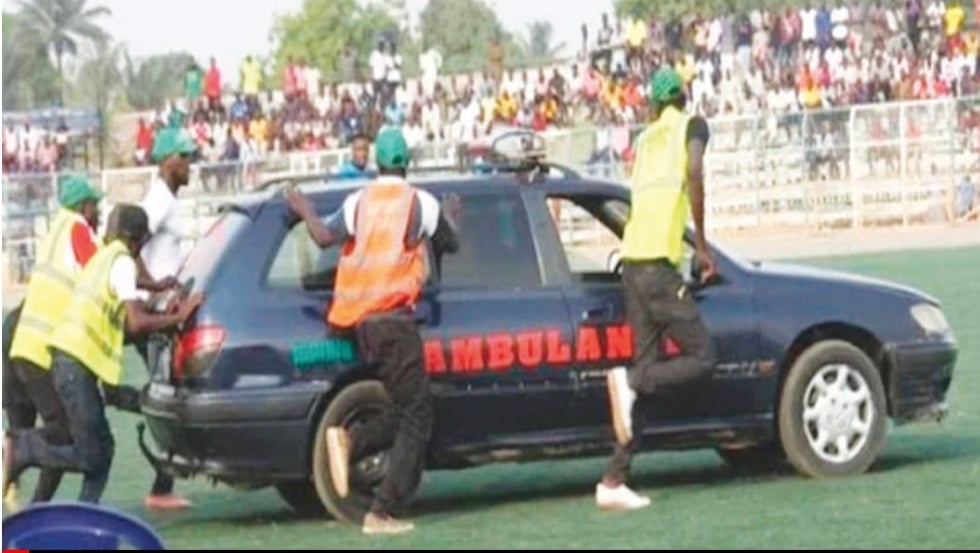
Martins fell unconscious and passed away despite the efforts of the medical team to revive him. Eyewitness accounts at the stadium also reported a delay in getting Martins to the hospital because of a problem with the ambulance.
In a landmark case that followed his death, Nasarawa United were found guilty of negligence, while the Nigeria Football Federation also directed that no further matches should be played unless there is a full complement of medical equipment at the stadia and personnel, as provided in the NFF Club Licensing Regulations.
Furthermore, the NFF said all match commissioners and the host FA “are to ensure they inspect all the facilities, including carrying out test runs before giving the go-ahead for any match to be played.”
“The system pays lip service to these things. When we have money, we don’t do it. If professional teams can’t live up to these expectations, what do we expect from non-league teams?” Dr Akinbinu adeed.
Primary care sports and exercise physician, Dr Jimi Osinaike, also adds that hypertrophic cardiomyopathy is most common among black athletes, hence the system must be proactive in terms of education, screening, and having a system of prompt emergency response.
“I would like to emphasise that despite preventive strategies such as pre-screening exercises, sudden cardiac arrest can still occur. A good example is Danish footballer Christian Eriksen, who had a cardiac arrest during the Euros in 2021.
“This suggests that adequate emergency response is important. Empirical evidence shows that early recognition of sudden cardiac arrest and CPR can prevent sudden cardiac death.”
The recurring nature of these incidents points to a deeper systemic issue that goes beyond individual health and reflects structural neglect.
Without deliberate intervention, awareness, and investment in medical preparedness, the cycle will continue, turning football pitches into silent theatres of preventable loss.
Copyright PUNCH
All rights reserved. This material, and other digital content on this website, may not be reproduced, published, broadcast, rewritten or redistributed in whole or in part without prior express written permission from PUNCH.