

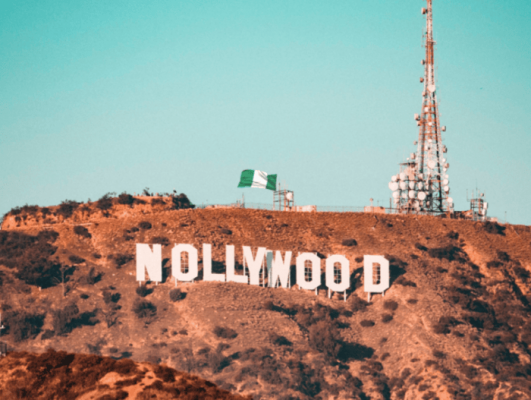
A foreign journalist gave it a nickname in 2002. In 2026, it’s a multi-billion-naira industry, split into at least four distinct sub-industries, still arguing about what to call itself.
Say “Nollywood” and everyone, from Lagos to London, knows what you mean. But almost nobody agrees on the details underneath the word: who actually coined it, whether the credited journalist even wrote the headline himself, whether the term fairly represents an industry made up of at least four separate language-based film cultures, or whether the label is a global marketing win or a form of erasure.
This carousel goes slide by slide through the documented origin, the authorship dispute, the pre-2002 history nobody talks about, the identity debate splitting filmmakers today, the regional fracture inside “Nollywood” itself, and the 2026 numbers behind the industry.
The most widely cited origin point is a September 2002 New York Times feature by journalist Norimitsu Onishi, headlined “Step Aside, L.A. and Bombay, Here Comes Nollywood.”
At the time, Onishi was based in Abidjan, Ivory Coast, working as the paper’s West Africa bureau chief. He travelled to Surulere, a district in Lagos known as a production hub, and documented what he saw: filmmakers shooting entire features in a matter of days, using minimal equipment, on tight budgets, at a volume that stunned him.
The word “Nollywood” (Nigeria fused with Hollywood) appeared in that piece and in the coverage around it, giving international readers a single, memorable label for an industry most of the Western world had never heard of.
Who Actually Coined It?
Here is where the official story gets complicated. Film scholar Jonathan Haynes, who is one of the most cited academic researchers on Nigerian cinema, has argued that the earliest documented use of “Nollywood” actually belongs to a different New York Times writer, Matt Steinglass, in a separate 2002 article describing Nigerian cinema.
That would mean Onishi’s more famous piece popularized the term rather than originated it.
But it further gets murkier as Onishi himself has said in later interviews that when academics ask whether he personally coined “Nollywood,” his honest answer is that a copy editor most likely wrote the actual headline the word appeared in. What this means is that he simply happened to be the writer whose article carried it into wide circulation. So the “man who named an industry” narrative, repeated constantly in explainer articles, doesn’t hold up cleanly under its own sourcing.
Read Also: Nigeria Has A Gambling Addiction Problem With 48 Million Site Visits Every Month
Most explainer content stops at “Nigeria + Hollywood, like Bollywood.” But Charles Igwe, CEO of Nollywood Global Media Group and one of the most frequently interviewed voices on the industry’s history, has offered a different reading.
According to him, Onishi’s inspiration may have actually leaned on the idea of “nothing wood” which is the concept of manufacturing something extraordinary out of virtually nothing. This is considering the improvised sets and minimal budgets Onishi witnessed firsthand in Surulere.
Whether that’s how the name actually started or just a story added later, it gives a much truer picture of the industry’s early days than the “Hollywood” mashup does.
This is the detail that fuels most of the industry’s frustration with the “Nollywood” narrative. Nigerian filmmaking did not begin in 2002 since it stretches back to the 1960s. This was immediately after independence, when celluloid films were already being produced and shown in cinemas.
Nigeria’s 1970s oil boom drove a wave of disposable income that turned moviegoing into a genuinely popular national pastime, well over two decades before any foreign journalist coined a nickname for it.
By the time “Nollywood” entered global vocabulary, Nigerian cinema was a mature, decades-old tradition finally being noticed.
The 1992 Turning Point
The real inflection point predates the name by a full decade. Living in Bondage (1992), a two-part supernatural thriller directed by Chris Obi Rapu, is widely credited with launching the direct-to-video “home video” boom that would define Nigerian cinema through the 1990s.
The genuinely transformative decision came from producer Kenneth Nnebue, who chose to distribute films on Video Home System (VHS) rather than depend on cinema infrastructure. This model let Nigerian films reach households across the country and the wider West African region years before streaming existed and long before the world had a name for what was happening. This VHS-driven wave is the actual foundation of what later got branded “Nollywood.”
So why did an outsider’s nickname stick, when the industry it described had already spent a decade building its own identity without one? Pattern recognition.
Global audiences and media outlets had already been trained by “Hollywood” and “Bollywood” to instantly decode any “-ollywood” label since it required zero explanation and traveled easily across languages and borders.
A phrase like “the Nigerian direct-to-video film industry” was accurate but forgettable and while “Nollywood” was neither accurate to the industry’s internal complexity nor original, it was instantly marketable.
That trade-off is exactly what critics point to when they argue the name serves global convenience more than Nigerian self-definition.
Acclaimed filmmakers Kunle Afolayan and Tunde Kelani have both stated publicly that the term glosses over a genuinely prolific era of Nigerian filmmaking that existed well before the phrase appeared in Western media in the 2000s, effectively crediting a nickname with “discovering” something that was never lost.
Critics go further on the politics of it that because the term originated from a foreigner describing a former British colony’s creative output, some stakeholders read it as an echo of colonial-era naming patterns; outsiders defining African culture for global consumption.
There’s also a structural critique: the “-ollywood” format inherently frames Nigerian cinema as a derivative of Hollywood and Bollywood, an imitation rather than an original tradition with its own distinct roots, aesthetics, and storytelling logic.
Supporters, including Charles Igwe, who continues using and promoting the term professionally, argue “Nollywood” solved a real problem: global investors, distributors, and audiences needed a legible, searchable entry point into an industry that had struggled for decades to register internationally despite genuine scale and talent.
Before the label existed, there was no shorthand for pitching Nigerian cinema to the world but after the labeling, the industry became instantly namable in boardrooms, film festivals, and eventually streaming platform catalogs.
The uncomfortable truth both sides have to understand is that the label may have functioned as a colonial-adjacent naming act and as the marketing hook that helped unlock billions of dollars in eventual investment. Those two things aren’t mutually exclusive, which is exactly why the debate hasn’t been resolved.
One Name, At Least Four Industries
“Nollywood,” in its strictest original sense, refers to English-language Nigerian film, which, by some estimates, has historically made up as little as 12% of total Nigerian film output. The rest is split across distinct, language-specific industries.
Yoruba-language cinema, called “Yorrywood,” accounts for roughly 55% of national output by some measures. Kannywood (Hausa-language cinema centered in Kano) which accounts for close to 30%, produces an estimated 200 films a month as of early 2026, employs over 30,000 people directly, and runs on a workforce where roughly 60% are under age 35, according to industry data reports.
There’s also a growing Igbo-language sub-industry sometimes called “Igbowood.” Each of these has its own stars, own audience, own cultural themes, and, critically, almost none of the global recognition “Nollywood” has captured, largely because English-language film travels internationally in ways Hausa- and Yoruba-language film has historically struggled to.
Whatever anyone thinks of where the name came from, it’s now attached to serious money. As of 2023, Nigeria’s film and music sectors combined contributed an estimated ₦1.97 trillion (roughly $1.4 billion) to national GDP, a 27.5% increase over the previous three years. By 2026, industry analysts put the creative sector’s GDP share at 2.3%, up from 1.4% in 2023, with revenue tracking toward a projected $14.8 billion. But a July 2026 industry-wide survey of 377 Nigerian creatives found the real bottlenecks are structural: unreliable power, limited access to capital, weak contracts, and broken payment systems.
Nonetheless, the industry produces around 2,500 films annually and remains the second-largest film industry in the world by volume and streaming has been central to that trajectory.
Since 2016, Netflix has spent $23.6 million on over 280 Nigerian titles, which is less than a fifth of its South African investment. This total nine-year commitment is a mere 0.1% of Netflix’s $20 billion global content budget for 2026 alone. Citing low market returns, the streamer began scaling back Nigerian originals in late 2024, signalling that it never viewed Nollywood as a major long-term bet.
Even so, ₦20 billion in projected 2026 box office revenue and a 2.3% GDP share remain modest next to the industry’s raw output and global name recognition. This is a reminder that “second-largest by volume” hasn’t yet translated into proportionate earnings or infrastructure. The gap between Nollywood’s cultural reach and its financial scale is, by most industry accounts, still wide open.
The theatrical momentum hasn’t slowed down, which is buttressed by how Toyin Abraham’s Oversabi Aunty crossed ₦1 billion in box office revenue across West African cinemas in January 2026, becoming the 4th-highest-grossing Nollywood film in history.
Notably, it became the first-ever directorial debut in Nollywood to reach that milestone. Reports flagged this as significant beyond the single film because it suggests Nigerian audiences are now responding to storytelling, casting, and buzz rather than only established directing pedigree, potentially widening the field for emerging filmmakers going forward.
It also confirms a strategic shift already underway since 2024 with Nollywood distributors like FilmOne increasingly counting revenue from cinemas across West Africa broadly, treating the wider region as a single theatrical market. On the infrastructure side, a proposed $100 million Film City development in Lagos is being positioned as the next major leap, aimed at attracting international productions with studio-grade facilities the industry has never had at scale.
Two Records Worth Celebrating
It’s worth celebrating what Toyin Abraham and Funke Akindele have each actually achieved, because the two milestones get conflated online.
Funke Akindele holds the record for the most billion-naira films by any Nigerian filmmaker with A Tribe Called Judah, Everybody Loves Jenifa, Behind the Scenes, making her Africa’s highest-grossing filmmaker of all time. None of these, however, was her directorial debut; that was Your Excellency, which didn’t hit the billion-naira mark.
Toyin Abraham holds a different record: Oversabi Aunty is her own directorial debut, and multiple 2026 sources confirm it as the first directorial debut in Nollywood history to cross ₦1 billion.
Two different and historic milestones from two accomplished women.
While box office records dominate headlines, the film “My Father’s Shadow” has quietly made cinematic history. Directed and written by Akinola Davies Jr. (with co-writer Wale Davies), this semi-autobiographical Lagos story set during Nigeria’s 1993 election crisis became the first Nigerian production to win at both the BAFTAs and the Gotham Independent Film Awards.
Produced by Funmbi Ogunbanwo and Rachel Dargavel as a UK-Nigeria co-production, the film’s historic run began in May 2025 when it became the first Nigerian film ever chosen for the Cannes Film Festival’s Official Selection, earning a Special Mention for the Caméra d’Or.
The film’s global acclaim solidified with a February 2026 BAFTA for Outstanding Debut, alongside Breakthrough Director at the Gotham Awards and Best Director at the British Independent Film Awards. It was also selected as the UK’s official entry for the 98th Academy Awards, making the December 2025 shortlist of 15 films. Back home, the film swept five categories at the May 2026 AMVCAs, including Best Movie, cementing its journey from a local narrative to the world’s biggest stages.
These box-office records are genuinely more impressive once you see what they’re built on. Nigeria’s population is estimated to be over 200 million people, yet as recently as 2023 the country had only about 251 cinema screens nationwide, with the average theatre housing just six screens.
For comparison, France (with a population of roughly 68 million, less than a third of Nigeria’s) opened 115 new cinema screens in a single year back in 2022. Nigeria, by contrast, only grew from 91 cinema locations in 2023 to 122 by 2025, with 135 projected by the end of 2026. And yet Nigerian cinema keeps setting records regardless: box office revenue climbed from ₦7.36 billion in 2023 to ₦15.64 billion in 2025, and is on track to cross ₦20 billion in 2026. The catch is that most of that growth came from rising ticket prices, not more Nigerians going to the cinema.
But 2026 shows the first real turnaround: Q1 admissions hit a six-year high, with Nollywood titles alone responsible for nearly 3 in 4 tickets sold. Every record Nollywood sets is still happening on a fraction of the physical infrastructure its population and demand should support, which means its actual ceiling, once real investment in screens and studios arrives, still hasn’t been tested.
Pulled together, a far more complicated story emerges than “a foreigner named our industry, how dare he?”
The name is documented to have come from outside Nigeria and that part isn’t in dispute but its authorship is contested even among the journalists credited with it.
As a result, it flattens at least four distinct language-based film industries (English, Yoruba, Hausa, and Igbo) into one export-friendly label.
Nonetheless, the explosive growth happening right now in 2026 are entirely Nigerian achievements, built by Nigerian filmmakers under a name none of them chose. Nollywood didn’t wait for permission to become one of the largest film industries on Earth. It did that with barely 300 cinema screens for over 200 million people, without the studio infrastructure Hollywood has or the state backing Bollywood enjoys, and under a nickname a foreign journalist’s copy editor may have written almost by accident.
So here’s what’s worth pondering: language shapes how the world values what we build, and names given by outsiders rarely capture the full complexity of what’s actually happening on the ground.
If Nigeria reclaimed its film industry tomorrow with names of its own choosing; Yoruwood, Kannywood, Igbowood, each recognized and funded on its own terms instead of folded into one label, would the world still see the same value? Or has “Nollywood,” controversial origins and all, already done the work of making Nigerian cinema legible on the global stage? Drop your thoughts in the comments section.
