

In this report, VICTOR AYENI examines how the pursuit of lighter skin drives some Nigerians to swallow handfuls of supplements, use whitening creams and undergo vitamin infusions, amid concerns of health risks
On September 29, as many people scrolled through X (formerly Twitter) to catch up on missed updates, a surprising video popped up.
In the 20-second clip that went viral the next day, a woman in a deep blue native outfit and gold chain sat in what appeared to be a beauty parlour, with a large banner bearing her photo in the foreground.
The woman, later identified by Saturday PUNCH as Divine Adedayo, the founder of a spa in Orile Agege, Lagos, was seen holding a bottle of water in one hand and a handful of pills and capsules in the other.
In two separate sequences, she tipped the multicoloured tablets and capsules – about 22 in all – into her mouth and swallowed them, washing them down with water.
While the unusual act immediately raised concerns among viewers, Adedayo’s caption to the original clip, which she posted on Instagram, read, “You see my life daily. Luxurious skin. See me for a free consultation.”
In another video on her Instagram page, where she wore the same attire as in the first clip, the spa founder showcased different products, one of which was named ‘half caste,’ ‘whitening oil’, and ‘customised cream,’ apparently all intended for skin whitening.
When the first footage began circulating and sparked massive backlash on social media, she made another video with a caption saying, “cry more” with bucket emojis.
Stirring what looked like an unknown pink mixture in a glass cup with a fork, she said in a sarcastic tone, “In case you want to cry more, here’s another one.”
With that, she drank the contents of the cup in a single gulp. Last week Sunday, Adedayo posted another video which was picked by several blogs.
In it, she held the capsules in her hand saying, “So, for you ignorant that are saying all sorts of rubbish, can you see? These are not drugs; these are supplements. I saw someone in a video on Facebook analysing rubbish.
“If you have money, see, they are supplements. Even this one too (the mixture in a glass cup) is a supplement, though I have to dilute it to use it because I’ve not eaten. It’s your mother that will have cancer.”
Reacting to the video, an Instagram user, Aramide Ajhike, wrote in the comments, “You all need to visit her store and buy one or two just to see her spotless skin in person. The camera doesn’t do her justice—even your favourite person who claims to be unmatchable can’t compete with her skin.”
Saturday PUNCH gathered that intending patrons usually place orders for these products through the page, and the skincare products are delivered to them at their respective homes or offices.
Concerns mount over skin whitening
On X, when the video was shared by Trending Explained, while the responses were largely negative, users expressed concerns over impending health problems and a flawed self-identity crisis.
“Skin whitening pills bought like this are rarely just one ingredient. You’re basically gambling with your liver and kidneys on a cocktail nobody tested,” a medical doctor, Augsburg Habila, said.
A family physician, Dr Chika Ehiemere, questioned whether anyone within the medical sector would recommend a patient taking 22 tablets in one sitting.
“No responsible doctor is prescribing that for skin whitening. Having lighter skin is not worth the liver damage. These pills are often unregulated, and mega-dosing them is how people end up with organ problems,” he stated.
Also reacting to the video, a Sociology of Education expert, Dr John Jonah, described the act of swallowing 22 tablets at once, “just to look like another person”, as being rooted in a wrong perception of beauty which could pose health risks.
“That act is a slow suicide that is being filmed for content. The skin might shine today, but tomorrow, they will be battling with liver and kidney problems; then their families will start a GoFundMe, or rush to church and they will start a prayer chain, and people will still say, ‘But she was fine yesterday.’
“If the colour God has given you pains you to the point of swallowing a handful of unknown pills, then the problem is not from the skin; it’s in the head. You can’t bleach your way into value. You can only poison the body carrying you,” Jonah noted.
How spas use dietary supplements
When our correspondent forwarded the initial viral video made by Adedayo to two pharmacists, they identified some of the capsules she held in her palm as vitamin E, vitamin D and omega-3 supplements.
They warned that megadosing on vitamins and dietary supplements, as well as using oral skin-whitening supplements such as high-dose glutathione and alpha-lipoic acid, could pose serious health risks, including acute liver toxicity and kidney failure.
However, findings by Saturday PUNCH showed that a batch of dietary supplements such as glutathione capsules, vitamin C, collagen, zinc, vitamin E, biotin, selenium, multivitamins and combinations containing several of these ingredients are heavily recommended and sold by some spa owners, self-acclaimed skincare experts and vendors on social media.
These oral dietary supplements – often grouped into specific ‘beauty categories’ –are given to clients to help them achieve a “glow from within” and tackle chronic skin issues.
Rather than a formal pharmaceutical “prescription,” these are usually provided as part of holistic skin consultations, aesthetic treatments, or customised clinical nutrition plans.
A Lagos-based spa consultant who preferred to be called Anita Gogo told Saturday PUNCH that although she does not specialise in ‘whitening’ the skin of her clients, they can give them glutathione paired with vitamin C, Niacinamide, and Alpha-Arbutin capsules to fade dark spots and tackle hyperpigmentation.
“We also use zinc supplements, vitamin A, and targeted “skin detox” herbal formulas to minimise breakouts or acne. We use Omega-3 fatty acids, Evening Primrose Oil, and Hyaluronic Acid capsules to hydrate their skin, which will make clients look younger in the long run.
“Skin dryness makes people look old quickly. We prescribe these supplements to help the skin rejuvenate itself from the inside out. But we don’t prescribe as many as 22 tablets as that viral video shows. In my own spa, I work with the skin colour of my clients. If you are caramel-skinned, what we will prescribe for you will be different from someone with dark skin,” Gogo noted.
However, Gogo stressed that having healthy skin goes beyond skincare or taking supplements. She noted that people needed to eat a balanced diet rich in vegetables, fruits, beans, whole grains, and eggs.
“There is no need for megadoses of supplements. What you need to maintain your skin is adequate hydration, sun protection through broad-spectrum sunscreen, protective clothing and sensible sun avoidance,” she said.
Heavy social media marketing
Social media has been said to amplify unrealistic beauty standards for women and younger audiences. Two of the platforms that heavily shape these standards by promoting polished, highly curated and visually striking content are Instagram and TikTok.
Fittingly, many skincare vendors market their products and supplements on these platforms, with an emphasis on skin lightening.
Saturday PUNCH also observed that most of these skincare vendors on social media have strikingly light skin.
One of their clients, who confided in our correspondent, stated that this is one of the factors that boosts their patronage.
“Those who patronise them won’t believe in the efficacy of their skin-lightening products if they were brown- or dark-skinned. For me, the first thing I want to see is a video or photo of the skincare expert. If I can’t see the result of her product on her face, or she’s using filters, then I’m not buying,” a client of a skincare brand, Tosin Ogundeji, disclosed.
In a video posted on the Instagram account of a spa owner, Lolade Kalejaye, she showed off two sealed containers, which she said contained vitamin capsules costing N65,000 each.
“These are vitamin drugs, and I’ve been using them for quite a while now. I came here myself to buy them. Actually, I’m using cream as well, but sometimes, you just get tired of using cream. But if you are using these vitamin drugs, forget it; your skin will continue to become spotless.
“You know, sometimes, I also get dark spots, even on my hands, but later, you will see them becoming white again. In fact, I want to pack 10 of these at once because those riders might want to delay in picking them up,” Kalejaye said.
In another video posted by an Instagram skincare vendor named Betty, she held up three bottles of pills, which she identified as supplements containing glutathione.
“You know I don’t bring rubbish; come for this. These are standard whitening supplements. They contain glutathione, collagen, Vitamin C and other good additives. You can pair two of these together; they are very effective. They will make your skin glow, and they are anti-ageing too,” she said.
Also plying her trade, an Instagram skincare vendor, Tony Onyegiri, described supplements as the most important part of skincare.
“People buy a lot of skincare products but neglect supplements. Supplements are my number one skincare. It works internally and externally,” she said.
However, the National Agency for Food and Drug Administration and Control had disclosed that it sealed eight cosmetics shops in Wuse Market, Abuja, late last year for selling banned, expired, and unregistered cosmetics, aphrodisiacs, and aesthetic medicines.
“Some individuals at the outlets were also found posing as dermatologists and pharmacists to prescribe harmful products,” NAFDAC said.
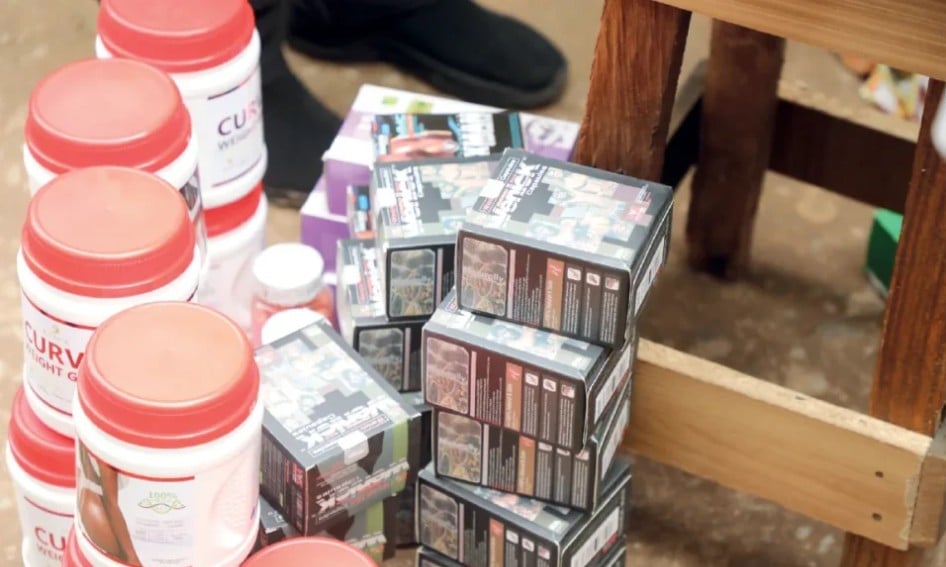
Among the confiscated items valued at over N170 million were Wenicks capsules, Maxman capsules, skin whitening vitamin gummies, collagen, Royal Jelly, glutathione whitening gummies, Dynewell syrup, and White Blinks.
“These products are associated with serious health risks, including kidney damage, skin cancer, and neurological disorders,” the agency stated.
According to one of the general provisions in the NAFDAC Dietary Supplement Regulations, 2025, “The labelling, presentation and advertising of dietary supplements shall not attribute to dietary supplements the property of treating or curing a human disease or refer to such properties.”
In the document, one of the general requirements issued “a warning not to exceed the stated recommended daily dose and to avoid overdose.”
‘Gastrointestinal tract at risk’
Highlighting some of the ingredients and products marketed for skin-related purposes, a pharmacist, James Ucheaga, noted that these supplements come in different dosage forms, ranging from tablets, capsules, caplets, gummies, powder, even syrups.
Speaking with Saturday PUNCH, he noted that although these listings demonstrate availability and marketing, they do not establish that a particular product is effective or safe.
“The concern becomes greater when someone decides that more pills must mean faster results. That is where the problem begins. The skin does not need a pharmacy full of tablets to be healthy.
“Healthy skin depends on adequate nutrition, hydration, a functioning skin barrier, protection from excessive ultraviolet exposure, management of acne and other skin diseases, adequate sleep and appropriate skin care.
“There is no scientific principle that says swallowing many different supplements will make a person’s skin healthier or lighter faster. In fact, taking several products simultaneously can create what pharmacists call polypharmacy or supplement stacking – using multiple medicines or supplements whose ingredients may overlap,” Ucheaga explained.
He clarified that the problem is that a person taking a glutathione capsule, vitamin C or E, zinc, a multivitamin, collagen, with another ‘skin whitening’ combination product, may not realise that several of these products already contain the same vitamins and minerals.
“The result may be an unnecessarily high total daily intake, and taking everything together does not make the body process the products faster. What happens when you swallow many pills is, first of all, the gastrointestinal tract has to deal with all of them.
“Multiple tablets and capsules can cause nausea, abdominal discomfort, heartburn, vomiting, diarrhoea or constipation. Zinc, for example, can cause nausea, vomiting, abdominal cramps and gastrointestinal distress when taken excessively. But gastrointestinal discomfort is only the beginning.
“Every substance that is absorbed has to be handled by the body. Depending on the substance, this may involve metabolism in the liver, circulation through the bloodstream, filtration by the kidneys, interaction with enzymes or transport systems, and eventual elimination. Therefore, swallowing 10 different products is equivalent to swallowing one product 10 times. And the danger increases further when some products are poorly labelled, adulterated, counterfeit or obtained from unreliable sources,” Ucheaga added.
The pharmacist warned that although not every beauty supplement damages the heart, an excessive intake of certain substances can disturb normal physiology.
Ucheaga added, “High-dose vitamin C can cause gastrointestinal effects and may increase the risk of kidney stones in susceptible people. Severe vitamin D toxicity can produce hypercalcaemia, which may cause dehydration, kidney stones and, in severe cases, cardiac arrhythmias and calcification of soft tissues, including cardiovascular structures.
“Severe selenium toxicity has also been associated with myocardial infarction and cardiac failure. The important point is that these are generally toxicity situations, not expected consequences of taking recommended nutritional amounts.”
Serums, injections and creams
Although many spas sell Vitamin C serum – a concentrated topical antioxidant used to brighten the complexion and fade dark spots, Saturday PUNCH learnt that there are some vitamin C serums that are specifically formulated to whiten the skin.
The owner of a spa in Magboro, Ogun State, Mrs Nafisat Odukoya, clarified that ‘skin whitening’ is often indicated on the bottle of these vitamin C serums, and they are usually purchased in the markets.
“They are topical; you apply them twice a day. The ones that do not whiten the skin are formulated by skincare experts themselves. But we do have clients who indicate their desire to lighten their skin and demand for that kind of serum.
“A small bottle is between the range of N5,000 and N7,000, and clients are usually advised to combine it with skin lightening creams and body wash for quicker effect. Even you, if you use these products, your skin colour will change within three weeks,” Odukoya told our correspondent.
Further investigations showed that in a bid to get quicker results, many spas bypass oral pills or topical serums and offer IV Vitamin infusions or ‘Myers’ Cocktails – which deliver high doses of these nutrients straight into the bloodstream.
“These are vitamin C intravenous drips,” a biochemist, Teniola Ayoade, noted. “I have met some girls who look like real-life Barbie dolls, especially during my NYSC days. That is what they used.
“These are some of the after-effects of these injections; you become light-skinned. These IV drips are quite expensive, but the after-effect is crazy when you think about it because the blood absorbs roughly 100 per cent of these substances.”
Recounting his ordeal with skin bleaching, an aspiring male model who preferred to be called Godwin Abba said one of his female friends introduced him to a skin whitening cream while he was an undergraduate.
“Back then I was insecure about my complexion. I am brown-skinned, but I felt being light-skinned would make me more attractive. She introduced me to Caro Tone, which she distinguished from Caro White (which is stronger in effect) and told me to use it with Skin White Soap.
“She kept telling me these won’t bleach my skin, that they would only make my ‘real’ complexion emerge. They actually worked, but I soon began to notice that only my hands were lightened; my face remained the same. Within three days of using them, I began to sweat abnormally. My clothes would be soaked whenever I walked any distance to receive lectures.
“My face towel became my companion; even when the fan was on in class, sweat would cover me, and people would be looking at me. Yet I kept using this cream to see its effect. One day, I opened the cream, and it had changed from its initial pink colour to brown. That was how I threw it away and stopped lightening my skin,” Abba recounted.
Liver, kidney damage
In an interview with Saturday PUNCH, a physician, Dr Zakariya Aminu, explained that the number of tablets or capsules taken by those in search of lighter skin does not, on its own, determine whether it is an overdose.
He clarified that the actual ingredients, strength and recommended dose of the medication are what matter.
“However, taking a large quantity of an unknown product at once can cause serious poisoning. An overdose can result in vomiting, dizziness, confusion, abnormal heart rhythm, seizures, difficulty breathing, loss of consciousness and, in severe cases, organ damage or death.
“Skin-lightening products themselves can also be harmful. Some may contain substances such as mercury, hydroquinone or potent corticosteroids. Prolonged use of these products is one of the commonest causes of chronic kidney disease, which, for some individuals, is a death sentence.
“The most worrying part is that many people may not know exactly what is contained in the products they are consuming or applying. Skin care should be about maintaining healthy skin, not putting your health at risk to change your complexion,” Aminu stated.
In his interview with Saturday PUNCH, the pharmacist, Ucheaga, noted that, aside from the kidneys, the liver metabolises many medicines and chemicals and is also involved in handling numerous nutrients.
“The liver can become an important site of injury when someone consumes excessive amounts of certain substances. Vitamin A is a well-established example. High-dose vitamin A is stored in the liver and can cause liver injury and, with chronic excessive exposure, fibrosis and other complications.
“Niacin, another vitamin sometimes present in supplements, can also cause liver injury at high doses, particularly with certain sustained-release preparations,” he added.
In a warning issued in its report, the World Health Organisation described skin lightening or skin bleaching as “a dangerous practice often associated with the risk of exposure to mercury salts to inhibit melanin production.”
It added, “Mercury-containing skin-lightening products are hazardous to health and have been banned in many countries. However, even in countries where tight controls exist, such products may be found being advertised and available to consumers via the Internet and other means.”
The New York City Department of Health and Mental Hygiene also disclosed that skin-lightening products contain mercury, which has been banned in the United States.
“These products are described as beauty creams, pearl creams, skin bleaching, fading, evening, brightening, or whitening products. They are usually marketed as treatments for uneven skin tone, acne, age spots, freckles and wrinkles. Mercury is usually not listed as an ingredient on product packaging,” the report warned.
WHO states that mercury in skin-lightening products can damage the kidneys and nervous system. This is why Nigerians should not assume that a product is safe simply because it is sold as a “beauty product”.
Psychological challenges
Sharing an experience with one of her old secondary school classmates, an X user, Abiyamo (@ScocialStranger), said she was surprised that the girl, who was ebony-skinned years ago, had now become like ‘Snow White.’
“When I made some investigations, I found out she was taking bleaching injections. I didn’t even know something like that existed, because her knuckles and every dead spot to the eye seem to blend.
“The same with her privates. The extent to which girls go to whiten their skin is simply fraudulent,” she noted.
Commenting on this, a psychologist, Dayo Courson, pointed out that being light-skinned has been portrayed as a beauty standard that people, especially women, are expected to aspire to.
He noted that the psychological challenges posed by internalised colourism, self-image and social reinforcement of the idea that being white-skinned is equal to being attractive often lead many to take risks.
“It’s sad, but people who swallow substances, or rub them on their bodies or inject them into their bloodstream have internalised the message that ‘being fair-skinned is more attractive.’ So, they have developed dissatisfaction with their complexion.
“Beyond the issue of health concern, it is also a major psychological challenge that may stem from adolescents who are seeking to create a separate identity. Constant exposure to carefully curated images of lighter-skinned celebrities, influencers and models can also alter a person’s reference point for what is considered attractive. Some of these people might need counselling to help them resolve issues with conditional self-acceptance,” Courson explained.
Issuing a warning, a consultant dermatologist, Dr Shakirat Gold-Olufadi, said, “Please, stop damaging the largest organ in the body. It is very easy to take care of the skin and equally easy to damage. Repairing it is usually very difficult and it may not even go back to the pre-damage state. It will cost more money, time and resources.
“Your dermatologist is talking now. A word is enough for the discerning wise. Finally, everyone has become a skin-care expert now because it is very easy to deceive gullible people in that industry, especially with social media. Know where you’re taking your advice from.”
Copyright PUNCH
All rights reserved. This material, and other digital content on this website, may not be reproduced, published, broadcast, rewritten or redistributed in whole or in part without prior express written permission from PUNCH.
Contact: health_wise@punchng.
