



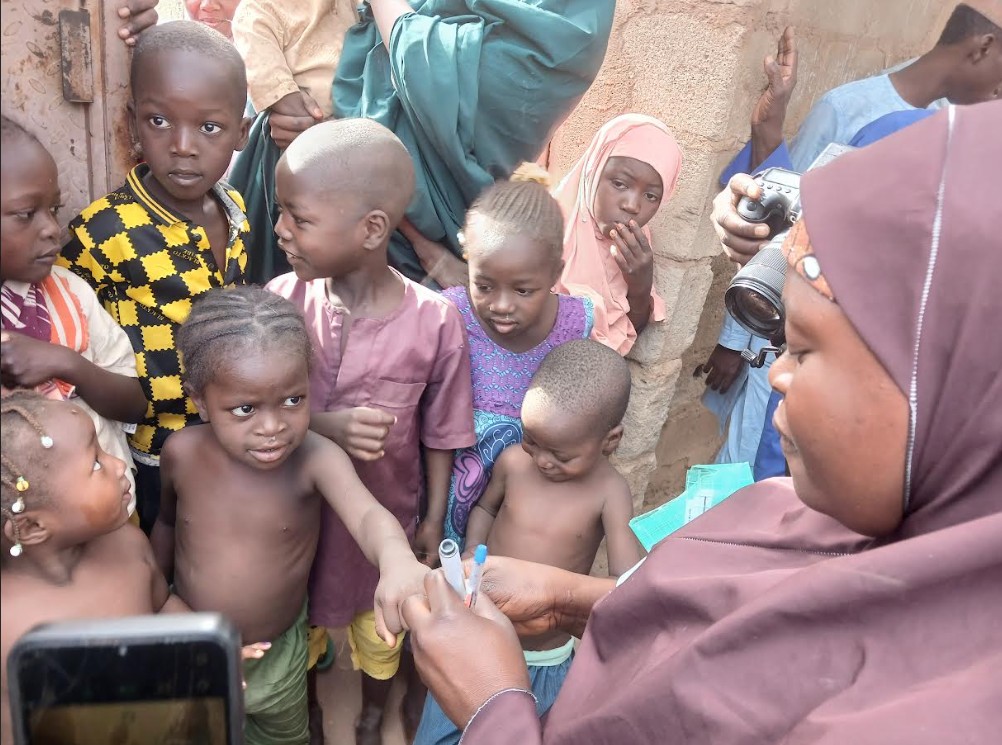
The Chief of United Nations Children’s Fund Bauchi Field Office, Dr Nuzhat Rafique, on Monday reaffirmed the commitment of partners and the Gombe State Government to eradicate polio, as the state commenced its first immunisation campaign for 2026.
Dr Rafique made this known during an interactive session with journalists shortly after an evening review meeting on the ongoing polio immunisation exercise in Gombe.
“This is the first polio campaign of 2026 in Gombe, and it is going to be very rigorous. It is very important for Nigeria to eradicate polio soon and become completely polio-free. Gombe is doing its best and trying very hard to reach that status,” she said.
She commended the state government for its commitment to the exercise.
“As always, thanks to His Excellency, the Executive Governor of Gombe State and his entire team for their strong commitment to this campaign. The Executive Secretary and I attended the evening review meeting, which shows the level of dedication,” she added.
According to her, the campaign, which began after flag-off activities at state and local government levels, is already recording steady progress.
“We have visited many hard-to-reach areas, and the teams are covering the LGAs effectively. The completion rate of settlements is increasing daily. This is a five-day campaign, and we expect even greater progress by days three, four and five,” she said.
Dr. Rafique noted that key components such as staff training, community engagement, and social mobilisation had been effectively implemented.
“The involvement of traditional leaders and emirs has been remarkable. Flag-offs were conducted in their palaces, and they are fully owning and leading the campaign alongside the government and partners,” she said.
Highlighting UNICEF’s contribution, she disclosed that the organisation had provided significant logistical and technical support.
“UNICEF, alongside other partners, is a major supporter of polio campaigns. We have provided over 965,000 doses of polio vaccines, which have been safely distributed across all LGAs by the state’s primary healthcare system,” she stated.
She added that the campaign targets about 771,000 children in the state, including over 50,000 “zero-dose” children who have never received any vaccination.
“We must reach every child. The government is taking the lead, and UNICEF and other partners are supporting to ensure no child is left behind,” she said.
On observed discrepancies in field implementation, Dr Rafique explained that such findings are part of efforts to improve quality.
“In every campaign, we set very high standards. Gombe is doing a wonderful job, and vaccinators are performing well, but there is always room for improvement.
These observations help us refine strategies and improve both coverage and quality,” she explained.
Also speaking, the Executive Secretary of the Gombe State Primary Health Care Development Agency, Dr. Abdulrahman Shuaibu, said extensive advocacy had been carried out across all levels.
“We have conducted advocacy at the state, local government, and ward levels. This includes engaging traditional and religious leaders, media organisations, women groups, and youth groups,” he said.
Despite the progress, he acknowledged the persistence of vaccine resistance in some communities.
“There are still pockets of non-compliance, not just in Gombe but across the country. We continue to sensitise communities and work closely with religious and traditional leaders to educate people on the importance of vaccination,” he said.
He emphasised that vaccines are safe, free, and effective in preventing diseases.
“We have seen improvements over the years in vaccine acceptance, which has also boosted routine immunisation coverage across the state,” he added.
On the recruitment of vaccination personnel, Dr. Shuaibu explained that community-based selection ensures trust and effectiveness.
“Each team consists of three members selected by local committees within their communities. These individuals are trusted and familiar with their environment. They are trained and given refresher sessions daily during the campaign,” he said.
He further noted that community leaders are being actively involved in addressing resistance.
“In our recent review meeting, we invited religious leaders, councillors, and community representatives from areas with non-compliance. Their involvement helps build trust and improve acceptance,” he said.
Dr Shuaibu disclosed that the state is targeting over 900,000 children aged 0–59 months in the current round of the campaign.
“We expect to achieve over 95 per cent coverage by the end of the exercise,” he added.
Copyright PUNCH
All rights reserved. This material, and other digital content on this website, may not be reproduced, published, broadcast, rewritten, or redistributed in whole or in part without prior express written permission from PUNCH.