


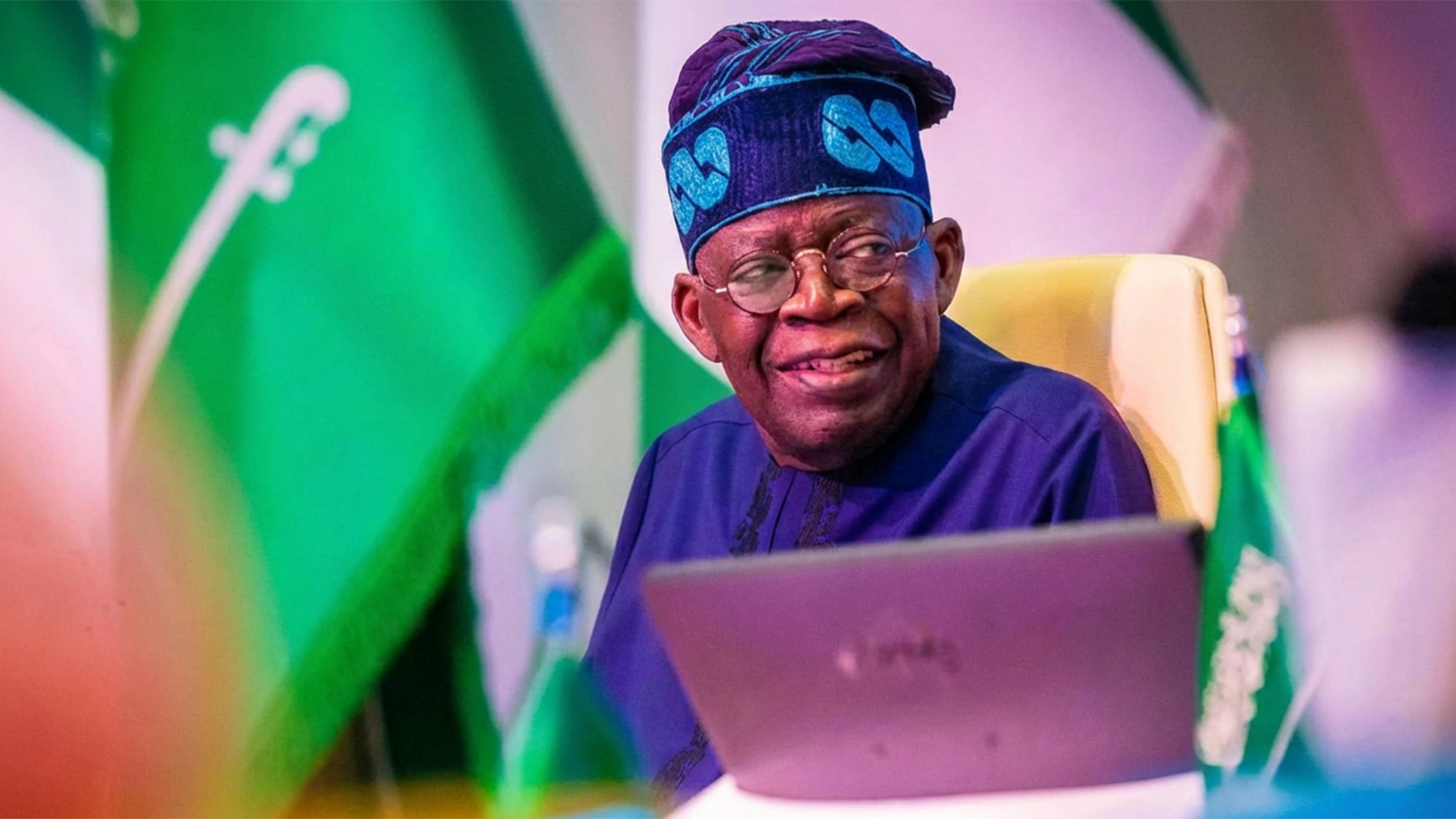
President Bola Ahmed Tinubu on Friday presented a ₦58.18 trillion 2026 Appropriation Bill to a joint session of the National Assembly, declaring that all armed non-state actors operating outside state authority would henceforth be classified as terrorists, as his administration moves to consolidate economic reforms and tighten Nigeria’s security architecture.
The budget, themed “Budget of Consolidation, Renewed Resilience and Shared Prosperity,” marks a critical phase in Tinubu’s reform agenda, aimed at locking in macroeconomic stability, strengthening resilience, and translating recovery into tangible improvements in living standards.
Addressing lawmakers, Tinubu said Nigeria’s economy is showing clear signs of stabilisation, citing improved growth, easing inflation, stronger revenues, and renewed investor confidence.
According to the President, Nigeria’s economy grew by 3.98 per cent in Q3 2025, up from 3.86 per cent in the same period of 2024. Headline inflation, he said, declined for eight consecutive months, falling from 24.23 per cent in March 2025 to 14.45 per cent in November 2025.
He also disclosed that external reserves had risen to a seven-year high of about $47 billion, providing more than ten months of import cover.
“These outcomes are not accidental,” Tinubu said. “They reflect difficult but deliberate policy choices. Our task now is to consolidate these gains so that stability becomes prosperity, and prosperity becomes shared prosperity.”
Appropriation Bill projects a total revenue of ₦34.33 trillion against an estimated total expenditure of ₦58.18 trillion, underscoring the government’s continued reliance on deficit financing to sustain growth and critical public spending.
A significant emphasis is placed on capital investment, with ₦26.08 trillion earmarked for infrastructure and other development projects aimed at boosting productivity and long-term economic resilience.
Recurrent non-debt expenditure is estimated at ₦15.25 trillion, while debt servicing will consume ₦15.52 trillion, reflecting the persistent burden of past borrowings on the fiscal framework. Consequently, the budget records a deficit of ₦23.85 trillion—equivalent to 4.28 per cent of Gross Domestic Product—highlighting both the scale of Nigeria’s development needs and the administration’s commitment to balancing fiscal sustainability with capital-led economic expansion.
The budget assumptions are based on a $64.85 per barrel oil benchmark, 1.84 million barrels per day production, and an exchange rate of ₦1,400/$.
Tinubu assured lawmakers that borrowing would remain disciplined and tied strictly to projects that deliver measurable public value.
The President directed the Minister of Finance, Budget Office, Accountant-General, and heads of Government-Owned Enterprises (GOEs) to enforce strict budget discipline, warning that Nigeria “can no longer afford leakages, inefficiencies, or underperformance.”
He announced full digitisation of revenue mobilisation, including automated collections, real-time monitoring, and performance dashboards, with revenue targets tied directly to leadership evaluations.
Security received one of the largest allocations at ₦5.41 trillion, reflecting what Tinubu described as a decisive shift in Nigeria’s security doctrine.
In one of the strongest statements of the address, the President declared that any armed group or individual operating outside state authority will be treated as terrorists, including bandits, militias, kidnappers, armed gangs, cult groups, forest-based armed collectives, and foreign mercenaries.
He further stated that financiers, ransom negotiators, informants, arms suppliers, transporters, political protectors, traditional rulers, and religious leaders who facilitate violent groups would also be designated as terrorists.
“The denominator is simple,” Tinubu said. “If you wield lethal weapons and act outside the authority of the Nigerian state, you are a terrorist.”
The administration, he said, is establishing a new national counter-terrorism doctrine anchored on unified command, intelligence-led operations, community stability, and judicial reforms.
Education received ₦3.52 trillion, while ₦2.48 trillion was allocated to health. Tinubu highlighted the Nigerian Education Loan Fund, which he said has supported over 418,000 students across 229 tertiary institutions.
He also announced that healthcare spending now represents 6 per cent of the total budget, excluding liabilities, and revealed that Nigeria had secured over $500 million in US grant funding for health interventions.
Infrastructure received ₦3.56 trillion, with emphasis on transport, energy, ports, agriculture, and food security. Tinubu described food security as “national security,” pledging investment in mechanisation, irrigation, storage, processing, and agro-value chains.
Acknowledging that reforms had imposed hardship, Tinubu said the sacrifices of Nigerians were not in vain and promised that 2026 would be a year of delivery.
“The greatest budget is not the one we announce,” he said. “It is the one we deliver.”
He pledged improved revenue efficiency, better-targeted spending, and stricter accountability to ensure Nigerians can see and feel the impact of public expenditure.
Tinubu concluded by calling for continued cooperation between the Executive and Legislature, saying unity of purpose was essential to delivering the promise of the Renewed Hope Agenda.
“With the resilience of the Nigerian people,” he said, “we will build a more secure, competitive, and equitable Nigeria.”