



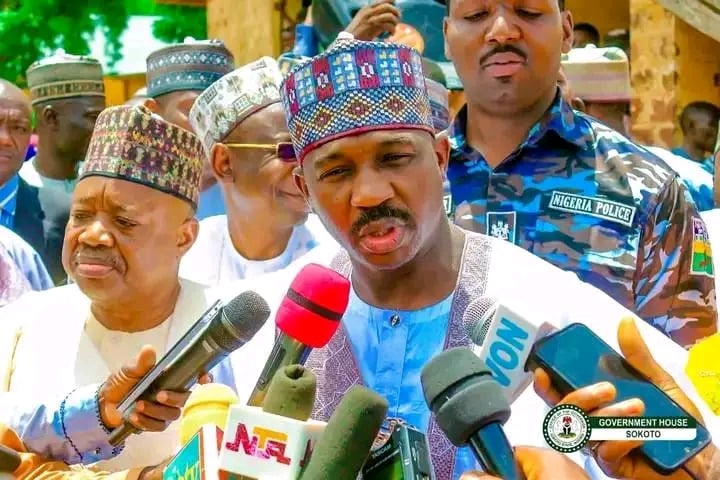


Governor Ahmed Aliyu on Wednesday presented a N758.7 billion budget proposal for the 2026 fiscal year to the Sokoto State House of Assembly, outlining plans to deepen security gains, expand social services and stimulate economic growth across the state.
The proposal, tagged the “Budget of Socio-Economic Expansion,” comes against the backdrop of lingering security challenges, rising living costs and growing demand for infrastructure and public services in Sokoto and across the North-West.
Addressing lawmakers, the governor said the budget was crafted through an unprecedented citizen-driven process, following town hall meetings held in the three senatorial districts of Tambuwal, Tangaza and Gwadabawa, where residents from all 23 local government areas and 244 political wards contributed to the planning process.
“The total budget size is N758,700,526,537.89, with projected revenue made up of N389.3 billion from the Federation Accounts Allocation Committee (FAAC), N74.5 billion in internally generated revenue, and N233.8 billion from grants, aids and capital development funds.
“Under the expenditure framework, we proposed N551.4 billion for capital projects, representing 72 per cent of the total outlay, while N207.2 billion, or 28 per cent, is earmarked for recurrent expenditure, in line with international fiscal benchmarks.
“Security remains a top priority in the 2026 fiscal plan, with over N45.2 billion allocated for the procurement of security equipment, patrol vehicles, motorcycles and other logistics to support security agencies battling banditry and violent crime in parts of the state.”
In the health sector, the government proposed N122.7 billion, accounting for about 16 per cent of the budget and exceeding the 2001 Abuja Declaration benchmark.
“The funds are expected to go into completing the Sokoto State University Teaching Hospital, Murtala Muhammad Hospital and premier hospitals in Binji, Tambuwal and Sabon Birni, as well as procuring ambulances and modern medical equipment.”
Education was allocated N115.9 billion, in line with UNESCO’s recommended funding range, while N109.1 billion was proposed for works and transportation, covering road construction, rehabilitation and improvements in public transportation.
Other sectoral allocations include N41.1 billion for water resources, N18.7 billion for agriculture, N17.4 billion for religious affairs, and N33.9 billion for humanitarian services, poverty reduction and youth empowerment programmes.
The governor said the economic sector received the highest share of the budget at 41 per cent, followed by the social sector with 37 per cent, reflecting the administration’s focus on growth, welfare and stability.
Providing further context, Aliyu told lawmakers that the 2026 proposal builds on the state’s improved fiscal performance in 2025, during which the government recorded over 65 per cent budget implementation and executed projects without borrowing.
He stressed that Sokoto State remains debt-free, adding that the government has no outstanding liabilities to contractors and intends to sustain fiscal discipline in the coming year.
The House of Assembly is expected to subject the proposal to detailed legislative scrutiny before passage.