




Gilbert Ekugbe
Surgeons at Redeemer’s Health Village, Ogun State, say robotic surgery reduces patients’ pain and shortens hospital stay because it uses smaller incisions that cause less tissue damage.
They explained that the use of robotic technology gives surgeons enhanced visualisation and greater precision during operations, which can help minimise blood loss and postoperative discomfort while supporting faster recovery.
The experts stated this on Wednesday at the Redeemer’s Health Village in Ogun State after the facility successfully performed its first robotic-assisted surgery.
The hospital’s first robotic-assisted prostate cancer surgery was carried out on a middle-aged man at the facility.
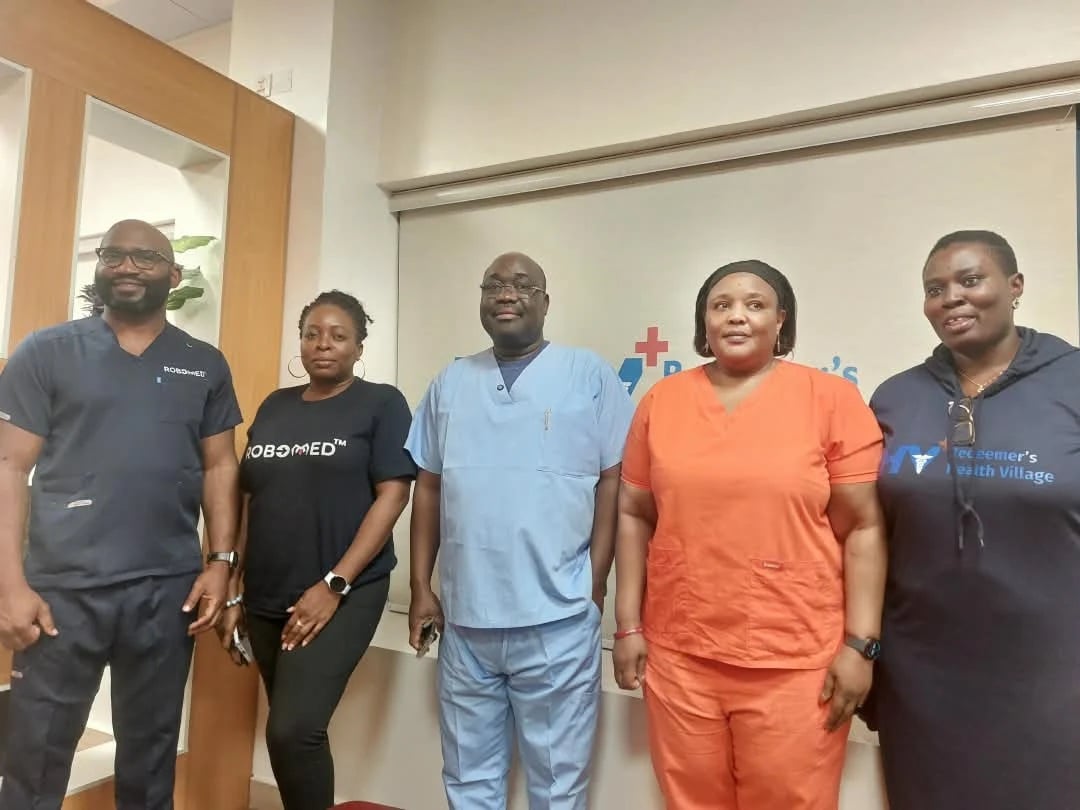
Urology experts, the in-house medical team, and robotic surgeons from RoboMed Global Inc., a US-based company, performed the procedure.
Announcing the feat, the Chief Executive Officer of Redeemer’s Health Village, Dr Ademola Dada, said the robotic-assisted surgery was a minimally invasive procedure with greater surgical precision that would ensure faster recovery for the patient.
“The patient goes home almost the same day or the next day, so there’s less trauma, and then, of course, success is better,” he said while briefing newsmen on Wednesday evening.
According to him, one of our core mandates is to ensure that the Redeemers Health Village is a premier destination for the best health care services in this country.
“For robotic surgery, the projection is that we want to make this affordable so that every single patient with conditions like prostate cancer and all of those things that robotic surgeries can do would have robotic surgery, because it gives better results and more precision.
“We want to be the premier destination for healthcare delivery services. Not just in Nigeria, but in the whole of the continent of Africa. We want to ensure that these services are made available to everybody, regardless of where you live, regardless of your social status,” Dada said.
The RHV CEO explained that aside from prostate cancer, the facility would also be making inroads into other surgical procedures involving robotic assistance.
“Yes, we are looking at other areas like cervical cancer, uterine cancer, colonic cancer, you know, cancers virtually, not only cancer, but even other conditions.
“One of the cases we’re going to be operating on during this period is a 28-year-old doctor who’s had a congenital deformity of the kidney from birth. That deformity is already damaging her kidney, and fortunately, the kidney is not fully damaged, so with this, we’ll be able to reverse that damage, and she can live a normal life,” he said.
Also speaking, a Professor of Urology and robotic surgeon, Obi Davies-Ekwenna, said robotic-assisted surgery allows better outcomes of the procedure.
According to him, robotic surgery allows us to do the surgery with smaller incisions and with a very magnified camera that helps us see better than what we can see with our own eyes.
“It also allows us to manipulate our hands in such a way that we can have almost 540 degrees of movement that your typical hand will not be able to do. So, mobility, visualisation, and precision, like being able to move something millimetre by millimetre, more than my hands can do, better than my hands can do.
“For everyone, every surgeon, every human, if you put your hand down, we all have a little bit of tremor, and that can also reduce precision. But the machine does not operate on its own, at least not yet. We still control the machine. So, the surgeon is still responsible for the surgery, still has to know where things are and how to move things around. But the machine allows us to do a better job in terms of tissue manipulation and things like that,” he said.
Davies-Ekwenna, who is also the Chief Executive Officer of RoboMed Global, said that with robotic-assisted surgery, patients experience less pain.
“Because there’s a smaller incision, there’s also less pain. Less wound infection. Because people get wound infections from big cuts. So, there’s less wound infection. And the patient can go home literally the next day,” the robotic surgeon said.
Copyright PUNCH
All rights reserved. This material, and other digital content on this website, may not be reproduced, published, broadcast, rewritten or redistributed in whole or in part without prior express written permission from PUNCH.
Contact: [email protected]