

Why the toothpaste, drugs, and food on Nigerian shelves can no longer be trusted and what it’s doing to our kidneys
On August 2, 2026, Leo Da Silva quote-tweeted a post asking, “Have you noticed the surge in mouth odour lately?” with his own blunt diagnosis: “It’s fake toothpaste. The toothpaste coming into Nigeria, I don’t know where they are from. When I enter other countries, same brand but different toothpaste.”
It’s a small, almost throwaway observation but it points to something much bigger than oral hygiene.
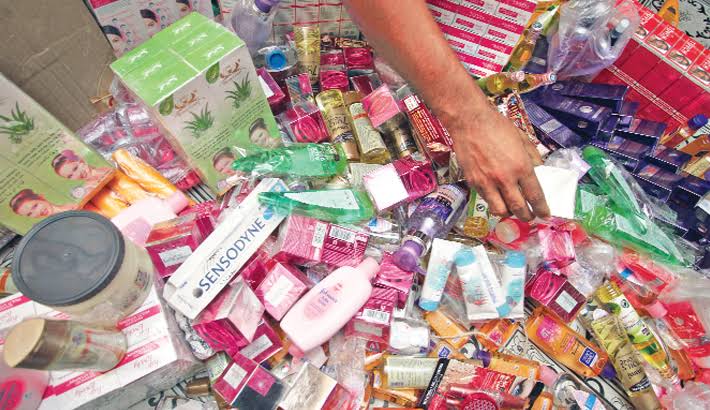
This wasn’t the first time Da Silva raised the alarm. In July 2025, he revealed that within a single month, he had unknowingly bought fake cod liver oil, fake Gestid, fake Sensodyne toothpaste, fake Simple face wash, and fake deodorant from a supermarket in Abuja.
His call for NAFDAC to raid major supermarkets exposed a harsh truth that counterfeiting in Nigeria has shifted from open markets into trusted retail spaces. That crisis has only deepened in 2026, flagged by April alerts over fake Colgate in Kaduna and a May raid exposing 240 illegal hubs mass-producing fake Cerelac, Hollandia, and spirits.
Driven by systemic gaps, this trade is direct pipeline to kidney failure.
The Scale Of The Problem
This isn’t a minor problem as the Standards Organisation of Nigeria (SON) recently destroyed over ₦20 billion worth of fake goods in one sweep. They seized dangerous items like cooking gas cylinders, car tires, wiring, roofing sheets, and steel doors. When these products fail, they cause fatal explosions and building collapses.
On the pharmaceutical side, NAFDAC’s enforcement record in 2026 alone tells its own story: about ₦3 billion in fake malaria drugs and cosmetics seized in Lagos in February, roughly ₦2 billion in counterfeit drugs destroyed in Kaduna, and close to ₦1.86 billion in falsified and expired products destroyed in Abuja by May.
SON estimates that as much as 80% of counterfeit products entering Nigeria are smuggled in from overseas, meaning this is fundamentally a border and supply-chain failure, not just a local market problem.
Read Also: Why Siblings Who Share Everything End Up Fighting The Hardest — The Sad Case Of P-Square
The uncomfortable part of Leo Da Silva’s story is that he wasn’t buying from Alaba or Ariaria but from a registered Abuja supermarket. This points to a deeper supply chain vulnerability. Industrial-scale counterfeit operations uncovered in markets like Idumota, Ariaria, and Onitsha Bridgehead have revealed sophisticated packaging factories and advanced printing presses capable of faking NAFDAC registration numbers with near-perfect accuracy.
These aren’t crude “Adidas-Abibas” knockoffs anymore as counterfeiters have become professionals. Fake products now look identical to the real ones, matching everything from fonts and holograms to batch codes. Because the packaging is so convincing, neither shoppers nor store owners can spot the difference until it’s too late.
Three verified cases from this year show the range of what’s at stake.
• In April, NAFDAC’s Kaduna surveillance team flagged unregistered toothpaste sold under names like “Coglaet ActivGel” and “Coglaet Herbal,” designed to pass as Colgate. The seller could produce no documentation for where the products came from.
• NAFDAC also issued an alert over counterfeit versions of Forxiga (dapagliflozin). This is a drug prescribed for diabetes, heart failure, and to slow the progression of chronic kidney disease being sold under near-identical names like “Forzigar” and “Foziga.” That a kidney-protective drug itself became a counterfeiting target is a sobering escalation.
• Separately, a joint NAFDAC, military, DSS, and police raid uncovered over 240 shops manufacturing fake Cerelac, Hollandia yoghurt, and spirits including Hennessy and Smirnoff using unsanitary water and recycled packaging, resulting in a further ₦5 billion in seizures.
The kidneys are the body’s filtration system, and counterfeit products assault them in three specific ways.
• First, toxic substitution: to cut costs, counterfeiters often replace safe ingredients in cosmetics, toothpaste, and soap with industrial-grade heavy metals like lead, mercury, and cadmium, which accumulate in renal tissue and destroy the nephrons that filter blood.
• Second, contaminated solvents: Nigeria has a documented history here. In November 2008, at least 84 Nigerian children died and dozens more suffered severe kidney damage after taking “My Pikin” teething mixture, which had been contaminated with diethylene glycol. This is an industrial solvent substituted for the safe compound propylene glycol.
• Third, under-dosing: fake antihypertensive or antibiotic drugs frequently contain little to no active ingredient. A patient with high blood pressure who unknowingly takes a fake antihypertensive keeps a dangerously elevated pressure that silently damages the blood vessels feeding the kidneys. This condition is known as hypertensive nephropathy.
Nigeria’s Kidney Disease Burden
The downstream cost is staggering. Chronic kidney disease (CKD) prevalence in Nigeria is estimated to range between 11% and 26% depending on the population studied, among the highest burdens globally, with Africans disproportionately likely to progress from CKD to full kidney failure.
Dialysis in Nigeria is almost entirely an out-of-pocket expense. Sessions have historically run around ₦30,000 each, three times a week, with first-year treatment costs estimated at roughly ₦8.9 million once medication, and consultations are factored in. This is several times the average Nigerian’s annual income and most families exhaust their savings within weeks of a diagnosis. As a result, a large share of patients discontinue treatment entirely once the money runs out, which is often a death sentence.
Desperation caused by widespread kidney failure has fuelled a disturbing secondary economy: illegal organ trade.
Investigations into Abuja’s underground kidney market found agents actively recruiting young, unemployed men from low-income satellite communities, offering roughly ₦1 million for a kidney. This is a fraction of what buyers, often from wealthier countries, ultimately pay.
This is a real-life example. In 2023, former Nigerian politician Ike Ekweremadu and his wife were jailed in London for bringing a young Nigerian man to the UK to harvest his kidney for their daughter.
It remains one of the biggest organ trafficking cases involving a public official, showing how public health failures can lead to the exploitation of vulnerable people.
The kidney failure and organ trafficking crisis from the previous slide isn’t going unnoticed by officials. At a NAFDAC destruction exercise in Abuja in May 2026, the Pharmacy Council of Nigeria stated plainly that the fake pharmaceutical products being destroyed that day had contributed to kidney damage and other health complications among Nigerians.
Lawmakers made the same link two months later when in July 2026, the Senate passed a bill proposing 15-year jail terms and asset forfeiture for fake drug dealers, with senators explicitly citing counterfeit drugs’ role in kidney-related disease and organ failure as justification for tougher penalties.
In response, the Standards Organisation of Nigeria (SON) has intensified raids and labeled counterfeit importers as “economic saboteurs.”
To curb illicit trade, the agency introduced mandatory Product Authentication Mark (PAM) QR stickers on imported goods, allowing consumers to verify authenticity via SON’s official portal.
Additionally, SON rebranded its Manufacturers Conformity Assessment Programme (MANCAP) certification and automated the system to slash processing times from 90 days to 30, making legitimate trade far faster and more attractive than operating underground.
No single agency can fight this alone, and 2026 has shown growing coordination. In July, the Nigeria Customs Service handed over roughly ₦53.39 billion worth of seized narcotics, counterfeit medicines, and expired pharmaceuticals to the NDLEA and NAFDAC following anti-smuggling operations at Apapa Port, including 6.7 tonnes of cannabis and over 339,000 bottles of codeine syrup.
SON has also deepened its partnership with the Nigerian Financial Intelligence Unit (NFIU) to trace the financial trails of major counterfeit importers, while working alongside Customs, the EFCC, and the Police to intercept goods at ports and pursue distribution networks rather than just confiscating stock at the point of sale. Whether this coordination can outpace the sophistication of counterfeit syndicates remains the open question.
The Survivalist Economy
To understand why counterfeiting persists despite these crackdowns, it helps to look past criminality alone.
Decades of currency devaluation, inflation, and high unemployment have squeezed household purchasing power severely. In an environment with minimal state safety nets, researchers who study informal economies note that extreme poverty can reframe what feels morally acceptable. There is often an immediate need to feed a family which can override abstract concerns about intellectual property law.
Trading in counterfeits also requires relatively low starting capital while offering high margins, making it an accessible, if illegal, form of entrepreneurship for economically marginalised young people. This context doesn’t excuse the trade but it explains why enforcement alone, without addressing the underlying economic pressure, has struggled to eliminate it.
There’s also a consumer psychology at play. International and luxury brands are marketed heavily as symbols of success and modernity, yet structural inequality means most Nigerians cannot afford the authentic versions.
Counterfeits, in this light, function as a kind of cultural bridge allowing lower-income consumers to participate in a global consumer identity that would otherwise be closed to them.
There’s also a more defiant undercurrent in some trading circles: Western intellectual property protections are sometimes viewed locally as tools that keep goods artificially expensive to benefit distant foreign corporations.
To be clear upfront, this isn’t a legal defense and it doesn’t excuse the trade. Counterfeiting remains illegal regardless of how unfair the pricing feels, whether the product is a handbag or a bottle of medicine. But within that illegal trade, some traders still frame cheap knockoffs of expensive imported goods as fighting back against high prices rather than stealing.
That framing, weak as it already is, completely collapses once the fake products are food, drinks, or medicine that people actually consume, since the harm shifts from a wallet problem to a health and life-or-death problem.
Nigeria also has a genuine, longstanding tradition of reverse-engineering as a form of industrial learning that is most visible in the Igbo apprenticeship system (Igba-boi) and manufacturing hubs like Aba, Alaba, and Ariaria.
For generations, studying and replicating an imported product’s design has been treated as legitimate skill-building and resourcefulness, not theft.
Reverse-engineering goods like furniture or electronics is a legitimate craft. The issue stems from a few bad actors who exploit this “local manufacturing” label to cloak deliberate counterfeiting of NAFDAC-approved food and drugs. These criminal operators lack the skill or transparency of true apprenticeships, hiding behind the broader trading ecosystem’s reputation to legitimize dangerous fakes.
For a young trader entering the market, the line between “learning by copying” and “faking a NAFDAC-approved drug” can feel culturally blurred, even though the health consequences of the two are worlds apart.
Let’s be clear about who is responsible: big counterfeit rings aren’t run by poor people just trying to feed their families.
NAFDAC raids on major counterfeit hubs regularly uncover industrial-scale packaging factories, advanced printing presses replicating NAFDAC numbers, and multi-ton distribution networks. These are infrastructure that requires serious capital and organisation.
Re-labelling expired medicine or filling capsules with inert powder is a calculated business decision to prioritise profit over human life.
That is why health advocates and lawyers want faking foods and medicines to be punished like poisoning or manslaughter. They are pushing for laws that would give offenders life in prison and take away their assets, knowing that small fines mean nothing to criminals making billions.
Fake medicine, baby formula, and toothpaste look just like the real thing, even down to the serial numbers but how to stay safe:
• Buy only from licensed pharmacies and trusted stores.
• Scan the SON QR code and check for the PAM sticker before using a product.
• Avoid prices that seem suspiciously cheap for brand-name items.
• Report suspicious goods to NAFDAC or SON.
While staying careful helps, stopping these fake-goods networks for good requires stronger law enforcement, stricter border checks, and people speaking up.
Have you or someone you know ever unknowingly bought a counterfeit product in Nigeria and how did you find out? Drop your thoughts in the comments section.