

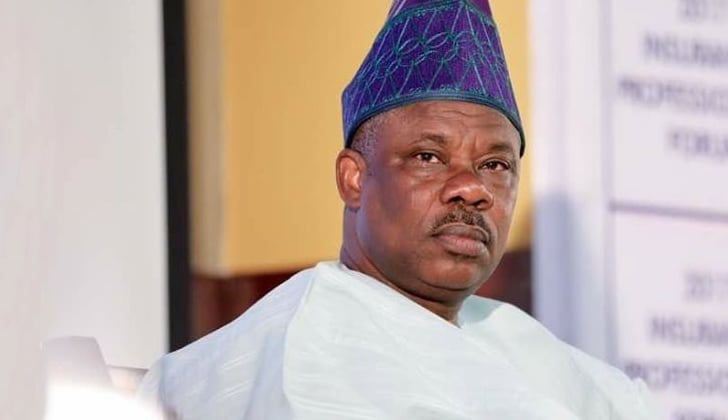

The Deputy Governor of Ogun State, Engr Noimot Salako-Oyedele, alongside a former governor of the state, Senator Ibikunle Amosun, and other Muslim leaders, have called for stronger unity, inclusive leadership and strategic collaboration among Muslims to achieve sustainable development and enduring community impact.
Salako-Oyedele and Amosun spoke separately in Abeokuta on Tuesday at a programme tagged “Ogun State Muslim Assembly,” organised by the League of Imams and Alfas, with the theme “Synergy, Leadership and Development in the Ummah of Ogun State.”
The Deputy Governor posited that religious knowledge alone, no matter how profound, cannot deliver development without active followership, structure and collective ownership.
She described Islamic scholars as custodians of faith, moral guides and a critical interface between the Muslim Ummah and government, noting that this role must be strengthened to improve engagement and policy outcomes.
Salako-Oyedele explained that even good ideas cannot succeed without followers, adding that religious leadership without grassroots participation would struggle to mobilise resources, influence policy and drive long-term growth.
She commended some Muslim organisations for effectively balancing religious authority with inclusive leadership, noting that such an approach has enabled them to build schools, universities, pilgrimage structures, zakat systems and vibrant da’wah programmes that empower members and encourage shared responsibility.
She maintained that leadership structures that are distant or exclusive often weaken trust, limit participation and undermine development efforts.
“As a politician, if you have fantastic ideas, you have a fantastic manifesto, you have the most laudable plans, but you don’t have followers, you cannot win an election, and your ideas and your ideology are going to die in the cooler.
“In the same way, a religious leadership structure without the active buy-in of its followership will always struggle to mobilise power, resources or influence.
“And this is where I believe we must speak honestly and constructively to ourselves, across Nigeria”, she said.
She emphasised that genuine synergy among Muslim leaders would help move the Ummah from gatekeeping to bridge-building, and from individual influence to collective strength.
Salako-Oyedele encouraged the League of Imams and Alfas to serve as a rallying platform for scholars and Muslim societies in driving unity, development and long-term prosperity within the state and the country.
Also speaking at the event, Amosun, who served as Father of the Day, described the assembly as timely, noting that divisions within Islam had weakened collective influence and distorted public perception of the Ummah.
“Over time, the practice and propagation of Islam have faced challenges, including differences among Islamic organisations and variations in Qur’anic interpretation arising from sectarian divisions,” Amosun said.
“These differences have sometimes led to disunity and conflicting teachings, portraying the Muslim Ummah as fragmented rather than united.”
He urged Muslims to prioritise their faith over affiliations and to anchor their actions in Qur’anic wisdom and shared understanding.
“When the Muslim Ummah works in synergy — united in teachings and collective purpose — we are better positioned to raise leaders who will uphold Islamic values and promote peaceful coexistence, social harmony and socio-economic development,” he said.
Speaking on the theme of the programme, the Registrar of the Joint Admissions and Matriculation Board, Prof Ishaq Oloyede, represented by a former Dean of the Faculty of Arts, University of Ibadan, Prof Abdulafeez Oladosu, decried persistent disunity among Imams in the state, warning that internal fragmentation had weakened the collective impact of Muslims.
Oloyede urged Islamic leaders to embrace renewed cohesion, expressing the hope that the assembly would herald a new era of greatness for the Ummah.
Earlier, the Secretary-General of the League of Imams and Alfas (Rabita), Ogun State, Sheikh Imam Tajudeen Adewunmi, said the assembly was convened in response to harsh realities facing Muslims, including challenges in education, healthcare, economic empowerment, social justice and socio-political integration.
Other speakers at the event who also called for a united front among Muslims across the country included a former Nigerian Ambassador to the United Kingdom, Amb Sarafadeen Tunji Ishola, and Emeritus Prof Kamaldeen Balogun, the Chief Imam of Gbagura-land and Mufti of Egba-land, among others.
