

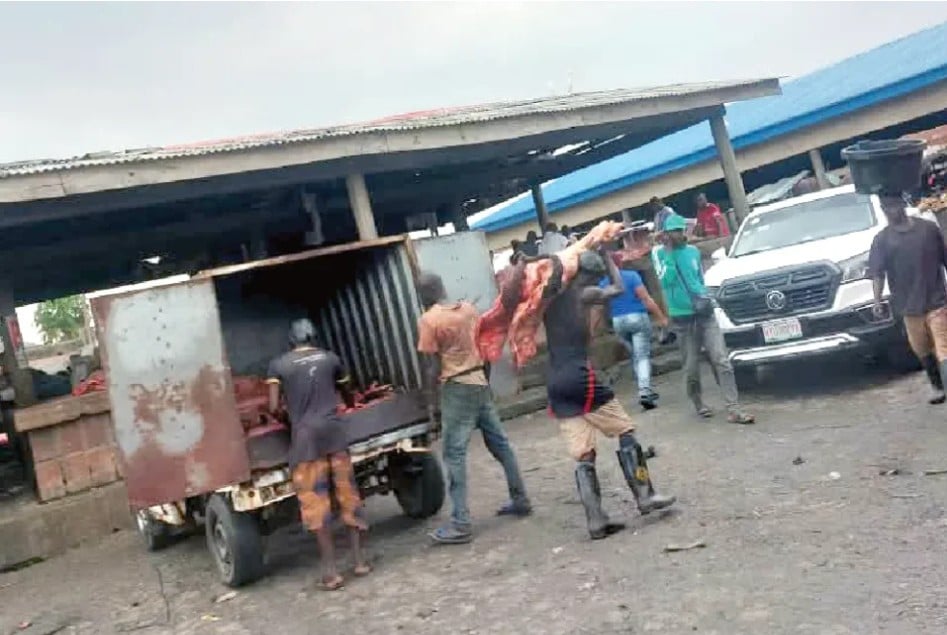
Across Lagos State, raw meat sold for human consumption is displayed on wooden slabs, exposed for hours to heat, airborne contaminants and swarming flies amid poor handling practices, heaps of waste and filthy market surroundings. These unhygienic conditions put millions of residents at risk of foodborne illnesses and other infections. IDOWU ABDULLAHI writes
From everyday meals to celebrations, meat, especially beef, is a major part of Nigeria’s diet. In Lagos State, residents commonly choose meat at home, in restaurants, bukas, and roadside food stalls, where it is prepared in different ways to suit diverse tastes.
Given its strong place in Lagos’ food culture, how cattle are slaughtered, handled, transported, displayed, and sold casts a shadow of safety concerns.
In several markets across Lagos where food vendors display their wares metres from waste and dirty environments, raw meat is left within reach of dust, flies, and other contaminants, creating potential health risks for consumers.
As Lagosians buy meat from these markets, the hygiene conditions under which the popular protein is handled and the environment, residents say, are now a source of concern for public health.
Interviews with some residents revealed that many have accepted the unhygienic situation as an unavoidable part of the meat value chain.
“I’m now used to it. Flies perching on meat displayed in markets is not new; it’s a common thing everywhere in the market, now worse with heaps of refuse everywhere in the markets.
“I once opened meat I bought from the market that was packed inside nylon, and a big fly escaped from it, which meant it was packed together with my meat from the market.
“Even though it’s not hygienic, those are the kind of unsafe practices that have been normalised in the state,” a resident of the Mushin area of Lagos, Mrs Omotadase Yasr, told PUNCH Healthwise.
10,000 cattle slaughtered daily
From beef stew and pepper soup to suya and assorted meat, beef has become deeply woven into Nigeria’s diverse food culture.
For many Lagos families, staple meals are considered incomplete without meat, making beef a regular item on their shopping list.
Across abattoirs and slaughterhouses in Lagos, an estimated 6,000 to 10,000 cattle are slaughtered daily, with the state leading in red meat consumption in Nigeria.
“Lagos slaughters not less than 10,000 heads of cattle daily; these include what is slaughtered in our barracks,” Lagos Commissioner for Agriculture, Abisola Olusanya, said in 2024.
Yet, checks by PUNCH Healthwise revealed that the journey from slaughterhouse to dining tables across Lagos exposes meat to several points of contamination, worsened by the recent waste management crisis in the state.
Findings show that poor sanitation, improper handling, and prolonged exposure in open markets turn meat into a potential public health concern.
Visits to markets
Visits to popular markets in Lagos, including Oko-Oba Abattoir, Army Arena Shopping Complex, Oyingbo, and Mile 12, revealed a troubling pattern of unhygienic handling of meat meant for human consumption.
At Oko-Oba Abattoir in the Agege area of Lagos, PUNCH Healthwise observed flies settling on exposed portions of cow meat as butchers were seen cutting the cattle parts into smaller portions for direct sale to retailers and consumers.
The market is widely known as a major abattoir supplying chunks of raw meat to several markets across Lagos where residents buy in smaller quantities.
Of particular concern are the meat porters who were offloading from meat vans and carrying chunks of meat directly against their bodies for onward transfer to the concrete tables in the markets.

Our correspondent observed that porters’ bodily sweat and body surfaces come in contact with the meat as they operate without visible aprons, gloves or hair coverings.
Poor handling, experts say, creates opportunities for microorganisms to get onto meat and spread from one surface to another.
In some parts of the market, massive cuts of raw meat sit exposed on rough wooden tables under umbrellas, conditions that can turn raw meat into a thriving ground for harmful bacteria in Lagos heat.
The surrounding environment, our correspondent observed, was filled with dark stagnant water and decaying organic waste.
Speaking with our correspondent, one of the butchers, who identified himself simply as Mufutau, said cleanliness in the market has improved, unlike what was obtainable a few years ago.
“The flies and the surroundings do not automatically mean that every piece of meat is contaminated or unsafe for consumers.
“This situation has improved, unlike when everywhere was muddy some years back,” the butcher, who had been trading in Abattoir for over a decade, argued.
Just like Abattoir, the meat sellers’ section of the popular Mile 12 market in the Kosofe Local Government Area of the state is situated in an environment that could predispose raw meat to contamination.
During a visit to butchers’ stalls in the Oniyanrin area, PUNCH Healthwise observed meat being handled and displayed for sale amid vehicular activity and human traffic, with no visible separation between the handling area and the wider market environment.
Flies were seen moving around the stalls where meat was being handled and sold, while the environment also creates favourable conditions for rodents and bedbugs.
Our correspondent observed that both butchers and consumers did not observe strict hygiene measures when handling meat, creating a possible spread of contaminants through the usual bargaining habits of touching the meat several times in their bid to buy and sell.
Also at the market, raw meat was seen being transferred from a van into a wheelbarrow and later placed directly on porous wooden tables that had absorbed blood and fluids over time, making thorough cleaning nearly impossible between sales.
While some of the porters in Mile 12 handling the meat carcasses wore an apron, some operated without any protective equipment.

“Flies are very stupid insects, and they also need to eat. So, it’s inevitable not to see flies around meat stalls like this,” a butcher, Wasiu Success, told PUNCH Healthwise.
When our correspondent probed further on why the meat is not in a covered display case, he said, “Those of us in this business are many, and customers need to see the meat you have before they come to price.
“Don’t forget that some customers won’t even buy if they don’t touch every piece you have on the table, so those are the reasons.”
During a visit to the popular foodstuff and general goods market in Oyingbo, in the Ebute Metta area of the state, our correspondent observed that while meat sellers’ sections are in an enclosed space, the meat was displayed vulnerable to flies, airborne dust, and other contamination throughout the trading day.
Away from their enclosed space, some meat sellers still displayed meat in the open-air markets, a few meters from waste collection points.
Meanwhile, the situation at the Army Arena Shopping Complex in Oshodi was no different from Abattoir, Mile 12, and Oyingbo markets. PUNCH Healthwise observed flies, waste, and raw meat sharing the same space.
During the visits, there were no protective glass guards or individual packaging that showed the meat sellers were conscious of hygienic standards in all four markets, which contravenes temperature control guidelines in meat sales.
Globally, temperature control is used to prevent the growth of harmful bacteria during meat sales, which is maintained from the slaughterhouse, through transport, to the retail display case.
Unhygienic practices amid unsafe food deaths
These unhygienic meat handling practices across Lagos markets come on the heels of fatalities linked to unsafe food across the country. Unsafe food can cause more than 200 diseases, ranging from diarrhoeal illnesses to cancers.
In June 2026, the Federal Government revealed that unsafe food causes more than 53,000 deaths and nearly 50 million illnesses annually in Nigeria.
Minister of State for Health and Social Welfare, Dr. Iziaq Salako, said Nigeria loses an estimated 4.26 million years of healthy life annually to foodborne diseases through illness, disability, and premature death.
“Nigeria records nearly 50 million foodborne illnesses every year, and unsafe food causes more than 53,000 deaths annually in our country. Together, these illnesses and deaths result in a staggering 4.26 million years of healthy life lost to illness, disability or early death,” Salako said during a ministerial press briefing to commemorate the 2026 World Food Safety Day.
Globally, the World Health Organisation estimates that about 600 million people fall ill after consuming contaminated food each year, while 420,000 die.
Meanwhile, several studies have shown that meat produced under unsafe handling practices may contain pathogens such as E. coli, Enterobacter, Salmonella, Acinetobacter, and Enterococci.

Others are Staphylococcus, Bacillus cereus, G. lamblia, E. histolytica, and A. lumbricoides, which, among others, may cause abdominal pains, intestinal obstruction, amoebic dysentery, liver abscesses, and death.
In a 2017 study published in BMC Public Health, an open-access, peer-reviewed journal, the researchers said that in developing countries, there was often a deficit of suitable and affordable equipment for the processing and transportation of meat.
According to them, these factors, combined with a lack of understanding of the risks of food-borne disease, lead to poor conditions in rural slaughterhouses.
The researchers called for proper regulation of the sector to improve hygiene and reduce the contamination of meat and spread of disease, as well as protect workers from occupational health hazards.
Lagosians fear eating contaminated meat
As unsafe food claims thousands of Nigerians, residents have called on the Lagos State Government to introduce and enforce stricter measures in protecting residents from the unhygienic handling and display of meat in markets across the state.
The residents, who spoke with PUNCH Healthwise, expressed concern that meat meant for human consumption was sometimes handled and displayed in conditions that could expose consumers to contamination and foodborne diseases.
They urged the government to strengthen monitoring of meat markets and ensure that traders comply with basic hygiene and food safety requirements.
A resident of Bariga, Mrs Ada Nweke, said it was important for the Lagos government to pay closer attention to the conditions under which meat was handled from the point of sale to when it was purchased by consumers.
“We have poor meat handling in Lagos, and the practice can introduce infection to the consumers if the meat is not properly cooked. We have a lot of foodborne diseases in Nigeria, and it could be some of these issues that are slowly killing Nigerians.
“We cannot continue to buy meat that is exposed to dirt and other contaminants and expect that there will be no consequences.
“The government needs to provide modern facilities for butchers to sell their meat to protect it from external contaminants and ensure that meat sold to the public is handled properly,” the middle-aged creative writer told PUNCH Healthwise.
Also, a public school teacher in the Ogba area of Lagos, Mrs Mariam Adio, said, “The government should provide transparent chillers where meat sellers can display their meat in a clean way as well as preserve it from getting contaminated.”
Another resident, Mr Adeyinka Oreniyi, called for more regular inspections of markets, saying enforcement should not be limited to occasional visits.
The businessman said, “The government should make sure that meat sellers maintain clean environments and that the meat is properly protected from flies, dust and other sources of contamination. This is about protecting the health of everyone who buys food in these markets.”
A trader and Oshodi resident, Mrs Lara Jolayemi, said, “We need the government to ensure proper hygiene is maintained in the markets.
“If the environment is clean and the meat is properly handled, both the traders and the people buying the meat will benefit by preventing unnecessary foodborne illness.”
Contaminated meat risky for consumers – Experts
Public health physicians, veterinary public health, and food safety experts have said contaminated meat could expose consumers to foodborne illnesses and other health complications.
Speaking exclusively to PUNCH Healthwise, they stressed that meat handled, stored or displayed under unhygienic conditions could become contaminated with harmful bacteria and other disease-causing organisms.
A Professor of Public Health at the University of Ilorin, Prof. Tanimola Akande, said, “Eating contaminated meat can cause foodborne infections like dysentery and gastroenteritis that present with diarrhea, abdominal pain, vomiting, dehydration, and blood in the stool.”

The don explained that consumers are at risk of gastroenteritis, food poisoning, and hepatitis E.
According to him, people who eat poorly handled meat from meat sellers in open markets who do not use gloves or cover meat properly during processing, storage, and sales are vulnerable to health complications.
Akande explained that consuming contaminated meat also affects public health.
“It will lead to an increase in foodborne infections, which directly increase morbidity in communities. It can also lead to some deaths. This is common among people in low socio-economic levels where food hygiene is very low,” he said.
To reduce the risk of infection and contamination, the don said, “Consumers should ensure meat is well cleaned before being used for cooking, and if it is to be stored before cooking, meat should be kept in a refrigerator to prevent the growth of organisms. Proper food hygiene must be followed, which includes proper cleaning of cooking utensils like knives used in cutting meat. Meat must be well cooked before consumption.”
Also speaking, a Professor of Veterinary Public Health and Preventive Medicine at the Univeristy of Ibadan, Kehinde Adesokan, said consuming contaminated meat could also worsen the burden of antimicrobial resistance.

“Since contamination could be associated with microbes, particularly bacteria, that means consumers are now exposed to the risk of being infected with bacteria associated with such contamination. And then, we also know that some of these bacteria could now be drug-resistant. It will enhance the proliferation of antimicrobial-resistant bacteria and pathogens, which may contribute to the prevailing challenge of antimicrobial resistance,” he said.
Porters can spread infection, contaminate meat
The seasoned veterinarian said unhygienic handling of meat by meat porters, where carcasses are placed directly on their bare bodies, head and hair, could contaminate meat meant for consumption.
Adesokan said, “That’s one of the possible routes of bacterial transmission. We know there are zoonotic pathogens that are foodborne which could be transmitted from humans to the meat and then from the meat to humans.
“That method of transportation of meat is not acceptable. It could be a source of the transmission and proliferation of pathogenic microorganisms. Even the clothing of the butcher or abattoir worker can also be a source of contamination to the meat.
“So, if such a person now places the meat, maybe on his shoulder, with his clothes already dirty, the meat can be contaminated and then transmitted to the consumers. Also, when porters place the meat on their bare body or head, we know that blood is one of the media for microbial multiplication.
“The head of those porters can become soaked, and the hair contaminated with blood. And then, of course, there will be microbial proliferation on such a person’s head or through their hair. And then, of course, he goes home, plays with his children or other people, and then exposes them to unnecessary infection.”
Contamination affects nutritional quality
A Registered Dietitian-Nutritionist, James Oloyede, said contamination affects the nutritional quality of meat.

According to him, while the nutrients may still be retained by the meat, the fact that it’s contaminated affects the quality.
Oloyede, who is the former Director of Nutrition Services and Health Education at the Osun State Primary Health Care Development Board, said, “When the meat is contaminated, the nutrients will not achieve their purpose and the body [will not be] benefiting from the nutrients inside the meat. When there’s any contamination, of course, there are also microbes feeding on the nutrients inside the meat.
“Because of the presence of bacteria in the meat, it will not allow the body to make use of those nutrients that are there. The body will come down with infections instead of benefiting from the micronutrients.”
Ensuring hygienic meat handling
Meanwhile, experts have urged the Lagos government, meat sellers and relevant authorities to prioritise food hygiene, proper storage and safe handling practices to reduce the risk of contamination.
In an interview with PUNCH Healthwise, a food safety expert and Professor of Food Science and Technology, Olugbenga Ogunmoyela, said hygienic meat handling was essential to protecting consumers from foodborne illnesses and other health risks associated with contaminated meat.

He called on government agencies responsible for food safety and meat inspection to strengthen monitoring of markets and slaughterhouses and enforce stricter hygiene regulations.
“Safe meat handling should cover the entire chain from slaughter and transportation to storage, display, and sales, and require good personal hygiene, clean facilities, proper temperature control, and regular monitoring to prevent contamination and protect public health. The practice of displaying them on unwashed and uncovered surfaces should be discouraged,” he said.
According to him, meat sellers should maintain personal hygiene, wear clean protective clothing and disposable gloves, cover cuts and wounds, and avoid handling meat when suffering from an infectious illness.
“Meat should be displayed on clean, washable, food-grade surfaces and protected from flies, dust, rodents, and other contaminants. Use of glass or wooden rectangular display boxes has been found very useful,” the don said.
He added, “Collaboration between meat sellers, market authorities, and food-safety regulators is essential to ensure that meat remains safe from slaughter to sale and consumption.
“In summary, government agencies should adopt an integrated approach that combines effective regulation, adequate infrastructure, continuous training, affordable technology, and consistent enforcement. This will help improve hygiene practices among meat sellers, reduce foodborne illnesses, and strengthen consumer confidence in meat sold in markets.”
Lagos plans sanctions for unhygienic practices
Meanwhile, the Lagos State Government has disclosed plans to heavily sanction butchers involved in unhygienic practices.
The General Manager, Lagos State Consumer Protection Agency, Mr Afolabi Solebo, said the agency would be taking strict action against unwholesome display of meat in markets.
“We will begin issuing compliance notices and penalties specifically for sellers who persistently display meat on bare ground or without proper covering,” Solebo told PUNCH Healthwise.
He clarified that while primary oversight of slaughterhouses, slaughtering operations, and ante-mortem/post-mortem meat inspection rests with the Lagos State Ministry of Agriculture, LASCOPA’s mandate kicks in from the point meat enters the market and retail chain, ensuring what reaches the consumer is wholesome, properly stored, and fairly traded.
Solebo said, “LASCOPA’s monitoring role is active and ongoing. Our enforcement officers patrol markets, especially during peak trading hours, to check for meat exposed to unhygienic conditions or products that appear unfit for consumption.”
The GM said that the agency was looking at collaborating with the Ministry of Agriculture to ensure a “joint operational framework that will see our officers and veterinary officials conduct coordinated, surprise inspections together”.
According to him, LASCOPA also plans to run focused programmes in high-density markets teaching both sellers and buyers the importance of proper storage and when to reject meat.
Meanwhile, efforts to get comments from the Lagos State Commissioner for Agriculture and Food Systems, Ms. Abisola Olusanya, proved abortive, as calls to her line did not connect, and messages sent via WhatsApp had not been responded to as of the time of filing this report.
Copyright PUNCH
All rights reserved. This material, and other digital content on this website, may not be reproduced, published, broadcast, rewritten or redistributed in whole or in part without prior express written permission from PUNCH.
Contact: health_wise@punchng.
