

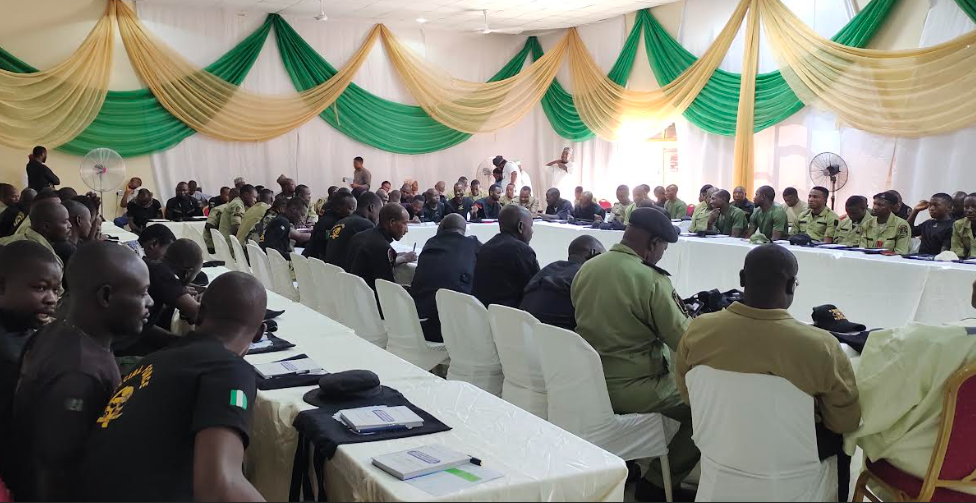

No fewer than 300 personnel of the Katsina State Community Watch Corps have commenced a week-long training in Standard Operating Procedures developed in areas around human rights protection, alternative dispute resolution, and related issues.
The training, which began on Monday, is organised by the Kukah Centre and is part of the Strengthening Peace and Resilience in Nigeria programme, implemented by Tetra Tech International Development. Participants were drawn from all 34 local government areas of the state.
The initiative comes amid decades of violence in Nigeria, particularly in the North-West and North-Central regions, and the growing reliance on community-based security outfits.
Several states, including Kaduna, Katsina, Benue, Plateau, and Sokoto, have established such outfits to complement conventional security agencies.
Declaring the training open, the Katsina State Attorney General and Commissioner for Justice, Fadila Dikko, commended the organisers for their foresight.
“We must appreciate the Kukah Centre and SPRiNG for this initiative. I urge you, participants, to apply the knowledge gained during this training. Governor Dikko Radda remains committed to ensuring lasting peace in the state.”
In his remarks, the Team Lead of the SPRiNG programme, Ukoha Ukiwo, outlined the programme’s focus areas since its inception in 2024.
He said SPRiNG had been working across federal, state, and local government levels to improve service delivery in institutions responsible for peace, security, and justice.
The programme also promotes women and youth participation, supports livelihoods, and addresses farmer-herder conflicts through climate-smart and sustainable practices.
Ukiwo added that SPRiNG had partnered with the Katsina State Government on several initiatives, including capacity building in alternative dispute resolution and mediation for traditional rulers, as well as training for female traditional leaders.
He further noted that the programme had supported key ministries, including the Ministry of Internal Security and Home Affairs, in conflict management, dialogue, and reconciliation. It is also contributing to the documentation and strengthening of the Katsina Amnesty Initiative.
“At the community level, we have supported economic empowerment initiatives for women and young people, while also investing in research to inform policy and practice,” he said, noting that studies conducted under the programme include analyses of weapons value chains.
Also speaking, the Katsina State Commissioner for Internal Security and Home Affairs, Nasir Mu’azu, described the training as timely.
“The present administration of Governor Dikko Umar Radda is fully committed to protecting lives and property across the state,” he said.
Earlier, the Project Manager, Bamber Terseer, said the project aimed to strengthen community security structures and institutionalise standard operating procedures.
He explained that the initiative sought to enhance coordination among security actors, promote adherence to legal frameworks, and improve service delivery at the community level.
“This training is part of efforts to institutionalise standard operating procedures, ensure accountability, and enhance professionalism in community security operations,” he said.
In his remarks, the Commander-General of the Katsina State Community Watch Corps, Suleiman Sayaya, described the programme as a major capacity-building effort aimed at professionalising the outfit.
“The training is designed to strengthen our operational approach. It is a fulfilment of the commitment made by the Kukah Centre and SPRiNG in collaboration with the Katsina State Government,” he said.
Sayaya added that the participants, drawn from across the state, are primarily command-level officers expected to cascade the knowledge to personnel in their respective units.
The training is part of activities on the Improving Community Security Initiatives for Accountable Service Delivery project.
