





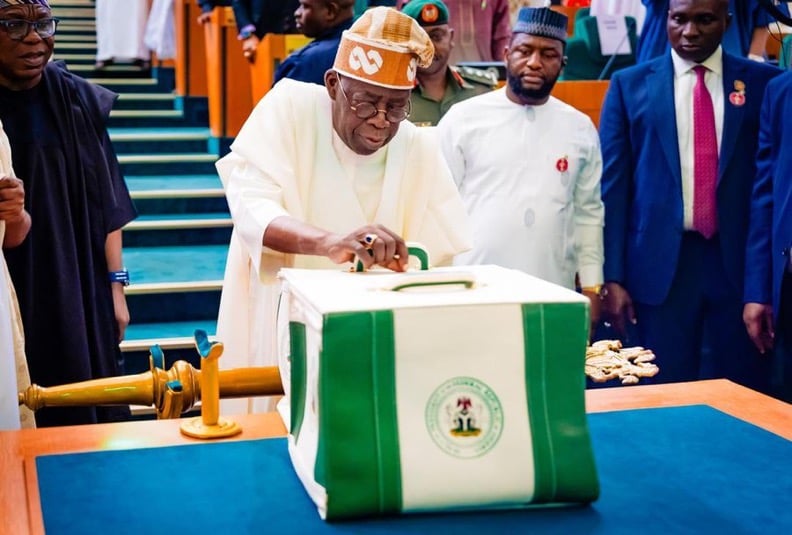


President Bola Tinubu on Friday, presented the 2026 Appropriation Bill to the National Assembly, describing the proposal as one anchored on realism, prudence and economic growth.
In a post on X (formerly Twitter) on Saturday, the Special Adviser to the President on Media and Publicity, Bayo Onanuga, stated that the expected total revenue for the 2026 fiscal year is ₦34.33tn, while total expenditure is projected at ₦58.18tn, including ₦15.52tn earmarked for debt servicing.
He added that recurrent (non-debt) expenditure is estimated at ₦15.25tn, while capital expenditure will amount to ₦26.08tn.
Onanuga disclosed that the budget deficit is expected to be ₦23.85tn, representing 4.28 per cent of the country’s Gross Domestic Product.
Explaining the philosophy behind the proposal, the post noted that “the 2026 Federal Budget is anchored on realism, prudence, and growth.”
It added that “these numbers are not mere accounting lines. They are a statement of national priorities. We remain firmly committed to fiscal sustainability, debt transparency, and value-for-money spending.”
According to the post, the 2026–2028 Medium-Term Expenditure Framework and Fiscal Strategy Paper provided the foundation for the budget, with projections based on conservative assumptions.
It stated that “our projections are based on a conservative crude oil benchmark of 64.85 dollars per barrel, crude oil production of 1.84 million barrels per day, and an average exchange rate of 1,400 naira to the US Dollar for the 2026 fiscal year.
“We will continue to reduce waste, strengthen controls, and ensure that every naira borrowed or spent delivers measurable public value.”
On sectoral allocations, the presidential aide said the budget reflects the administration’s Renewed Hope Agenda and the practical needs of Nigerians.
According to the breakdown, ₦5.41tn was allocated to defence and security, ₦3.56tn to infrastructure, ₦3.52tn to education and ₦2.48tn to health.
Highlighting the interconnection between the sectors, the post stated that “these priorities are interlinked. Without security, investment will not thrive. Without educated and healthy citizens, productivity will not rise. Without infrastructure, jobs and enterprises will not scale.”
It added that the 2026 budget was designed to deliver “a single, coherent programme of national renewal.”


