







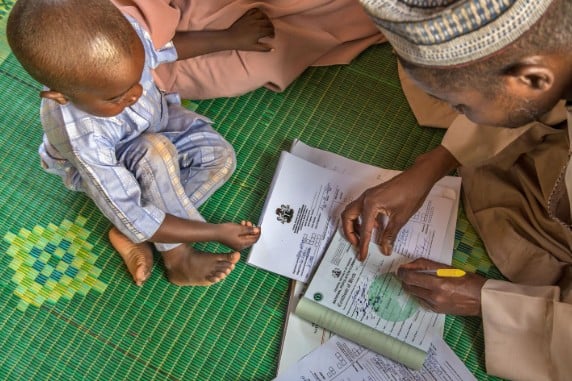
The cost of birth certificates, limited awareness and difficulty accessing registration centres are leaving many children in Gombe State without legal identity — their first formal recognition by the state. PUNCH Healthwise investigations reveal that these barriers could shut children out of essential services, including healthcare, education and social protection. CHIMA AZUBUIKE reports
For 26-year-old mother of five, Aisha Danbayo, birth registration has remained less about its importance and more about whether she can afford the process.
Danbayo, who lives in Unguwa Idi area of Gombe Local Government Area of Gombe State, said that though she had heard people talk about the need to register children at birth, she was yet to understand what practical benefits the document would bring to her family.
“I have heard people talk about the need for birth registration, but I have not seen the importance yet. I noticed that there is also N500 to N1000 involved; that is, people make payments. One question I keep asking is, can’t it be free?” she said.
With the rising cost of food, transportation, and other household necessities, Danbayo said paying for birth registration could easily become another burden for families already struggling to meet their basic needs.
“I may reconsider registering my children if they make it free. I consider the money a waste because I don’t know what the government, both state and federal, seeks to achieve,” the full housewife said.
Not a priority
For another mother and resident of Unguwa Idi, Maryam Mahmoud, birth registration is not even a priority.
The 32-year-old petty trader and mother of eight said she had not registered any of her children, questioning what she described as the practical benefits of the exercise.
“I gave birth at a traditional birth attendant, but even if I did in the hospital, I will never register them.
“There is no need because I haven’t seen the use. Will it provide my children jobs, or better healthcare?” she said.
She continued saying, “I don’t know the importance of that, and I don’t want to know. I just believe in doing the little I can to give my children a better future.”
The experiences of Danbayo and Mahmoud point to a wider concern that extends beyond individual households in Gombe State.
Their situation highlights the challenge facing birth registration in Gombe and Nigeria as a whole, where gaps in awareness, affordability, and access continue to leave some children without official proof of their identity and age.
Findings by PUNCH Healthwise show that while the Federal Government, through the National Population Commission, sees civil registration as a foundation for legal identity, population planning and access to services, some parents in Gombe still struggle to understand its immediate value.
Birth registration
Birth registration is an essential prerequisite for legal identity and the fulfilment of children’s rights, according to the United Nations Children’s Fund.
UNICEF and the NPC estimated that Nigeria alone accounted for 11 per cent of unregistered children in West Africa.
According to UNICEF, only about 43 per cent of over five million children born every year in Nigeria are registered on time.
It added that more than 50 per cent of the births of children under five remain unregistered.
The organisation noted that many parents delay registering their children because the weak systems in Nigeria still allow unregistered children to access some public services.
“Nigeria is home to 28 million children under 5 without a birth certificate. This includes 20 million unregistered children and 8 million children whose births are reported as registered but lack proof in the form of a birth certificate. The births of 6 in 10 children are not registered; over 8 in 10 lack a birth certificate,” UNICEF stated in its Nigeria’s statistical profile released in June 2026.
But the importance of the exercise goes beyond identity documentation.
Accurate records of births and deaths provide vital statistics that can help the federal and state governments understand population trends, plan health services and measure the effectiveness of interventions.
Cost limitation
Several mothers who spoke with PUNCH Healthwise lamented that the ‘cost of registration’, distance to registration centres and lack of information, and the difficulty associated with navigating the registration process are barriers to the exercise.
A 21-year-old mother of three who resides in Liji, Yalmatu Deba Local Government Area, Sadiyya Mohammed, said the financial burden associated with obtaining birth certificates could discourage families from completing the process.
She said, “I can’t tell you that I don’t know the benefits, but the problem I have is based on the N1000 for the certificate, depending on the age. The government should make it free.”
According to Mohammed, the challenge extends beyond the amount paid for the certificate because families living far from registration centres also have to spend money on transportation.
“When you calculate the entire cost, and you check it with other needs, you will know it’s quite a lot to overlook. That could make a pot of vegetable for my children,” Mohammed added.
Similarly, a 30-year-old mother of six from Akko Local Government Area, Aminatu Usman, said she had little knowledge of where or how to register her children.
“I don’t know where and how to get my children registered. If I knew, I guess I would give it a try. I don’t see or hear adverts encouraging registration, nor have I been sensitised about the importance.”
Usman said the absence of information had kept her children outside the formal registration system, but she was willing to act now that she had learnt more about the process.
“Now that I’m aware, I will go and process birth certificates for my children. So that they can be included in the government’s plans. My youngest child is 6 months, and the ones ahead are yet to get their certificates.”
For Rashida Emmanuel, a mother of five, the issue is not necessarily ignorance of registration but the desire to avoid what she described as unnecessary stress.
“I don’t like stress, so I just send someone to get them for me. I did the sorting out of the arrangement. I don’t like wasting time on things I can sort out,” she said.
Emmanuel recalled the difficulties she experienced while trying to obtain a birth certificate for her first child, saying the process involved repeated visits and uncertainty over what was required.
“In the past I experienced a lot of back and forth before I learnt the hard way, if you don’t meet the good ones, they will stress your life instead of telling you what exactly they want.”
For the mothers interviewed in Gombe, however, the success of the registration drive may ultimately depend on whether the system becomes easier to understand, easier to access and less costly to navigate.
Free registration for children under five
Checks by our correspondent on the NPC website show that birth registration for children under the age of five is free at every NPC registration centre.
However, the self-service birth registration option attracts a fee of N5,000.


The self-service birth registration is available only to children born in Nigeria who have a National Identification Number. At least one of the child’s parents must be Nigerian and have a valid birth certificate.
Following a successful application, the certificate can only be downloaded once.
‘Not informed about birth registration’
For Jummai Musa, who gave birth on a Sunday at the Specialist Hospital, Gombe, the immediate concern after delivery was the arrival of her baby, not registration.
Musa said she was neither issued a birth certificate nor informed about the registration process.
She said, “I was not issued a birth certificate, nor was I told about any registration process. Ordinarily, I want one for my baby, so I need to look for how to get it.
“You know, for some people it takes days or hours to recuperate; most of the time such people lose track of the date they put to birth, and it may lead to conflicting details.”
Speaking further, Musa noted that she believed in the impact of birth registration but said many parents were not sufficiently informed about how to complete the process.
“I know the importance of birth registration to development, but not much is known about how to go about the entire process. I heard it can be achieved through online registration and offline in some centres.”
Another mother, Grace Sambo, said the loss of her documents after moving to Gombe from Baga in Borno State forced her to seek a replacement several years later.
“As far back as 2013, when we moved to Gombe from Baga, I lost my documents, so I had to look for how to get the certificate. Around 2021, I finally made up my mind on where to get the certificate for some amount,” she said.
Sambo said she eventually sought the document because she needed it for an important administrative purpose, but acknowledged that without that immediate need, she might not have pursued it.
“I wouldn’t have bothered to register my details if I didn’t need it to process my admission then, but I don’t regret it because it’s important,” she added.
Sunday births
An NPC officer, who pleaded for anonymity, said parents who give birth outside working hours do not have to panic about registering their children immediately.
He encouraged parents to register their children and explained that the process remains available after delivery.
“We have almost 17 registration centres here in Gombe. There is one at Bolari Maternity, one at the Specialist Hospital, one at the Federal Medical Centre, and one at Hewagana Maternity. We also have centres at Pantami and the Federal Teaching Hospital. There is also the Local Government office behind the hospital, and we work with the state office opposite the State Hospitals,” the official said.
He said parents could register a child born on a Sunday on the next working day.
The official said, “For instance, if a woman gives birth on Sunday and the child is not registered that same day, she can still register the child later. She can come on Monday to register the birth.
“During registration, they will ask for the name of the child, the date of birth, the name of the mother, the mother’s age and qualification, as well as information about the father. They may also request a picture of the child. The picture can either be presented physically or shown on the parent’s phone.
“If the child is born on Sunday, the parent can come and register the child on Monday. There is no problem with registering the child on the next working day.”
The official added that parents could also wait until after the naming ceremony, when the child had been given a name, before completing the registration.
He said, “After the naming ceremony, once the child has been given a name, the parent can go for the registration. They can come on Monday since we don’t open during the weekend or whenever they are able to, once the child has been given a name.”
Millions of children remain unregistered
The National Population Commission said Nigeria records an estimated five million births annually, but millions of births and deaths remain unregistered.
The Federal Commissioner representing Gombe State on the commission, Abubakar Danburam, said birth registration coverage in Nigeria currently stands at about 57 per cent, while death registration remains below 20 per cent.


He said the gaps in civil registration affected legal identity documentation and deprived government of reliable demographic information needed for planning.
Danburam disclosed that the commission had commenced nationwide digital registration of births and deaths through the VitalReg platform under the Electronic Civil Registration and Vital Statistics system.
According to him, the system became fully operational across the 36 states and the Federal Capital Territory on July 1, 2026.
He said, “It is my distinct honour and privilege, on behalf of the National Population Commission, to formally announce the full commencement of the digital registration of births and deaths on the VitalReg platform under the Electronic Civil Registration and Vital Statistics system.
“Effective 1st July 2026, this transformative initiative is now operational across the thirty-six States of the Federation and the Federal Capital Territory.”
Danburam said the digital reform was designed to make registration faster and more accessible while reducing paperwork, waiting time and unnecessary travel.
“According to him, the VitalReg platform would provide 24-hour online access to services, digital certificate issuance where applicable, automated data validation and a more secure national Civil Registration and Vital Statistics database.
“The platform is designed to modernise birth and death documentation and improve citizens’ access to these services nationwide,” he said.
The commissioner said the NPC had established 4,011 functional registration centres across the 774 Local Government Areas, with plans to increase the number to about 8,000.
He also said the commission had reviewed fees for some specialised administrative services, including record modifications, certificate reissuance, attestations and verification requests.
However, he stressed that the review would not affect basic birth registration and birth notification services.
“Let me assure Nigerians that this review is not intended to create barriers to access. Birth registration and birth notification services remain highly subsidised, in line with the Commission’s commitment to achieving universal registration,” he said.
Birth registration necessary – Gombe
The Gombe State Commissioner for Information, Moses Kyari, said birth registration was critical to planning and the delivery of social services.


Kyari linked the exercise to the state’s efforts to maintain an accurate social register and identify the population requiring government intervention.
“Birth registration is very important because it allows for proper planning. Now that we have the National Social Register, we need to know the number of people residing in Gombe State,” Kyari said.
He stressed that registration was not restricted to indigenes of the state but applied to births occurring within its geographical boundaries.
“Registration of birth is not done on the basis of indigene status. It is based on whoever gives birth within the geographical location called Gombe State. This helps the government to develop an accurate Social Register,” he explained.
Kyari said reliable population data was also essential to the implementation of social protection programmes.
“If you can recall, the Federal Government recently launched a $1 billion Social Intervention Fund for Nigerians, targeting about 40 million people living in extreme poverty through conditional cash transfers. How can we get the kind of data required for such interventions if we do not register births and deaths?
“So, birth registration is of paramount importance for planning and for determining how best to provide amenities and other services for citizens of Gombe State. It therefore has a special place with us.
“From time to time, the Ministry of Information, through the Gombe Media Corporation, also runs jingles and organises town hall meetings to sensitise Nigerians on the importance of birth registration.
“Basically, at the level of health facilities, whether primary or secondary healthcare centres, constant awareness is also carried out among women attending antenatal and postnatal clinics. That is the strategy,” Kyari said.
Govt plans to cover birth registration cost
Kyari acknowledged the concern over fees, saying the government was considering ways of reducing the financial burden on citizens.
He said, “As for the concern about the money paid for registration, the fee is mainly to take care of logistics and the running of the programme itself. The government is looking at ways to reduce the burden by taking that cost off the people. As of now, that arrangement has not been perfected, but it is in the pipeline.”
NPC plans localised birth registration
Beyond Gombe, the NPC said it was pursuing partnerships aimed at decentralising birth registration and bringing services closer to communities.
Danburam said the commission had signed a partnership compact with the Association of Local Governments of Nigeria, the National Identity Management Commission, UNICEF and Barnksforte Technologies Limited on the decentralisation and localisation of birth registration and legal identity.
Danburam, who is the NPC federal commissioner representing Gombe, said, “The alliance aims to decentralise and localise registration services at the community level, improving accessibility, enhancing operational efficiency, and strengthening grassroots participation in civil registration processes and ultimately improving data accuracy and inclusivity across the country.”
He said the digital system was also expected to strengthen the country’s digital identity ecosystem through secure interoperability with relevant government institutions.
Danburam, therefore, called on state and local governments, healthcare institutions, traditional and religious leaders, civil society organisations and other stakeholders to support timely registration.
“The success of this historic reform depends on the active participation of all stakeholders and every Nigerian,” Danburam said.
He added that improved civil registration would help guarantee legal identity from birth while providing credible demographic information for governance and national development.
“Together, we can build a modern civil registration system that guarantees every Nigerian a legal identity from birth, provides credible demographic data for national development, and supports effective governance and evidence-based planning,” he said.
Copyright PUNCH
All rights reserved. This material, and other digital content on this website, may not be reproduced, published, broadcast, rewritten or redistributed in whole or in part without prior express written permission from PUNCH.
Contact: [email protected]


