

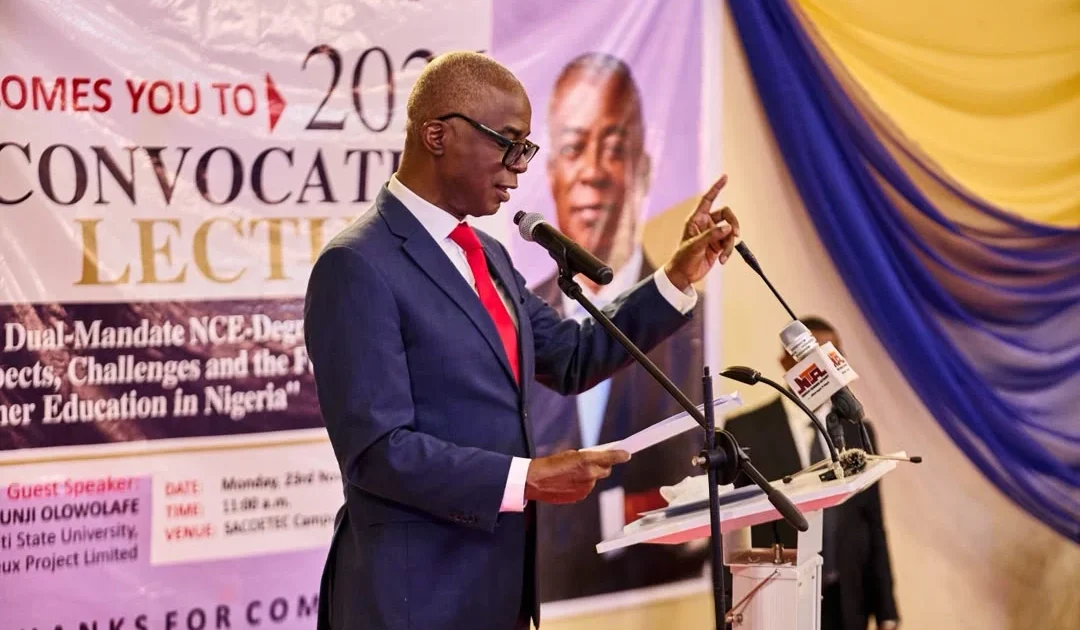

Business leader and Chancellor of Ekiti State University, Dr Tunji Olowolafe, has called for sustained investment in teacher education, saying Nigeria’s dual-mandate NCE-degree programme could help restore the prestige of the teaching profession and strengthen the country’s education system.
Olowolafe made the call while delivering the 2026 convocation lecture at the Sikiru Adetona College of Education, Science and Technology, Omu-Ajose, Ogun State, on Monday.
The lecture was themed, “The Dual-Mandate NCE-Degree Programme: Prospects, Challenges and the Future of Teacher Education in Nigeria.”
He described the reform, enabled by the Federal Colleges of Education Act 2023 and operationalised in May 2025, as the most significant structural change in teacher education since the Ashby Commission of 1959.
The programme allows eligible colleges of education to award both the Nigeria Certificate in Education and bachelor’s degrees through a five-year pathway designed to combine practical teaching skills with academic training.
However, Olowolafe warned that granting institutions autonomy would not, on its own, guarantee the programme’s success, stressing the need for sustained funding, curriculum reform and the integration of technology.
He also highlighted Nigeria’s estimated one-million-teacher shortfall, warning that the country must prepare its teaching workforce for a growing population of school-age children.
“Nearly eight million babies will be born in Nigeria this year alone. In 2032, those children will walk into Primary One classrooms across this country,” he said.
The EKSU chancellor also identified the Nigeria Tax Act 2025 as an opportunity to strengthen education financing through the Tertiary Education Trust Fund and the Nigerian Education Loan Fund.
He said NELFUND had disbursed more than ₦372bn to over one million students for tuition and upkeep, urging the SACOETEC management to help eligible students access the loan scheme.
On curriculum development, Olowolafe advocated the early integration of vocational skills, coding and digital literacy into education.
He said artificial intelligence should complement rather than replace the human qualities required of teachers.
“AI can explain a quadratic equation at midnight, but it cannot offer the steady, empathetic guidance of a caring adult,” he said.
He added that honesty, fairness, empathy and civic responsibility remained essential values that teachers must impart to learners.
As part of efforts to support education infrastructure, the Tunji Olowolafe Foundation announced plans to establish a GOMTECH centre at SACOETEC.
The solar-powered information and communications technology centre will be equipped with high-speed internet facilities, with the foundation expected to fund, power and co-manage it with the college.
The initiative builds on the foundation’s existing digital education projects, including Project Digi-Teach at EKSU, which aims to certify all 650 lecturers in digital and AI-enabled teaching.
It also operates a GOMTECH centre in Are-Ekiti, where rural schoolchildren, university students and teachers receive training in artificial intelligence, coding, graphic design and Mandarin Chinese.
The foundation further pledged to recognise academic excellence at the college by honouring first-class degree graduates, NCE distinction holders and the overall best graduates in both categories.
Lecturers selected through student ratings will also receive recognition for their contributions to teaching.
Addressing the graduating students, Olowolafe urged them to embrace lifelong learning, drawing on his transition from medical training to entrepreneurship and academia.
He cited former Nigerian leaders Sir Abubakar Tafawa Balewa, Shehu Shagari and Chief Obafemi Awolowo, who had teaching backgrounds, as examples of the profession’s contribution to national leadership.
“Your training is a launchpad, not a ceiling,” he told the graduates, urging them to remain connected to their alma mater and contribute to the development of future generations.
