



Deborah Tolu-Kolawole
The Federal Government is planning to identify and equip Ebola treatment centres in states with designated ports of entry as the number of identified contacts linked to Nigeria’s confirmed case rises to 53.
The measures are part of efforts to strengthen the country’s preparedness for a possible spread of the disease, with the government assessing isolation capacity at the University of Abuja Teaching Hospital and planning an infection prevention and control assessment at Karu General Hospital.
According to an Ebola situation report obtained by our correspondent on Sunday, the authorities are also working to establish referral mechanisms for suspected cases, strengthen surveillance at ports of entry and improve the capacity of healthcare facilities to manage possible infections.
The FG is also strengthening preparedness for the Ebola outbreak by assessing isolation.
The report stated that the University of Abuja Teaching Hospital had undergone a needs assessment and optimisation for isolation and treatment, while an infection prevention and control assessment was planned for Karu General Hospital, Abuja, to determine its capacity to accommodate a possible surge in isolation needs.
Under the next steps for case management, the report stated that the authorities would pursue the “Identification and optimisation of treatment centres in states with designated POEs,” referring to designated ports of entry.
It also listed establishing referral mechanisms for suspected cases as a priority, specifying the need to arrange transfers of patients “from point of detection to treatment centres.”
The document read in part, ‘’The measures are aimed at ensuring that suspected Ebola cases can be identified, isolated and referred promptly, including in states that may need to respond to infections detected at international entry points.
“University of Abuja Teaching Hospital readiness as an isolation and treatment centre. Concluded needs assessment & optimisation in UATH
“Identification and optimisation of treatment centres in states with designated POEs. Conduct IPC assessment for surge capacity for isolation in Karu General Hospital.”
The development comes as the Nigeria Centre for Disease Control and Prevention approved an emergency payment of N100,000 per person weekly to support people placed in isolation or quarantine, following complaints about the cost of feeding, accommodation and maintaining their families.
The NCDC Director-General, Dr Jide Idris, disclosed the financial intervention during a press briefing on Sunday, explaining that the payment was introduced to ensure that people identified as contacts could comply with public health monitoring arrangements without additional financial hardship.
The situation report said the national incident management system had been activated under the coordination of the Coordinating Minister of Health and Social Welfare, Prof Muhammad Ali Pate, with implementation of prioritised activities underway across the response areas.
It added that an Incident Action Plan had been finalised to guide coordination among government agencies, healthcare facilities and response partners.
Under the coordination pillar, the report listed sustained coordination across the “one health sectors and partners,” as well as the continued implementation of the action plan and strengthened preparedness in high-risk states.
Idris said the agency introduced the N100,000 weekly payment after some contacts complained about the financial burden of remaining in isolation or quarantine, including the cost of feeding, accommodation and providing for their families.
“We are paying for their accommodation; we are paying for their feeding. Some of them are asking for a stipend to maintain their families,” he said.
The NCDC chief added, “We are providing N100,000 per person per week just to maintain their comfort and feeding, because they were complaining.”
He explained that the intervention was not part of the original response plan but became necessary because of the circumstances surrounding the outbreak.
“This was not planned for, but it is an emergency. We will continue to review it as we go along,” Idris said.
The payment is intended to ease the financial pressure on people required to comply with public health monitoring and isolation arrangements, particularly those who may be unable to continue their normal work or business activities during the monitoring period.
Idris stressed that the responsibility for supporting contacts and managing public health emergencies should not rest with the FCT alone, warning that other states would need to make adequate financial and logistical provisions should similar emergencies arise within their jurisdictions.
“This is not the responsibility of the FCT alone. What we have to do for the FCT, we have to do for any other state, just in case,” he said.
He urged state governments to prepare the resources needed to support contact tracing, isolation, surveillance and other emergency response activities.
The situation report said 53 contacts had been identified, line-listed and categorised, with contact tracing and monitoring continuing.
It listed the identification and categorisation of the contacts among the activities already undertaken under the surveillance and contact-tracing pillar.
The document also stated that the next steps included classifying contacts according to exposure status and providing daily follow-up based on their categories.
The figure represents an increase from the initial 44 contacts announced after the confirmed case was reported in the FCT.
Idris explained that 44 of the 53 primary contacts were associated with the health facility where the patient was treated, while the remaining nine included household members and people who attended to her during an earlier visit to an emergency room.
The investigation has ,therefore, expanded beyond the facility where the infection was confirmed, with health officials seeking to establish whether other people could have been exposed before the patient was isolated.
The NCDC is also identifying secondary contacts to determine whether any of the identified individuals may have subsequently exposed others.
“For each person, we are going to ask questions. We have to establish who they have been in contact with. If we can identify those people, they will also be monitored,” Idris said.
The agency said contacts would be monitored daily, while anyone who developed symptoms would be assessed promptly.
Idris disclosed that one contact who reported feeling unwell had tested negative, although surveillance and follow-up activities were continuing.
The NCDC has also reviewed its case definition for Ebola disease to guide health workers, surveillance teams and other stakeholders in identifying suspected infections.
Under the revised criteria, suspected cases may include people with sudden fever and specified symptoms who have relevant travel or epidemiological links, people with unexplained bleeding, or those who develop symptoms following contact with a confirmed or probable case.
The agency also advised community members to report unexplained deaths and people with symptoms suggestive of Ebola, particularly where there is a history of possible exposure.
Genomic sequencing completed
The report disclosed that genomic sequencing of the confirmed case had been completed by the NCDC National Reference Laboratory and the African Centre of Excellence for Genomics of Infectious Diseases.
It noted that the “phylogenetic sequencing” had been concluded by the two institutions.
The next steps include sharing the genomic sequencing report, continuing diagnostic testing and maintaining laboratory records.
The NCDC also plans to position additional laboratory reagents and commodities across the national network of laboratories to support testing for Ebola virus disease.
Laboratory capacity is a critical component of the response because suspected cases must be investigated promptly and confirmed through appropriate testing before public health authorities can make case-management decisions.
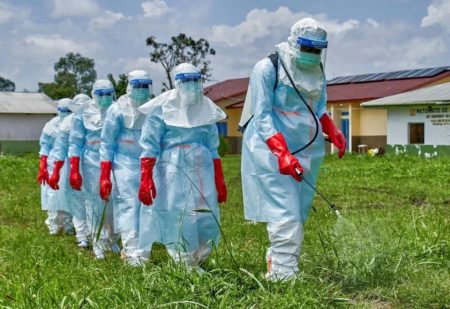
The government is also strengthening infection prevention and control measures in healthcare facilities to reduce the risk of transmission to health workers, patients and other people who may come into contact with suspected cases.
The report said infection prevention and control capacity assessments had been conducted across states and health facilities, while the facility currently managing the patient had been engaged on appropriate guidelines and standard operating procedures.
The measures cover standard precautions and additional precautions required when managing suspected or confirmed Ebola infections.
The next phase will involve implementing an infection prevention and control ring strategy across designated perimeters to strengthen screening and isolation measures.
The report specifically listed the planned implementation of the “IPC ring strategy across concentric perimeters to strengthen screening and isolation measures.”
The NCDC is also working to improve the capacity of healthcare personnel through training and sensitisation, particularly in facilities that could be required to detect, stabilise or refer suspected cases.
Idris had acknowledged the need to strengthen infection prevention and control expertise at subnational levels, noting that states and local health facilities needed improved capacity to respond effectively to infectious disease emergencies.
“When our infection prevention and control teams visit a facility, they assess the systems in place and identify areas that need to be corrected,” he said.
He added that the agency was continuing to train healthcare personnel to improve their competence in infection prevention and control.
“Capabilities and competencies at the subnational level are not as high as they should be. We are responsible for building those capabilities. That is why training is one of our most important priorities,” Idris said.
Supplies, surveillance strengthened
The situation report said the national stockpile of personal protective equipment and other essential supplies had been increased as part of preparations for a possible expansion of the response.
It added that 500 donated laboratory testing kits had been incorporated into the stockpile, while additional protective equipment and essential commodities would be positioned in high-risk states.
The government is also strengthening surveillance at airports and other ports of entry.
According to the report, Port Health Services had conducted an in-depth investigation with aviation stakeholders to support the response, while enhanced surveillance at all ports of entry would continue.
The next phase includes strengthening preparedness and readiness in high-risk states, establishing referral mechanisms for suspected cases and identifying treatment facilities that can respond to potential cases outside the FCT.
Moreover, the NCDC is sustaining public communication and community engagement activities, including monitoring public discussions about Ebola to identify misinformation and address concerns.
The report said the agency had issued public advisories on preventive measures and conducted social listening to generate insights for managing misinformation. It listed sustained, proactive two-way communication across platforms as one of the next steps.
It urged Nigerians to rely on official information, avoid spreading rumours and cooperate with health officials carrying out contact tracing.
The confirmed case involves a woman who travelled to Nigeria after visiting Uganda, following a trip to the Democratic Republic of the Congo.
According to information previously provided by health authorities, she developed symptoms on October 7, sought medical attention in Abuja on October 11 and tested positive for the Bundibugyo strain of Ebola virus on October 20.
The World Health Organisation has said investigations are continuing to establish the likely source of the infection.
The Bundibugyo strain is one of the Ebola virus species associated with outbreaks in parts of Central and East Africa. Its identification has heightened the importance of regional surveillance, timely laboratory diagnosis and coordination among countries responding to the disease.
The NCDC situation report said the national incident management system had been activated, with the Incident Action Plan guiding activities across coordination, surveillance, laboratory services, case management, infection prevention and control, risk communication, logistics and port health.
The government has also called for sustained coordination among federal and state authorities, healthcare facilities and response partners to ensure that suspected cases can be identified and managed promptly.
The WHO has consistently emphasised that early detection, isolation, contact tracing and infection prevention and control are essential to containing Ebola outbreaks.
Nigeria has previous experience responding to the disease. During the 2014 outbreak, the country contained transmission through rapid identification of cases, isolation, contact tracing and coordinated public health interventions.
The current response is drawing on those lessons, with health authorities seeking to improve isolation readiness, strengthen laboratory capacity and ensure that states can provide appropriate facilities and resources if additional cases are identified.
The NCDC urged Nigerians to remain calm while observing preventive measures, including regular hand hygiene and avoiding direct contact with the blood or other body fluids of people suspected of having Ebola.
The agency stressed that the virus spreads through direct contact with the blood, body fluids or tissues of infected people or animals, as well as contaminated materials.
The agency warned against stigmatising people placed under monitoring, stressing that cooperation with public health authorities is necessary to prevent further transmission.
Copyright PUNCH
All rights reserved. This material, and other digital content on this website, may not be reproduced, published, broadcast, rewritten or redistributed in whole or in part without prior express written permission from PUNCH.
Contact: health_wise@punchng.