

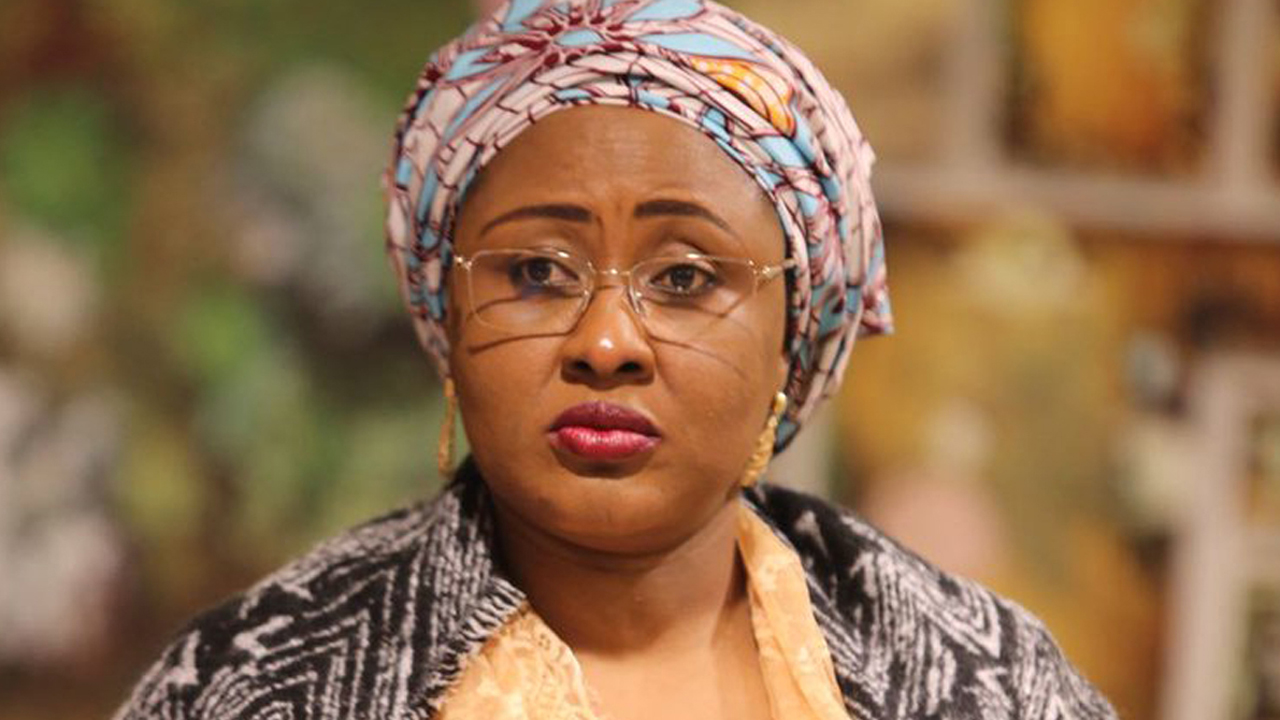
Former First Lady Aisha Buhari has offered her most revealing insider account yet of life inside Nigeria’s most fortified residence, alleging exclusion, whispered manipulation and medical missteps during Muhammadu Buhari’s eight-year presidency.
Her most startling claim is that individuals close to the President planted recording devices in private rooms, effectively turning living quarters into listening posts.
Confidential conversations, she alleges, were harvested and relayed to a small circle of power-brokers who used the information to heighten suspicion and tighten their control of presidential access.
She insists this was not authorised security work but an informal intelligence system run by people who viewed surveillance as personal leverage.
The result, she says, was the erosion of trust within the First Family and a widening gulf between the President and anyone outside the privileged inner ring.
Her testimony forms a key part of From Soldier to Statesman: The Legacy of Muhammadu Buhari, authored by Dr. Charles Omole and recently presented to the public inside the banquet hall of the Presidential Villa, Abuja.
What emerges is a portrait of a presidency shaped as much by unelected courtiers as by constitutional authority.
According to Aisha, the moment Buhari transitioned from opposition to power in 2015, the hierarchy around him was reset. Women who campaigned alongside her vanished from the Villa, and access became transactional.
She recalls seeing a ministerial list outside Abuja and realising “the circle had tightened” and that her own partnership with Buhari carried little institutional weight.
In her telling, proximity was commandeered by men who styled themselves as interpreters of presidential will, and gatekeepers against his wife.
She refuses to treat the term cabal as rumour. Instead, she describes a network of elderly relatives and associates who feared her “strong character” might dilute their influence.
Her daughter, she recalls, warned early that she should reach an “arrangement” with the old guard. Aisha rejected the idea, saying she would not negotiate space with “septuagenarians.” She assumed civility and competence would prevail; she now calls that assumption naïve.
She argues that the shift affected her marriage. According to her, before office, Buhari invited criticism, discussed decisions and sometimes deferred to her judgement.
But inside the Villa, she says, he grew more insulated and increasingly dependent on a shrinking advisory circle.
She maintains he disliked imposition and refused to groom a successor or commission polling ahead of 2023, believing surveys would inflame factions.
Into that vacuum, she claims, stepped relatives seeking leverage, loyalists seeking contracts and “arbiters” seeking control of his schedule.
Her husband’s health, Aisha insists, became one of the most misunderstood aspects of Buhari’s presidency. His 154-day medical leave in London in 2017 spawned wild speculation, from organ failure to body doubles.
She dismisses such conjecture and argues instead that his deterioration began with disrupted nutrition and a breakdown in routine after Villa aides sidelined a dietary programme she claims to have overseen for years.
She recalls convening the President’s physician, Chief Security Officer, housekeeper and the then-DG of the SSS to outline what she believed an elderly body required: scheduled meals, supplements, vitamins and rest. She says the plan was ignored.
Gossip escalated into suspicion, and advisers allegedly told Buhari that her supplements were harmful. For about a week, she claims, he believed them: doors were locked, habits changed and vitamins stopped.
A sparse eater even at his best, she says Buhari began losing weight, evidence, in her view, of mismanagement rather than mystery.
When Buhari was eventually flown to London, she says doctors prescribed stronger supplements than the ones she had administered. Buhari resisted them until she mixed the powders discreetly into juice and oats. Within days, she recalls, he regained strength and mobility, a detail she offers to underscore her belief that nutrition, not intrigue, was central to the crisis.
Aisha acknowledges that age and history carried their own toll. Buhari spent nearly three years in the field during the Civil War, often drenched by rain and exposed to harsh elements. Early-life smoking aggravated sensitivities, and air-conditioned offices irritated his lungs.
She argues that environmental strain and age shaped his decline more than any exotic ailment.
When his final hospitalisation came, she says doctors diagnosed pneumonia, an illness that becomes serious when ageing lungs struggle to recover. Public speculation pointed instead to cancer or leukaemia.
That uncertainty, she argues, was fuelled by her husband’s administration’s weakness in strategic communication. Silence created a vacuum, and rumour rushed in. Her account of Buhari’s final year is restrained but vivid.
She describes a calendar dominated by funerals, trans-Atlantic trips and family obligations.
She recalls children keeping vigil at his bedside, consultations with nurses and the quiet strain of monitoring breathing without melodrama.
When Buhari died in London at 82, procedure quickly displaced private grief. Embassy waivers were issued and logistics took over.
Aisha credits President Bola Tinubu for establishing a burial committee and ensuring Buhari received state honours without administrative confusion.
She also commends Vice President Kashim Shettima and his wife for their support, and singles out Group Captain Abubakar Sadiq Adamu of the Presidential Air Fleet, the pilot who flew Buhari home after leaving office in 2023, and who flew his remains back to Daura after death.
Her son, she says with controlled pride, coordinated logistics from London to Nigeria, stepping into a public role his father once shielded him from.
She notes that men who previously controlled access suddenly saw their influence evaporate. “Their strength was him,” she says. “He is no longer there, so they were afraid of my son and me.”
She insists neither she nor her children seek retribution, but her conclusion is blunt. Those gatekeepers, she says, were “men without capacity”, perhaps fit for a small council role, but not for the stewardship of a presidency.
Aisha Buhari’s account blends accusation with memory, turning the private life of a First Family into commentary on political culture.
Where others saw opacity, she saw mismanagement. Where the public saw conspiracy, she saw communication failure. And where admirers praised silence, she now calls it a liability.
Her testimony may not settle debate about Buhari’s legacy. But it sharpens a more uncomfortable question: how much do Nigerian presidents truly govern, and how much is governed for them?