

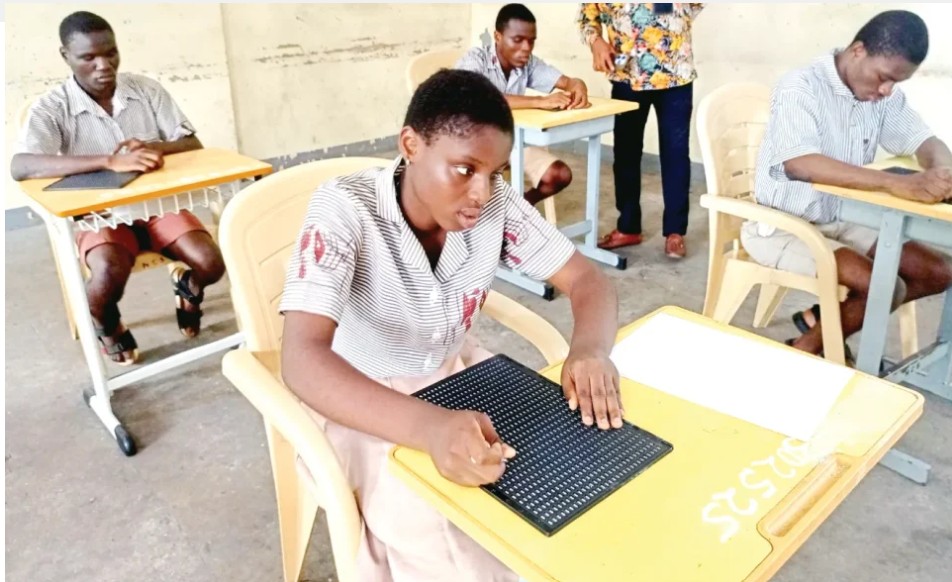
For blind candidates and others with disabilities, delays by the West African Examinations Council in releasing their results and necessary documentation threaten their chances of gaining admission to tertiary institutions, CHIJIOKE IREMEKA writes
With his 251 score in the Unified Tertiary Matriculation Examination, Hassan Adebayo, a visually impaired candidate, thought he had secured admission to study law at the University of Ilorin, Kwara State.
The 26-year-old said he watched this opportunity slip away due to the delay in the release of his WASSCE result by the West African Examinations Council, which frustrated all his efforts.
Adebayo had thought that, with his score, it would be a straight walk to the University of Ilorin’s admission merit list, but the delay in the release of his WASSCE result changed everything for him.
The visually impaired candidate sat the 2026 WASSCE alongside his sighted counterparts as well as other people with disabilities, hoping to continue his academic journey to tertiary education this year, but this dream was thwarted by WAEC.
A graduate of King’s College, Lagos, he told Saturday PUNCH that while the results of his sighted colleagues were released, his result and those of other students with disabilities were delayed for weeks.
A person living with a disability can be defined as a person who has a physical or mental impairment that has a substantial and long-term effect on their ability to carry out day-to-day activities.
In addition to their condition, a number of them are frustrated by loss in admission into tertiary institutions occasioned by result delays.
According to Adebayo, he lost his admission opportunity at his most preferred institution because the university’s admission portal had closed before his result was released.
“I feel bad because I had made up my mind that I was going to study at the University of Ilorin, my first choice. I lost that admission because WAEC did not release our results on time, weeks after they released other people’s results.
“Now, I have been forced to change my institution to the University of Abuja. With my score, I was happy that I was going to study Law at the university, but the delay has ruined it,” he said.
Although he was informed that the change of institution had been effected to the University of Abuja, “no admission” best described his experience so far.
“They cannot open admission for other people and close it even before our results are released. It is not right. We are being denied our right to tertiary education.
“The government must extend the admission deadline for us and ensure that none of us who are qualified for the 2026/2027 session is denied admission based on a failure that was not ours, but that of the government and its agencies involved,” Adebayo added.
‘Forced to abandon my childhood dream’
For Chinedu Nkwocha, the delay in the release of his examination results by WAEC has left him sad and frustrated.
The Imo State-born candidate from King’s College, Lagos, said he was marked absent in several subjects he sat for, and consequently, his results in those subjects were not released.
“I was marked absent in three of my subjects, especially Mathematics. I have been sad since then. I have been following up with WAEC, but there has been no response.
“Till today, over two months later, my result is still not out. I’m very sad that I lost out because I know the effort I put in. I submitted a letter to WAEC, and up till now, I have not heard from them. I went to Ikorodu to do so,” Nkwocha told Saturday PUNCH.
After waiting endlessly for his WASSCE result, the 25-year-old used his NECO exam result to gain admission to the University of Port Harcourt, Rivers State, to study Broadcasting, his childhood dream.
“I have an E8 in Mathematics, and the course I applied for is Broadcasting, but they said I require Mathematics for it. I didn’t want to use NECO earlier because of the Mathematics, but when my WASSCE result did not come out, I was forced to use NECO.
“So, I applied for Broadcasting, but during the eligibility test, I did not pass because of my E8 in Mathematics. I was asked to change my course to another one that does not require Mathematics. It was a tough one for me because Broadcasting has been my childhood dream.
“I am a comedian, and I looked at the course that would enhance my work, and Broadcasting is the best for me. But now, I have to change to another course with less Mathematics. I am planning to do this by Monday, and I do not know what the admission process will look like or how long it will take to be completed,” Nkwocha said, fighting back tears.
Nkwocha wistfully noted that many of his friends who chose UNILAG would have to write another JAMB examination next year because the school had closed its admission portal for the 2026/2027 session.
“By the time WAEC releases our results, the admission portals of our universities will have closed. I am fortunate to have chosen a school whose portal does not close early.
“But others who chose UNILAG have lost their admission opportunities for this session because admission has closed. They have to write JAMB next year,” he said.
Nkwocha appealed to WAEC and the government to address the challenges faced by blind candidates, particularly in Mathematics, to ensure that their results are released alongside those of their sighted counterparts.
He believes there should be a special way of addressing their Mathematics examinations when it comes to people with disabilities, saying that their examinations should not be treated in the same way as those of sighted students.
“We write the same Mathematics examination as they do. Even getting a C6 in Mathematics is difficult for us because we do not have access to specialised instruction. There should be laws compelling WAEC and its officials to mark and release our results alongside those of our sighted counterparts.
“I used the computer system and not Braille. So, why won’t they mark our scripts at the same time and release our results together?” Nkwocha queried.
A pattern of delay
Disability advocates said the release of WASSCE results for sighted candidates who sat the May/June 2026 WASSCE, without the release of results for their counterparts with disabilities, was an act of discrimination and a denial of their fundamental rights to higher education.
Findings revealed that WAEC released the results of the examination on August 5, 2026, with its Head of National Office, Amos Dangut, announcing the outcome in Lagos.
According to him, 1,959,668 candidates from 24,207 schools registered for the examination, while 1,950,726 eventually sat for it.
He said the results of 1,834,695 candidates, representing 94.05 per cent of those who sat the examination, had been fully processed and released.
However, the results of 116,031 candidates, representing 5.95 per cent, were still being processed due to issues the council said were being resolved.
The council also withheld the results of 167,486 candidates, representing 8.59 per cent of the total number of candidates, over alleged examination malpractice.
These withheld results included those of blind candidates and others with different forms of disabilities across the country.
Discrimination against PWDs
An education consultant, Joel Nwakonobi, said the human cost of the delay could be enormous, including frustration, anxiety, and the psychological burden of repeatedly confronting barriers that their sighted peers do not face.
He noted that, with some institutions already closing their portals for the uploading and verification of WAEC results, affected candidates faced the possibility of being locked out of opportunities they had worked for years to attain.
“There should be an adequacy of WAEC’s arrangements for candidates with disabilities, and the responsibility of relevant government institutions to ensure that inclusive education is not undermined by examination procedures.
“Such could be consistent with Nigeria’s commitments to equality, non-discrimination, inclusive education, and the rights of persons with disabilities, including protections provided under the Discrimination Against Persons with Disabilities (Prohibition) Act 2018 and other relevant legal and policy frameworks,” Nwakonobi added.
The 2018 Act, signed into law in January 2019, is an attempt to protect people living with disabilities by prohibiting all forms of discrimination against persons with disabilities and guaranteeing their full integration into Nigerian society.
In Nigeria, the World Health Organisation estimates that there are about 25 million persons with disabilities, constituting approximately 20 per cent of the country’s total population.
According to a lawyer and rights activist, Lawrence Ndukwe, Section 42 of the 1999 Constitution provides for the right to freedom from discrimination based on ethnic group, place of origin, sex, religion, or political opinion.
He said this does not make any reference to persons with disabilities, and the Constitution does not make specific provisions regarding the rights of persons with disabilities.
Hence, “the DAPD Act, 2018, is the primary law that addresses this issue,” he said.
“This law recognises the critical role that environmental, social, and institutional impediments play in the full realisation of the rights of people with disabilities.
“It also recognises the importance of making efforts to ensure the inclusion and full participation of students with disabilities in Nigerian schools,” he added.
The United Nations Convention on the Rights of Persons with Disabilities recognises that disability arises through interactions between people with disabilities and the constraints that prevent them from participating fully and effectively in society on an equal footing with others.
It emphasised that it is a human rights instrument designed to promote, defend, and safeguard the full and equal enjoyment of all human rights and basic freedoms by all people with disabilities, as well as to encourage respect for their inherent dignity.
“More specific principles of the Convention are: respect for inherent dignity; individual autonomy, including the right to make one’s own choices; and independence of persons; non-discrimination; full and effective involvement and inclusion in society; respect for difference and acceptance of persons with disabilities as part of human diversity and humanity; equality of opportunity and accessibility; equality between men and women; and respect for the changing capacities of men and women,” the UN noted.
Nigeria ratified this Convention in 2007 and its Optional Protocol in 2010, and domesticated it through the Discrimination Against Persons with Disabilities (Prohibition) Act of 2018.
Lost admissions, deferred hopes
A specialist in disability-inclusive development, governance, and public policy, Dr Adebukola Adebayo, had earlier raised concerns over the delayed release of examination results for blind candidates who sat the May/June 2026 West African Senior School Certificate Examination.
He noted that their results had yet to be released two weeks after those of other (sighted) students had been released.
Adebayo, the founder and chief consultant at Inclusive Development Consults Limited, Nigeria, was worried that the blind candidates would not be able to process their admission into tertiary institutions of their choice due to the delay.
“For example, any of these blind candidates whose choice is the University of Ilorin will miss his/her admission into that university because the University of Ilorin is closing the uploading and verification of WAEC results into its admission portal by 3:00 pm today, Friday, August 21, 2026,” he said.
He maintained that the late release of the results of blind candidates was not new but a recurring decimal in WAEC’s pattern of releasing results.
“This has been the practice for decades. Several blind candidates have lost admission into tertiary institutions to further their education due to these delays. Due to the psychological effect of this, many blind students have either struggled to pursue tertiary education or lost out completely on the opportunity to obtain tertiary education.
“Blind students sit for their WAEC examinations at the same time as their sighted colleagues – no reason will be acceptable for the delay in the release of the results of blind candidates. This situation is considered unjust, discriminatory, unfair, and unkind to blind students who put in so much effort to go through secondary education despite all the inclusivity and accessibility challenges they are confronted with.
According to him, this was a clear breach of the Constitution of the Federal Republic of Nigeria, 1999, the Discrimination Against Persons with Disabilities (Prohibition) Act 2018, the National Policy on Inclusive Education, the National Policy on Education, and every other relevant legal and policy framework that guarantees the educational rights of all Nigerians, including those with disabilities.
The proprietress of Tulip Field School, Festac, Ngozi Nwolisa, said the delay was causing tension and undermining the strong efforts made by students in pursuit of their education.
“In most cases, it is difficult for a child to sit for an examination, especially JAMB and WASSCE, and predict what they would score. Some who score 250 this year may write next year and score 190. And this is the reason any loss of an admission opportunity is a big deal for these candidates.
“I would, therefore, appeal to WAEC and universities to follow through on these raised concerns in order not to deny these special candidates admission,” Nwolisa said.
We have a peculiar case – WAEC
Responding to a question in an interview with Nigeria Tribune on the release of results for candidates with disabilities, the Registrar and Chief Executive Officer of the West African Examinations Council, Dr Amos Dangut, said the results of candidates with special needs had been released.
“However, we have a peculiar case in this instance. Usually, when we release results, we have those who have one issue or the other that we take time to manually resolve.
“It happens that the larger numbers come from this category, and that is why we always make room for a form of regulated control assistance to be given to these candidates.
“I am sorry; I do not have the percentage record here with me because I did not expect the issue to come up. I can authentically inform you that we have released results of candidates with special needs,” he said.
Nobody should be disqualified, says FG
When contacted for comments on the issue, the Director of Press and Public Relations at the Federal Ministry of Education, Mrs Boriowo Folasade, said the ministry was working to address the situation without putting affected candidates under undue pressure or risking their disqualification.
She stressed that no child should be subjected to intense pressure over the issue.
Following this, she noted that the Federal Government had proposed a new examination timetable that would see candidates sitting the 2027 WAEC, NECO, and other major external examinations receive their results by August, ahead of the September admission process into tertiary institutions.
Boriowo said the Minister of State for Education, Prof Suwaiba Ahmad, disclosed the plan during a meeting with heads and representatives of examination bodies at the Federal Ministry of Education headquarters in Abuja.
“The meeting focused on harmonising examination schedules, preventing clashes among major examinations, and ensuring that results are processed and released within agreed timelines,” she said.
According to the proposed timetable, JAMB will conduct the 2027 Unified Tertiary Matriculation Examination from March 15 to 25, with results expected in the same month.
NECO’s Senior School Certificate Examination is scheduled to be held from April 1 to May 14, while WASSCE will run from May 11 to June 18.
Both NECO and WAEC are expected to release their results in August 2027.
Also, the National Business and Technical Examinations Board examination is proposed for June 1 to July 5, while the National Board for Arabic and Islamic Studies examination will be held from June 10 to July 9. Results from both examinations are also expected in August.
“The proposed schedule places the examination bodies under pressure to complete their respective processes in time to meet the government’s August results-release target,” she said.
The Education Ministry said the initiative was part of the education reform agenda of the Minister of Education, Dr Tunji Alausa, under the Nigeria Education Sector Renewal Initiative, which seeks to improve efficiency, coordination, and educational outcomes.
It added that engagement with examination bodies would continue to ensure compliance with the proposed timelines, strengthen accountability, and align the release of results with tertiary admission schedules.
Copyright PUNCH
All rights reserved. This material, and other digital content on this website, may not be reproduced, published, broadcast, rewritten or redistributed in whole or in part without prior express written permission from PUNCH.
Contact: health_wise@punchng.