

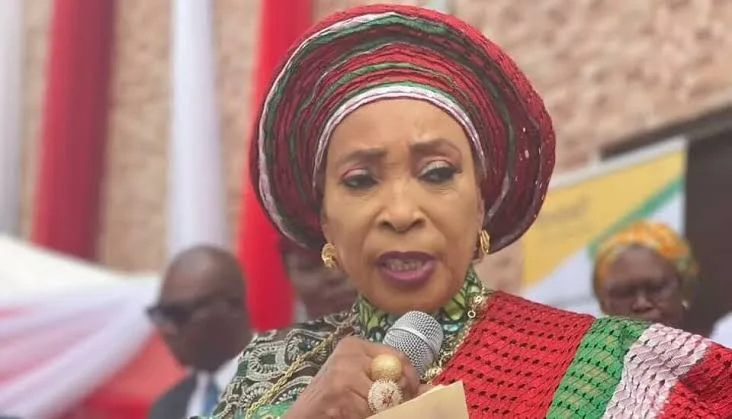

The Chairperson of the Board of Trustees of the Network Against Child Trafficking, Abuse and Labour, Chief Titi Atiku Abubakar, wife of former Vice President Atiku Abubakar, has said Nigerian girls are becoming a nuisance in foreign countries, a situation she said has contributed to international partners’ support for anti-human trafficking efforts in Nigeria.
Abubakar made the statement on Thursday in Abuja at the public presentation of NACTAL’s review of the 2025 Trafficking in Persons Report released by the United States Department of State.
Explaining the motivation behind the support from international partners, she said they wanted Nigerian girls to remain in the country rather than migrate abroad and become a burden on their host countries.
“You see, why our partners are actually helping us? Because they want our girls to stay at home. Our girls are becoming nuisance in overseas countries. So that is why these partners are helping us,” she said.
She added that the partners were supporting both Nigeria’s anti-trafficking efforts and the girls to enable them to remain in their country.
“They are supporting us, they are supporting the girls. They want them to stay at home and do whatever they want to do in their homes, in their country,” Abubakar said.
The NACTAL board chair also called for stronger collaboration among civil society organisations, saying the network could not tackle human trafficking, abuse and child labour without broader participation.
She described the organisations working with NACTAL as frontline actors in the fight against trafficking and related offences.
“NACTAL has about 286 foot soldiers, those are the CSOs that are working with NACTAL because NACTAL alone cannot do it. So we must bring everybody on board to help in this fight,” she said.
Meanwhile, the immediate past president of NACTAL and regional representative of the West African Coalition Against Trafficking in Persons and Smuggling of Migrants, Abdulganiu Abubakar, said the network’s review of the 2025 US report found that the contributions of the Nigerian government, development partners and civil society organisations were underrepresented.
He said the review was commissioned after the report’s release to examine its assessment of Nigeria’s efforts to combat human trafficking, particularly in victim protection, rehabilitation and shelter provision.
According to him, development partners had supported policy development, provided assistance to victims and helped refurbish shelters operated by civil society organisations and the National Agency for the Prohibition of Trafficking in Persons.
Abubakar said about 10 NAPTIP shelters had benefited from refurbishment support, but the interventions were not adequately captured in the US report.
He added that the contributions of more than 289 NACTAL member organisations and Nigeria’s role in regional anti-trafficking initiatives in West Africa deserved greater recognition.
However, he acknowledged that Nigeria continued to face challenges in implementing anti-trafficking policies, citing inadequate funding, weak political will and shortcomings in the prosecution of cases, particularly high-profile cases.
He urged the Federal Government to increase funding for ministries, departments and agencies responsible for combating human trafficking and demonstrate stronger commitment to enforcing existing policies.
“The government of Nigeria needs to do a lot in terms of funding. The political will and commitment should improve,” he said.
Abubakar also called on the government to create an enabling environment for civil society organisations and development partners to operate independently while complementing government efforts.
He further urged the authorities to recognise investigative journalists who expose human trafficking cases and alleged perpetrators.
In his remarks, NACTAL President, Osita Osemene, announced plans to increase the network’s membership from about 286 civil society organisations to 500 within the first three months of his administration and at least 1,000 within one year.
Osemene said the expansion would strengthen local participation and improve support for victims and vulnerable groups.
He maintained that the fight against human trafficking should not be left to international partners, urging Nigerians to take greater responsibility for addressing the problem.
“The fight against human trafficking is a collective responsibility, and everybody must come together to ensure that this fight is won,” he said.
Osemene added that his administration would prioritise capacity-building programmes to equip more civil society actors with the professional skills required to respond to human trafficking and child labour cases.
He said the initiative would combine an expansion in membership with training to improve the quality of interventions available to victims.
