

By Bola Bamigbola
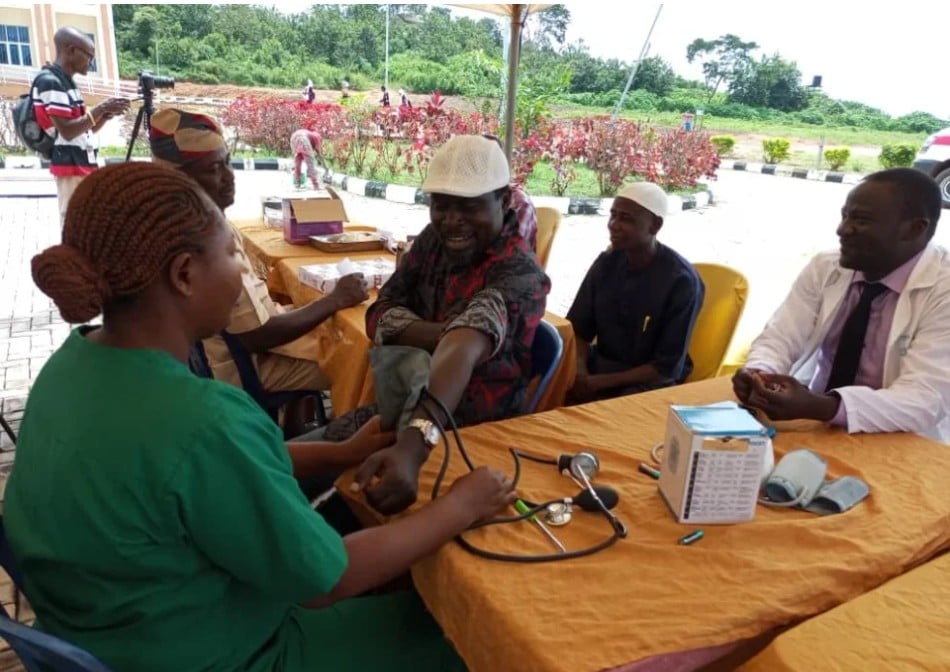
About 1,000 residents and staff members of the Federal University of Health Sciences, Ila-Orangun, Osun State, have been screened for hypertension, hepatitis and obesity as part of activities lined up for the institution’s maiden convocation.
The medical outreach, coordinated by the Dean of the Faculty of Clinical Sciences, Dr Abayomi Ojo, was held on the university campus on Wednesday.
Giving an overview of the exercise in an interview with PUNCH Online, Ojo said the medical team observed that many people were living with high blood pressure without being aware of it.
He said, “Students, staff, and members of the surrounding communities were the beneficiaries. We screened them for weight and height because overweight is becoming endemic in our society. Underweight is also a big problem.
“We checked their height and calculated their Body Mass Index. We are able to determine if you are within the spectrum for obesity, and if you are in that spectrum, we advise you and refer you appropriately, because we know that obesity has the tendency to reduce lifespan.
“Once you leave there, you go to the blood pressure stand where we screen for blood pressure, blood glucose, diabetes, hepatitis B and hepatitis C. We do a lot of screening tests. High blood pressure is a common systemic disease in our environment. After that, we sit them down, give them advice, and refer those who need further care. We screened about one thousand people.”
Ojo, who is the Chairman of the university’s Medical Outreach Committee, also decried Nigerians’ nonchalant attitude towards regular medical checks and urged people to undergo periodic screening to prevent avoidable deaths.
“From the checks, we saw that a lot of people have high blood pressure and they do not know. The blood tests also showed that some people have high blood sugar and infections. Hepatitis B and C were also positive in some of our patients today.
“These disease conditions are unlike malaria, where you have a fever and you know you are sick. These diseases stay within the body, and you would not know. That underscores the need to do regular body checks. It is important. Several disease conditions kill when we are not informed until it is too late,” he said.
On the need for regular medical checks, Ojo added, “Part of what we have noticed here is that people don’t want to know that they are sick. I don’t know if it is cultural. They think that it is better not to know. That what they don’t know will not kill them, and only what they know will kill them.
“But it is the opposite. Whether you know or you don’t know, it will kill if it is there. It is always better to know. There is no scientific evidence that suggests that it is better not to know. Understand what makes good health and avoid exposure factors.”
PUNCH Online reports that the Vice-Chancellor of the Federal University of Health Sciences, Ila-Orangun, Osun State, Prof Akeem Lasisi, said Nigeria might continue to have more female medical practitioners as cultural barriers to girls’ education gradually decline.
Lasisi made this known while responding to questions about the higher number of female students in the university compared with males at a press briefing ahead of the institution’s maiden convocation in Ila-Orangun.
According to statistics presented earlier, Lasisi put the university’s student population at 3,332, comprising 2,245 females, representing 67.38 per cent, and 1,087 males, representing 32.62 per cent, across four faculties.
The vice-chancellor also said the rejection of cultural bias against females and women’s natural inclination towards caring would make them more likely to choose medical professions.
Copyright PUNCH
All rights reserved. This material, and other digital content on this website, may not be reproduced, published, broadcast, rewritten or redistributed in whole or in part without prior express written permission from PUNCH.
Contact: health_wise@punchng.
