

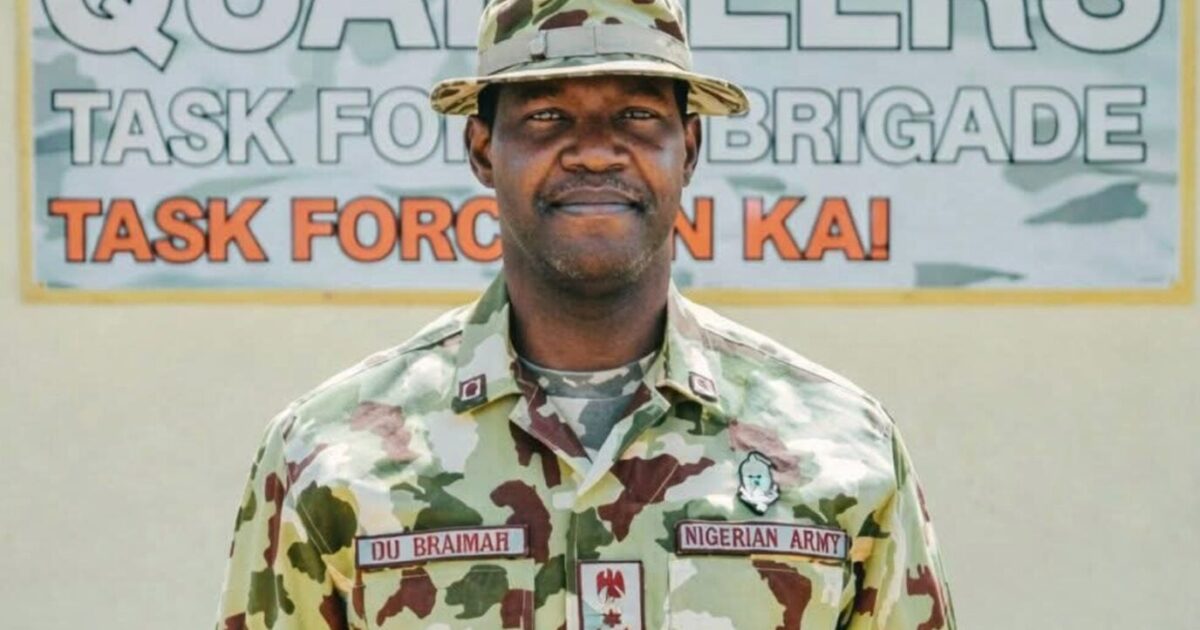

The Resource Centre for Human Rights and Civic Education has described the killing of Brigadier General Oseni Braimah as a “national alarm bell,” warning that Nigeria’s security architecture has become fragile.
The Defence Headquarters on Friday confirmed the death of the Commander of the 29 Task Force Brigade in Benisheikh, Borno State, Brigadier General Braimah, following a terrorist attack on a military formation.
The military said the brigade commander and three other personnel — two officers and two soldiers — were killed in action during an intense engagement with terrorist elements in Kaga Local Government Area of the state.
Speaking at a state-of-the-nation press conference in Abuja on Tuesday, the Executive Director of CHRICED, Ibrahim Zikirullahi, said the killing of the senior officer underscores the depth of the country’s security crisis.
He said, “This was not merely another tragic incident in a long list of security failures. It was a symbolic rupture — a moment that exposed the fragility of Nigeria’s defence architecture. When a senior military officer, operating within what should be a fortified command environment, is overrun and killed by insurgents, it sends a chilling message about the state of national security.”
He stressed that the incident goes beyond a routine security breach, describing it as a symbolic rupture rather than “merely another tragic incident in a long list of security failures.”
Zikirullahi said, “The death of Brigadier General Oseni Braimah stands as one of the most devastating indicators of Nigeria’s deepening security crisis.
“When a senior military officer, operating within what should be a fortified command environment, is overrun and killed by insurgents, it sends a chilling message about the state of national security.
“The question, therefore, is: if a brigadier can be ambushed and killed, what hope remains for ordinary citizens?”
The CHRICED director warned that the attack has far-reaching implications for Nigeria’s defence system, noting that it reveals internal vulnerabilities within the military’s operational command structure — from intelligence failures to inadequate fortification and compromised planning.
“It exposes the erosion of morale among frontline troops, who are left with a sense of abandonment when their commanders fall in battle,” he added.
He further noted that the incident underscores the growing boldness of insurgent groups, who now demonstrate the capacity to strike high-value targets with precision and confidence, adding that it also “deepens public anxiety, reinforcing the perception that no one — civilian or military — is safe.”
Zikirullahi maintained that the killing reflects deeper systemic issues, saying, “This tragedy is not just about the loss of a single officer. It is a mirror reflecting the systemic failures that have allowed insecurity to metastasise across the country.”
He said the development raises urgent questions about leadership, strategy, intelligence coordination, equipment, and political will.
“The death of Brigadier Braimah must therefore be seen as a national alarm bell — a stark reminder that Nigeria’s security crisis has reached a point where even the walls of military command are no longer impenetrable,” he added.
Zikirullahi called for sweeping reforms, insisting that the situation demands accountability, reform, and a complete rethinking of the nation’s security architecture.
“It is a call for accountability, reform, and a complete rethinking of the nation’s security architecture,” he said.
Addressing the media, he urged journalists to uphold the highest standards of investigative reporting, exposing corruption, insecurity failures, and abuses of power, while also calling on them to resist intimidation and censorship and promote fact-checking and counter-misinformation efforts.
He also charged citizens to take a more active role in governance, saying, “Remain vigilant and engaged, recognising that democracy requires active participation, not passive observation.”
He added that Nigerians must demand accountability from elected officials at all levels, using lawful and peaceful means.
