


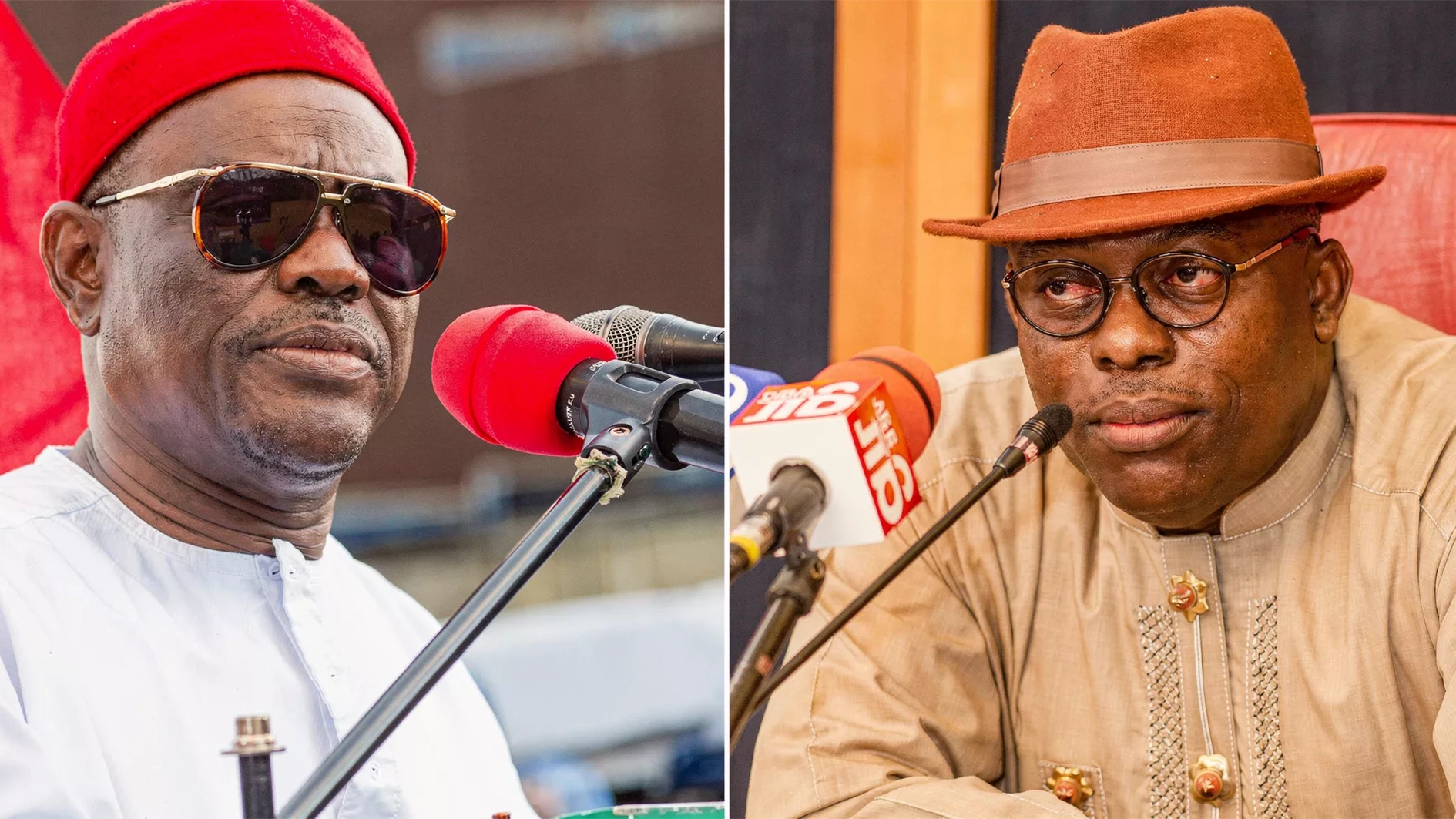
The political landscape of Rivers State, long considered the crown jewel of Nigeria’s oil-rich Niger Delta, has reached a critical juncture as of early January 2026. The enduring friction between the Minister of the Federal Capital Territory, Nyesom Wike, and his successor, Governor Siminalayi Fubara, has transcended the typical boundaries of a localized political skirmish, evolving into a systemic crisis that threatens the foundational stability of the state and the democratic norms of the nation. Following a period of state-mandated hibernation under emergency rule in mid-2025, the return to democratic governance has not brought the anticipated stability but has instead served as a catalyst for a more sophisticated and worrisome phase of political combat. As the actors navigate the early days of 2026, the rhetoric of disagreement has replaced the language of development, and the quest for political superiority is overshadowing the mandate for public service.
The Chronology of Discord
The current phase of the crisis is rooted in the events of late 2025, when the fragile peace agreement brokered by President Bola Tinubu in June of that year began to systematically unravel. The lifting of the six-month state of emergency on September 18, 2025, marked the return of Governor Fubara to the helm of affairs, but it also signaled the end of a period of neutral administration by the federal Sole Administrator, Ibok-Ete Ibas. Upon his return, Fubara inherited a state that was fiscally robust—reporting a jump from N300 billion to N600 billion in the state government account during the emergency period—but politically fractured.
By December 2025, fiscal priorities became the primary source of disagreement. Pro-Wike elements within the Rivers State House of Assembly pushed for a Supplementary Appropriation Bill, a move that Fubara rejected on the grounds that the N1.48 trillion budget previously passed by the National Assembly for the state was sufficient for the fiscal year. This rejection was viewed by Wike as a declaration of independence and a betrayal of the structural influence he sought to maintain over the state’s financial apparatus. At a meeting held at the residence of Ferdinand Alabraba, a preeminent political elder in Port Harcourt, Wike explicitly declared a “fresh war” on the governor, signaling a departure from any remaining pretence of reconciliation.
The subsequent defection of both major camps into the All Progressives Congress (APC) in December 2025 created a paradoxical environment. While Fubara sought to leverage the state’s executive authority to claim leadership of the party in Rivers, Wike asserted that a late defection does not confer leadership, mocking the governor’s lack of existing party structure at the ward and local government levels. This power struggle within the APC has further complicated the crisis, as the federal government now faces the challenge of managing a state where its newest high-profile members are actively seeking each other’s political ruin.
The Godfather’s Mirror: Humility and Lineage as Strategic Restraint for Governor Fubara
In addressing the role of Governor Siminalayi Fubara, it is essential to look beyond the immediate tactical moves and consider the deeper sociological and historical archetypes of political mentorship. The relationship between a benefactor and a protégé in Nigerian politics often mimics the Gemeinschaft—the traditional communal bond—where loyalty is not merely a preference but a foundational requirement for social and political order.
In the Nigerian political theatre, the “godfather” is often the architect of the “access” that makes governance possible. Fubara, by his own history, was the “handpicked successor” whose rise was reportedly fueled by state resources and the political structure established by Wike. To attempt to dismantle that structure prematurely, or to ignore the “political lineage” that birthed his administration, is to invite the wrath of the benefactor and the subsequent collapse of the governing apparatus.
Fubara’s New Year charge, which emphasized prayer over “instruments of war,” suggests a burgeoning awareness of the need for restraint. However, true strategic restraint involves more than just a preference for peace; it requires a respectful acknowledgment of the “generational chain” of power. The governor must learn that justice and stability in a fractured political world are often found not in the absolute defeat of one’s mentor, but in the cultivation of loyalty and the maintenance of honorable relations. By honoring the lineage that provided him the platform, Fubara may find the space to lead without the constant threat of “drums of war” drowning out his developmental agenda.
Moral Restraint and the Burden of Mentorship for Minister Wike
The perspective of Minister Nyesom Wike requires an equally deep moral reflection, one that can be found in the counsel of Ogbuefi Ezeudu to the protagonist Okonkwo in Chinua Achebe’s Things Fall Apart. Ezeudu, the oldest man in the village and a repository of communal wisdom, famously warned Okonkwo against participating in the sacrifice of Ikemefuna, the young boy who had lived in his household and looked to him as a father figure: “That boy calls you father. Do not bear a hand in his death.” Okonkwo, driven by a pathological fear of being perceived as weak or “unmanly” (a reaction to the shameful legacy of his own father, Unoka) ignored this advice. By personally delivering the blow that killed Ikemefuna, Okonkwo did not prove his strength; instead, he initiated the moral and structural collapse of his household and his community.
In the contemporary context of Rivers State, Governor Fubara is the protégé who calls Wike “father”. Wike’s role as the mentor was to provide the “compass of experience” to guide the next generation of leaders. However, the Minister’s recent rhetoric—vowing that the governor will never get a second chance and threatening to reveal the details of the agreement that returned Fubara to power—mirrors Okonkwo’s obsession with total domination and the annihilation of any perceived defiance. Wike’s assertion that his own political career would come to an end if Fubara secures a second term is a manifestation of the “Okonkwo complex,” where the mentor perceives the independence of the protégé as a personal existential threat.
Elder statesmanship and legacy consciousness demand a different approach. The true test of a political mentor is not the ability to “remote control” a successor, but the capacity to exercise moral restraint against political annihilation. If Wike persists in bearing a hand in the political death of Fubara, he risks destroying the very political structure he claims to protect. The warning of Ezeudu is a call to paternal responsibility; it suggests that the destruction of one’s political offspring is a crime against the “Peace of Ani” (the social contract), one that inevitably leads to the banishment of the perpetrator from the hearts of the people and the annals of respected history.
Minister Wike must consider that his legacy is not measured by the absolute obedience of his subordinates but by the institutional stability he leaves behind. The current crisis, marked by the setting ablaze of local government secretariats and the threat to the national economy and stability of the region, is a direct consequence of the breakdown in the mentorship bond. By embracing the role of the wise elder rather than the bravest warrior, Wike could transform the current conflict into a moment of renewal. Failure to do so might result in the tragedy of a once-great leader whose actions ultimately spoiled the peace which they were meant to preserve.
The Legislative Mandate: Restoring the Constitutional Sanctity of the House of Assembly
The Rivers State House of Assembly has become the primary battleground for the factional politics of the state, a development that has severely compromised its constitutional mandate to enact laws for peace, order, and good governance. The mass defection of 16-17 members to the APC on December 5, 2025, led by Speaker Martin Amaewhule, has effectively split the legislature into two competing camps. This division has led to a situation where legislative activities are driven by the quest for factional fealty rather than the welfare of the citizenry.
The recent controversy over the N100,000 Christmas bonus highlights the absurdity of the current legislative deadlock. While the Nigeria Labour Congress (NLC) praised the governor for the payment to civil servants and pensioners, the Assembly returned the funds, arguing that the transfers to their personal accounts lacked legislative approval. This focus on procedural skirmishes while the state’s developmental plans face delays and investors become uncertain should be abhorred. The legislative mandate is a sacred trust; to use it as a weapon in a fresh war is a violation of the tenets of constitutional democracy.
Conflict Transformation: A Call for Diplomacy and Relationship Repair
The escalation of tensions among supporters on both sides necessitates a shift in strategy from mere “conflict resolution”—the finding of temporary fixes—to “conflict transformation”. Conflict transformation theory posits that conflict is not a negative incident to be suppressed but a “motor of change” that can be used to rebuild relationships and systems more constructively. As leadership thinker Lazarus Takawira insightfully noted, “Diplomacy in leadership is winning the war on behalf of both sides”. This principle challenges the zero-sum mentality of the current crisis, where one side’s victory is perceived to require the other side’s complete annihilation.
Diplomacy in this context means acknowledging the interests and needs of both parties. Fubara needs safety, protection, and the autonomy to serve his mandate, while Wike needs respect, the preservation of his legacy, and a sense of political relevance. A transformational approach would seek a constructive compromise where both sets of needs are met without destroying possessions or causing fear to gain control. As seen in history, from the Mozambique Peace Process to Kenya’s Power-Sharing Agreement, lasting stability is achieved only when leaders are willing to uncover the truth and foster reconciliation.
Supporters must realize that the future of Rivers State lies not in winning the war for a faction, but in winning the war on behalf of both sides, by securing a future where peace is a continuously evolving quality of relationship.
The Defining Leadership Moment
Indeed, the re-emerging political crisis in Rivers State at the start of 2026 is a defining moment for all actors involved. For Governor Siminalayi Fubara, it is a test of his ability to blend “street-smart” leadership with the quiet power of negotiation and humility. He must move beyond the political noise and demonstrate that his leadership is anchored on faith, perseverance, and service to the people. His willingness to draw lessons from political lineage will determine whether he can carve out his own path without burning the bridges of his own history.
For Minister Nyesom Wike, the crisis is a test of his elder statesmanship and paternal responsibility. He must realize that great leadership is a reflection of honest service and that a powerful leader has no problem letting go of power. By “not bearing a hand in the death” of his protégé, he can preserve a legacy that is evocative and exciting rather than one marked by factional tendencies and political annihilation.
For the Speaker and members of the Rivers State House of Assembly, the moment calls for a return to principled governance and constituency welfare. They must rise above the polarity that does not respect party lines and refocus on their mandate to ensure that the governance outcomes for the people of Rivers State are positive.
Ultimately, the crisis will shape not just the political fortunes of individual actors, but the democratic norms and political culture of Rivers State and Nigeria at large. As the state enters 2026, the choice is clear: to continue on a path of zero-sum political victories that leave the house in ruins, or to embrace the diplomacy of leadership that “wins the war on behalf of both sides”. The sounds of war must be transformed into a symphony of stability, for the sake of the stability of the region, the national economy, and the survival of Nigeria’s democracy. This is the “horizon of the preferred future”; one where peace is not a static end state but a continuously evolving quality of relationship built on trust, empathy, and connection.
• Prof. Steve Azaiki, OON, a former Secretary to the Bayelsa State Government, was in the House of Representatives from 2019 to 2023.