
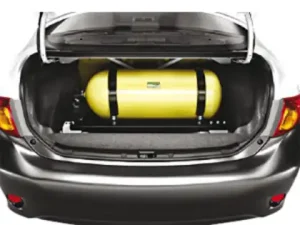



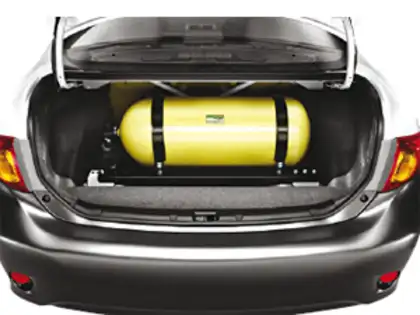


The Presidential Initiative on Compressed Natural Gas and Electric Vehicles has warned motorists against using roadside mechanics to convert their vehicles to compressed natural gas.
Pi-CNG said improper installations and the use of unauthorised equipment could undermine safety and damage vehicles.
It said motorists must use accredited conversion centres, where technicians are trained to install the equipment and inspect vehicles before the conversion process begins.
The warning came during a media visit organised by the initiative to Rolling Energy, a certified CNG conversion centre in Jahi, Abuja, on Thursday to mark the United Nations World Sustainable Transport Day.
The visit was designed to give first-hand knowledge of how petrol-powered vehicles are converted to use CNG, as well as address public concerns about the safety of the technology.
The Head of Brand and Communications at Pi-CNG, Onyekachi Eke, who led the team, said the exercise was part of efforts to improve public understanding of CNG and correct misconceptions surrounding its use.
“We cannot emphasise it enough. You need to go to an accredited centre. Please do not go to a roadside mechanic. An accredited centre. You have the list on our website: https://pci.gov.ng/. The list of accredited conversion centres and refuelling stations is there,” the official said.
During the demonstration, the Technical Process Manager at Rolling Energy, Julius Yaama, explained that CNG conversion involved adding a separate system to a vehicle’s existing components, allowing it to operate on both petrol and gas.
He said the installation must be carried out without interfering with the vehicle’s original manufacturer-installed components.
“First and foremost, conversion is a process whereby you add a component to an already existing component. The moment you do that, the car automatically becomes a hybrid.
“What you need to do is to think out of the box and see where you can place your own components to work side by side with the car’s existing components. You are not to tamper with any of the existing components on the car,” Yaama said.
He identified the major components of the conversion kit as the control unit, high-pressure pipes, reducer, refill valve and injectors.
He explained that gas stored in the cylinder at a pressure of between 200 and 250 bars had to pass through a reducer, which lowers the pressure before it is supplied to the engine for combustion.
Yaama also stressed the importance of inspecting vehicles before conversion, warning that installing CNG equipment would not automatically resolve existing engine problems.
He said vehicles with faulty spark plugs, ignition coils or other mechanical defects could continue to experience the same problems after conversion because the gas system works alongside the vehicle’s existing components.
“Before we do conversion, we do a pre-inspection. For instance, if your car is jerking or the plugs are not good or the coils are not good, whatever the car does after combustion, the CNG will copy it and replicate it in the gas system.
“If your car does not pass that inspection, we are not going to convert the car. We have to send you back to the mechanic to check the car and put it in proper shape before you come back for conversion,” he said.
The technician further warned that vehicles with weak or smoky engines might not deliver satisfactory performance after conversion.
He said although several vehicle models could be converted, some direct-injection and turbocharged engines required specialised kits rather than the conventional sequential systems commonly used in Nigeria.
Yaama also attributed some reported CNG-related incidents to improper modifications, including the use of cylinders not designed to withstand the high pressure involved in gas storage.
He cautioned motorists against attempting to increase the gas capacity of their vehicles by attaching unauthorised cylinders to the approved storage system.
According to him, CNG cylinders have a lifespan of 15 years from their production date and must be inspected and handled in line with safety requirements.
On maintenance, he said converted vehicles required periodic checks, including attention to spark plugs and the gas system’s sensors and filters.
He advised motorists to carry out routine maintenance every three to six months, depending on the condition and usage of the vehicle.
The initiative said CNG remained a cheaper and cleaner alternative to petrol, but maintained that public confidence would depend partly on proper installation, adequate safety awareness and access to certified conversion and refuelling facilities.