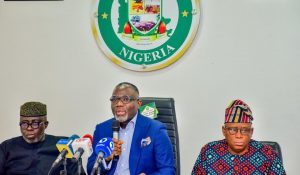



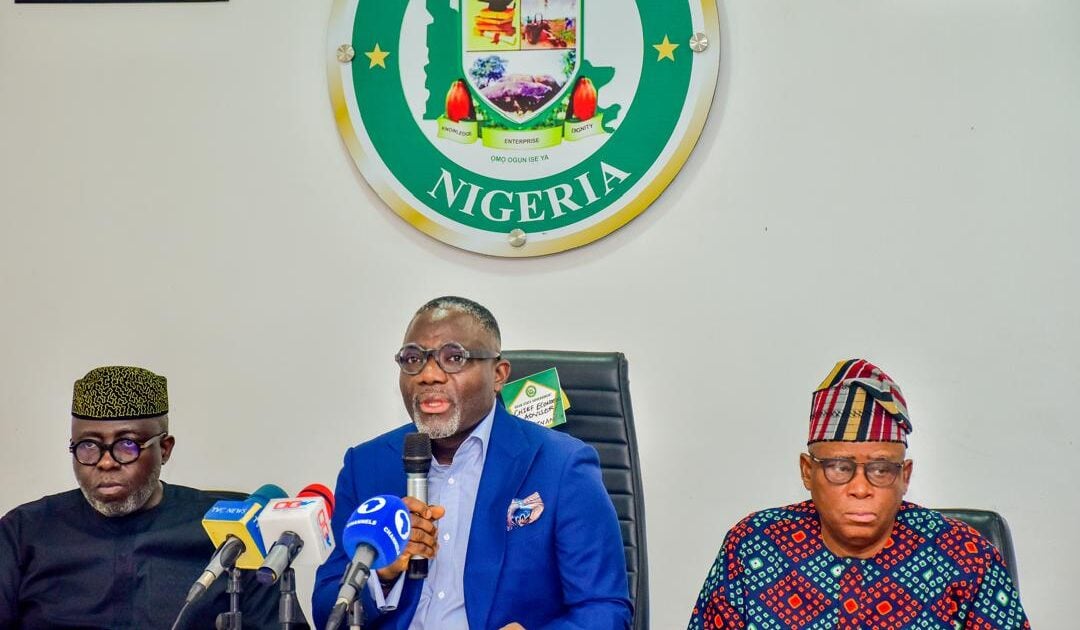


The Ogun State Commissioner for Finance and the Chief Economic Adviser to the Gov Dapo Abiodun, Dapo Okubadejo, on Tuesday said that the debt profile of the state is around N494bn.
Okubadejo said that while the local debt, which was N133bn in 2019 when the present government resumed office, stood at N194bn as of December 2025, the foreign debt, which was also N33bn as at 2019, is now N300bn.
He explained that the sharp increase in the foreign debt was due to the devaluation of the naira, explaining that a dollar, which used to exchange for N330 in 2019, now goes for between N1500 and N1400.
This is just as the Commissioner also said that the Internally Generated Revenue of the state, which used to be about N50bn in 2020, is now over N240bn, while the projection of the government for the year 2026 stands at N512bn.
Okubadejo disclosed this on Tuesday during the 2026 budget media briefing held at Olusegun Osoba Press Centre, Governors’ Office, Oke Mosan, Abeokuta.
The Commissioner said that the state government has efficiently managed the debt and that the borrowings were actually used to finance the infrastructural development of the state.
He explained that “As of December 2025, the local debt was N194 billion. And when you look at that, with the level of infrastructure that we have done, also taking note of the fact that the debt as of 2019 was N133 billion, compared to N194 billion by December 2025, you will see that we have exhibited fiscal discipline.
“And of course, if you look at the foreign debt, the foreign debt is N300 billion, the foreign debt, of course, is what it is due to devaluation. There’s been a devaluation of the Naira from N330 to $1 in 2019, approximately, to what we have now, which is around N1,500 or N1,400.
He stated further that”So even without taking a dime, the $100 million of debt we had in 2019, foreign debt, which was about N33 billion at that time, just without even doing anything, and with even payment of principal and interest over the last six years, the $100 million which was N33 billion at that time is now almost N150bn”.
Okubadejo stated further that what is most important with debt is not its quantum alone, but the quantum has to be within the fiscal responsibility guidelines, which the government has not breached.
He explained, “What have you done with the debt? Have you used the debt to fund infrastructure? And if that’s the case, which is the case here, then you’ve used that debt at whatever average interest rate it is, around 20% thereabouts,
“You’ve used that debt to edge against inflation. Because what you did in 2019-2020 at N330 Naira to a dollar, of course can not amount to same cost in 2025 when the exchange rate is now between N1500 and N1400 and with inflation averaging almost 30%, you can see what the cost of that infrastructure you missed in 2019, you can see how much it’s going to cost you now.
“So taking debt to fund infrastructure is a wise thing, and we will continue to do that optimally within the guidelines of the law”.
On the state’s fiscal outlook, Okubadejo revealed that the 2026 budget increased from ₦1.054 trillion in 2025 to ₦1.668 trillion, while Ogun’s economy expanded from ₦3.5 trillion in 2019 to ₦18.96 trillion in 2026.
He added that IGR grew from ₦50 billion in 2019 to ₦240 billion in 2025, with projections of ₦512 billion this year.
Okubadejo disclosed that the astronomic economic growth recorded in the state from the gross domestic product of about N3.6 trillion to a projected 18.96 trillion this year didn’t come by accident but by series of deliberate efforts of the present administration to ensure ease of business through the provision of infrastructure, seamless land administration, improved security, among others.
“And this growth, again, is not by accident, because if you look at the average rates of all these indicators across the country, the growth trajectory is not the same. And to talk about really why all of these are happening, and I think the first one is a conducive business environment, which is driven by so many factors.
“The first is the ease of doing business, which the administration of Gov Dapo Abiodun has embarked upon since 2019. And that entails, first, the security situation.
“The security we have enjoyed in the state is wonderful, and that’s why you see a lot of investors interested in putting up their businesses in the state.
“The second, of course, is the reforms that this administration has also put in place across several areas. First is the acquisition of land, which is essential in setting up businesses and factories. We’ve significantly improved the processes of acquisition of title documents”.
Okubadejo added that the state government has also cleared the backlog of pension and gratuity arrears owed to workers who retired between 2012 and 2020, reaffirming its commitment to the welfare of retirees.
According to him, annual pension payments rose from ₦6.7 billion in 2019 to ₦20 billion in 2025, with projections showing a possible increase to ₦40 billion by 2029.
He disclosed that the state had so far paid ₦23.3 billion in gratuities covering retirees from 2012 to 2020, alongside ₦32.8 billion in outstanding gratuities for local government retirees inherited by the administration.
Okubadejo added that between 2019 and July 2, 2025, the state disbursed ₦93.26 billion in pensions under the Defined Benefits Scheme and ₦94.78 billion to local government pensioners.
He assured that the remaining backlog would be cleared as Internally Generated Revenue (IGR) continues to improve, noting that over 300 workers who retired in July 2025 are currently receiving six-month palliatives pending the completion of their pension documentation.
The commissioner also described the newly approved Additional Pension Benefits (APB) as the first of its kind in Nigeria, adding that amendments to the state’s pension law would be pursued to formally integrate the scheme.
Also speaking, the Commissioner for Budget and Planning, Olaolu Olabimtan, said the 2026 budget reflects strong fiscal reforms, noting an 85 per cent budget execution rate in 2024 and sustained financial stability.
Other commissioners highlighted sectoral achievements, including massive road construction, increased healthcare funding, rail extension plans, education support programmes, and expanded housing projects across the state.