




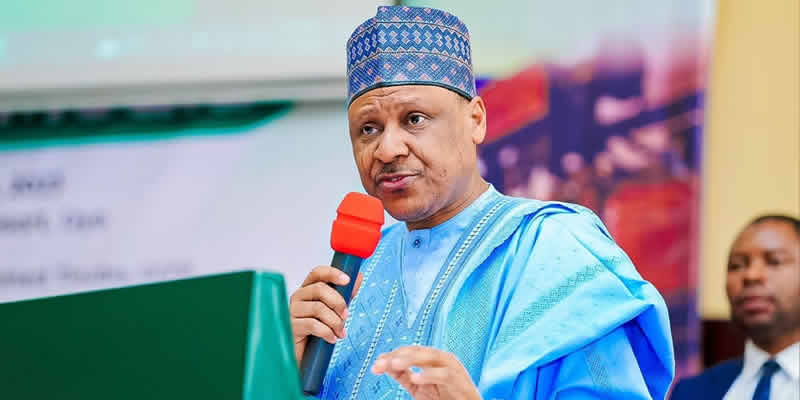


The Federal Government has raised concerns over the growing threat of misinformation and disinformation, urging Nigerians to strengthen media literacy as a safeguard against false narratives in the digital age.
The Minister of Information and National Orientation, Mohammed Idris, gave the warning on Thursday at the close of a two-day event marking the unveiling of the International Media and Information Literacy Institute at the National Open University of Nigeria in Abuja.
PUNCH Online reports that President Bola Tinubu had inaugurated the institute on Wednesday at the Presidential Villa, positioning Nigeria at the forefront of global efforts to combat misinformation and promote responsible communication.
The institute gained international recognition in November 2025 when UNESCO approved its designation as a Category 2 institute—the first of its kind globally—during its 43rd General Conference in Samarkand, Uzbekistan.
Speaking at the event themed “Empowering knowledge societies through media and information literacy in the digital age,” Idris said the ability to critically assess and verify information has become indispensable in a rapidly evolving technological landscape driven by Artificial Intelligence.
Represented by the Executive Secretary of the Nigerian Press Council, Dili Ezughah, the minister stressed that media literacy is no longer optional.
“In a world shaped by rapid technological change and the constant flow of information, the ability to think critically, verify facts, and engage responsibly is fundamental to the health of our societies and the strength of our democracies,” he said.
He warned that the consequences of misinformation extend beyond theory, with real implications for governance, peace, and social cohesion.
“The establishment of the institute comes at a time when the world is grappling with misinformation, disinformation, and the erosion of trust in institutions,” he added.
Idris described the institute as a critical platform to promote responsible information use and informed citizenship, noting that hosting it places Nigeria at the centre of a key global agenda.
He reaffirmed the Federal Government’s commitment to supporting the institute through partnerships with UNESCO and other stakeholders to ensure measurable impact.
“As a ministry, we remain fully committed to supporting the institute to achieve its mandate and deliver meaningful outcomes,” he said.
In his remarks, the Vice-Chancellor of the university, Uduma Uduma, described the institute’s establishment as a transition from concept to reality, reflecting Nigeria’s institutional capacity and alignment with global educational goals.
He noted that the digital era has created what he termed an “epistemic paradox,” where access to information has increased without a corresponding rise in understanding.
“Media and information literacy is no longer an academic accessory; it is essential for responsible existence in today’s world,” he said.
Also speaking, former Minister of Information and Culture, Lai Mohammed, described misinformation as a major threat to national security and unity.
He reiterated his long-standing advocacy for regulating social media platforms, stressing that such measures should not be misconstrued as censorship.
Director of the institute, Sharon Omotosho, outlined a strategic roadmap aimed at positioning the centre as a global hub for research, policy development, and collaboration.
She said the institute would focus on research, advocacy, training, and partnerships to build what she described as “a media and information literate world.”
Omotosho added that the institute would also serve as a global observatory to track trends in information ecosystems and support evidence-based policy interventions.