







The Federal Government on Thursday reaffirmed its commitment to the 1,028-kilometre Lagos–Abidjan Corridor project but raised fresh concerns over design standards, funding structure and unequal distribution of the highway across participating West African countries.
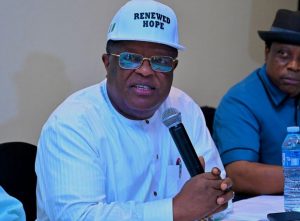
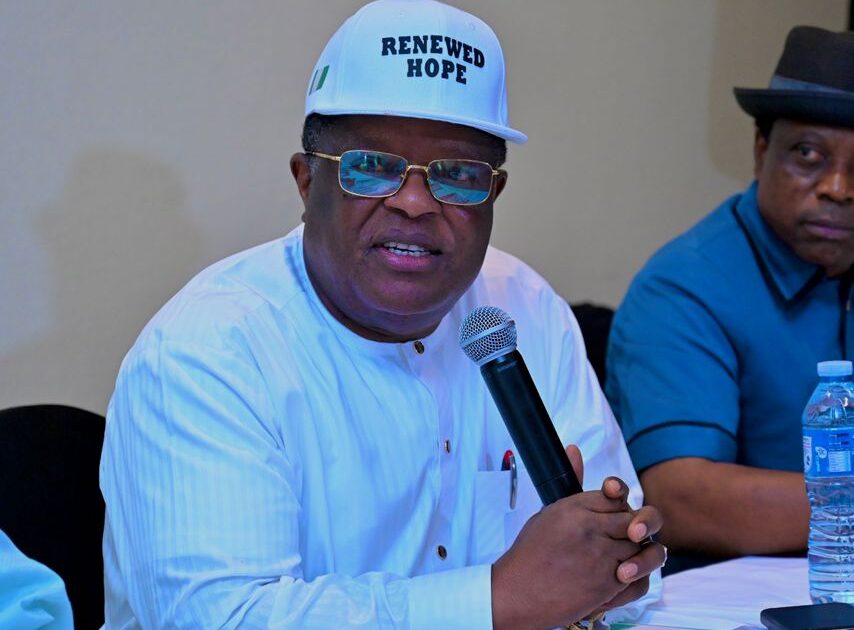
The Minister of Works, David Umahi, disclosed this during a high-level meeting with a delegations from the ECOWAS Commission and the African Development Bank in Abuja.
Umahi stressed that while Nigeria remains fully committed, critical issues must be resolved at the level of Heads of State before the project can move forward.
The position was contained in a statement signed by the Senior Special Assistant to the Minister of Works (Media), Francis Nwaze.
The Lagos–Abidjan highway is a flagship regional infrastructure project designed to connect five countries, Côte d’Ivoire, Ghana, Togo, Benin, and Nigeria, linking major economic hubs along the West African coast.
Speaking at the meeting, Umahi said the project has the full backing of President Bola Tinubu, noting that infrastructure development remains central to the administration’s economic agenda.
“I bring greetings from His Excellency, President Bola Tinubu, who is fully committed to infrastructural development in Nigeria,” the minister said.
However, in a rare show of candour, Umahi flagged unresolved technical and political issues surrounding the project.
“On the engineering side, I will be very direct. There are unresolved issues on the Lagos–Abidjan corridor. The distribution of corridor length across countries is unequal, and that can only be resolved at the level of Heads of State,” he stated.
He revealed that Nigeria’s portion of the corridor is about 79.5 kilometres but would be constructed to a significantly higher standard than originally proposed under the ECOWAS framework.
“I am executing mine with reinforced concrete and three lanes on each carriageway, not the two-lane ECOWAS design. I have also rejected aspects of the ECOWAS design due to lack of consultation and impractical elements,” Umahi said.
The minister added that Nigeria is currently developing its own design blueprint tailored to local realities, which will be completed within weeks.
“We are developing our own design. It will account for existing infrastructure, obstacles along the corridor, and practical implementation realities. The data we are generating will guide our execution,” he explained.
Umahi stressed that agreeing on a funding model remains a major hurdle, warning against premature movement into procurement without political consensus.
“Once the design is finalised and approved by member states, the funding model must be agreed by Heads of State. Until that is resolved, moving into procurement and financing is premature. That is my position,” he said.
Despite the concerns, the minister reiterated Nigeria’s commitment to the project, describing it as critical to regional trade and economic integration.
“We remain committed to this project because it will connect Nigeria’s infrastructure to neighbouring countries and deliver mutual benefits across West Africa,” he added.
He also linked the corridor to Nigeria’s broader infrastructure push, noting that it would integrate with major ongoing projects such as the Sokoto–Badagry Superhighway and the Lagos–Calabar Coastal Highway.
“At the end of the corridor, which will connect at Badagry, we already have 162 kilometres awarded and ongoing. We are also taking the Uyo section, about 180 kilometres, to the Federal Executive Council for approval this week,” he said.
Providing updates on other projects, Umahi disclosed that sections of the Lagos–Calabar Coastal Highway were progressing steadily.
“Section one, 47.47 kilometres in Lagos, is completed and will be commissioned in May. Section two, 55 kilometres, will reach the Ogun boundary and is expected to be completed by December,” he said.
He added that construction is advancing in Akwa Ibom and Cross River states, alongside other legacy corridors linking Lagos to Abuja and extending into the North-East.
“These projects represent a major transformation not just for Nigeria but for the wider West African region,” he noted.
Earlier, the ECOWAS Director of Transport, Chris Appiah, said the delegation’s visit was part of ongoing consultations with member states to harmonise technical inputs and address outstanding issues.
“Honourable Minister, we have had several engagements with your project focal team and technical consultants on the Nigeria section of the highway. We have reviewed the designs, taken comments, and provided responses,” Appiah said.
He added that similar consultations had been conducted with Côte d’Ivoire, Ghana, and Togo, while discussions with Benin would follow its recent elections.
“We are here today to report to you as the Chair of the Steering Committee and to take up any final issues on the technical side,” he said.
On financing, the African Development Bank, represented by Salawou Mike Moukaila, described the corridor as a top priority, with strong interest from global financiers.
“As you tasked the bank to mobilise financing for the corridor, we have taken this very seriously. Our senior management, including the President of the bank, has made this project a priority because it will enhance regional integration,” Moukaila said.
He disclosed that the bank is currently undertaking an identification mission across multiple countries to design a financing framework and kick-start initial phases of the project.
“There is strong interest from co-financiers within and outside Africa. They want to see the bank take the lead in mobilising financing and deploying its instruments,” he added.
Moukaila emphasised Nigeria’s strategic importance to the success of the corridor.
“The Nigerian section is critical because a significant portion of trade originates from Nigeria along this corridor,” he said.
He described the project as a “game changer” for regional connectivity and economic growth, while commending the Federal Government’s ongoing infrastructure drive.
“On behalf of the bank, we commend President Bola Tinubu and the Honourable Minister for championing infrastructure development, which is vital for regional integration across West, Central, and East Africa,” he said.
The Lagos–Abidjan Corridor is one of West Africa’s most ambitious cross-border infrastructure projects, expected to boost trade, reduce transport costs, and improve connectivity among coastal economies.
The highway will link major ports and commercial centres across five countries, forming part of the broader ECOWAS regional transport network.
However, large-scale cross-border projects in Africa often face challenges, including funding gaps, policy misalignment, and differing national priorities.
Nigeria’s insistence on higher construction standards and clarity on financing could shape the final structure of the project, while also setting a benchmark for future regional infrastructure initiatives.


