

Ayoola Babalola
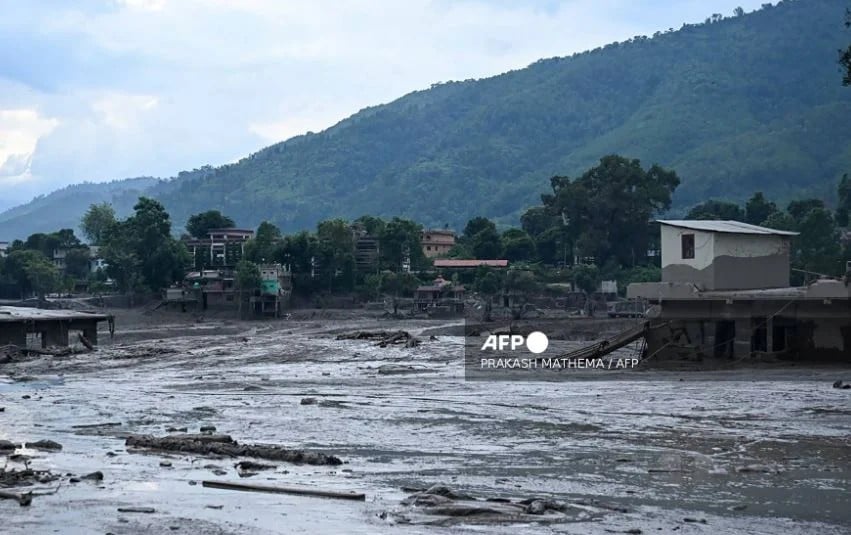
The death toll from last week’s devastating flash floods in Nepal has risen to 1,222, with 4,875 people still missing as rescuers continue to search through debris and isolated communities a week after the disaster.
According to The Hindu, citing Nepal Police and the National Disaster Risk Reduction and Management Authority, bodies have been recovered across eight districts, with Chitawan recording the highest number at 348, followed by Nawalparasi East with 218 and Nawalparasi West with 208.
Nuwakot has recorded 155 deaths, while 127 bodies have been recovered in Rasuwa, 69 in Gorkha, 60 in Dhading and 38 in Tanahu.
The scale of the disaster has also complicated the search for missing people, 583 of whom are foreigners, while thousands remain unaccounted for in areas where roads, bridges and communication networks were swept away.
The joint security operation involving the Nepal Army and other security agencies has so far rescued 11,993 people by helicopter and land routes. About 21,314 security personnel have been deployed for search and rescue operations.
The humanitarian crisis was underscored on Wednesday in Bidur, where survivors were forced to use a temporary cable crossing over the swollen Trishuli River after floodwaters destroyed roads and bridges.
The Nepal Army installed the roughly 250-metre cable, which residents and soldiers have been using to move people across the river, including those needing medical treatment, medicines, food and other essential supplies.
The disaster has also spread across the Nepal-China border. In Tibet’s Gyirong county, where flooding struck near the Nepal border, 21 people have died, and 541 remain missing, according to Chinese authorities cited by The Hindu.
China reopened the highway leading to the Gyirong border crossing on Wednesday after floodwaters destroyed sections of the route, allowing heavy rescue equipment to reach the disaster zone.
Reuters reported that search teams equipped with life-detection devices and dogs were subsequently deployed.
India has also stepped up its response, with a fifth aircraft arriving in Nepal carrying an 11-member rescue team, specialised equipment and 5.5 tonnes of essential medicines, according to India’s Ministry of External Affairs.
The disaster has meanwhile renewed scrutiny of development and environmental practices in the Himalayan region. Environmentalist Sunita Narain said the scale of the flooding was linked to decades of treating rivers and mountains as though they could be continually re-engineered, particularly through extensive hydropower development.
The continuing recovery operation comes as authorities confront the destruction of transport links and the large number of people still missing, leaving the final human cost of the disaster uncertain.
Copyright PUNCH
All rights reserved. This material, and other digital content on this website, may not be reproduced, published, broadcast, rewritten or redistributed in whole or in part without prior express written permission from PUNCH.
Contact: [email protected]
