




Once a symbol of hope for children with hearing impairments, the Imo State Secondary School for the Deaf has fallen into ruin, becoming a monument to years of neglect. In this report, UCHE OKERE exposes the decay, insecurity and abandonment confronting vulnerable students who continue to cling to education as their only lifeline to a better future despite overwhelming odds
Motorists speeding along the ever-busy Owerri-Orlu Road could easily miss the faded signpost announcing the Imo State Secondary School for the Deaf, Ofekata Orodo, in Mbaitoli Local Government Area.
Like the institution it points to, the signpost has faded into the background, ignored, forgotten, and slowly wasting away.
Its weather-beaten frame, peeling paint and faded lettering stand as a silent monument to years of neglect, offering only the faintest clue to the heartrending stories and grim realities hidden beyond its gates.
However, the signpost tells only a fraction of the story.
Nothing prepares a first-time visitor for what lies beyond the entrance. Behind the crumbling walls unfolds a haunting portrait of abandonment, decay and forgotten dreams, where children with hearing impairments struggle to learn in conditions that betray every promise of dignity, safety and inclusive education.
The facility is in a state worse than a pigsty. Yet, within its crumbling walls are nearly 150 students whose determination to learn remains unbroken, clinging to education as perhaps their only hope of rewriting their stories.
Beyond the rusting gate is not just a neglected public school but a forgotten world where children live in silence, not simply because they cannot hear or speak, but because those entrusted with their welfare have, for decades, looked away.
For many of these children, their greatest burden is not deafness. It is abandonment.
Some were brought here by parents and relatives who saw their disability as a family secret best hidden from neighbours and friends.
Once admitted, many were simply left behind, rarely visited, if at all, while their existence was quietly erased from family life.
From a distance, the sprawling school almost deceives the eye.
Rows of towering palm trees sway gently across the expansive compound, casting long shadows that give the surroundings an air of calm. They create the illusion of a serene learning environment.
That illusion disappears almost immediately.
Abandoned school, forgotten students
Established in 1984, the mixed secondary school once symbolised opportunity.
It was created to give children with hearing impairments access to quality education under the guidance of specialist teachers trained in sign language and deaf education.
For countless families, it represented proof that disability did not have to determine destiny. Today, that promise is slowly dying.
By 10 am on Wednesday, when Saturday PUNCH visited, the school’s main gate stood wide open.
There was no security guard, gatekeeper or anyone to monitor who entered or left the premises.
Immediately beyond the black gate was a vast palm plantation occupying several plots of land to the right, while the classrooms, hostels and administrative buildings stood quietly to the left, bearing the unmistakable scars of abandonment.
After momentarily taking in the beauty of the palms, the reality became impossible to ignore.
The gatehouse, our correspondent learnt, had long been abandoned, lying empty since the retirement of the last security personnel.
Nearby, broken taps, apparently vandalised, sat like relics of a forgotten era.
It was gathered that there was no running water anywhere within the premises. Ironically, the classrooms themselves were spotless.
The floors were neatly swept, with hardly a piece of litter in sight. The environment was unusually quiet, interrupted only by the soft sounds the students made and the graceful movements of their hands as they conversed fluently in sign language.
Their silence was striking. Yet it spoke volumes.
One of the first things a visitor notices is the remarkable bond between the students and the handful of caregivers who continue to look after them despite the harsh conditions.
They laugh, tease one another and console one another. Their conversations flow effortlessly through expressive signs and facial expressions.
But for anyone unfamiliar with sign language, they remain trapped behind an invisible wall, desperately trying to communicate a reality that words can barely capture.
Through gestures, they told stories of neglect, hunger, loneliness and parents who rarely came to see them.
From observation, what should be a school has gradually become a holding facility where many families leave children, they neither know how nor wish to care for, safely hidden from curious eyes back home.
The hostels tell another painful story. Fewer than 20 beds serve almost 150 students.
Many are forced to improvise where and how they sleep, squeezing into whatever space is available.
Yet, despite the obvious overcrowding, little appears to have changed over the years.
Electricity has long become a memory. Power poles within the compound have been vandalised, while electrical cables were stripped long ago, leaving the school in perpetual darkness once night falls.
Raped, hungry
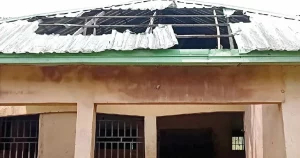
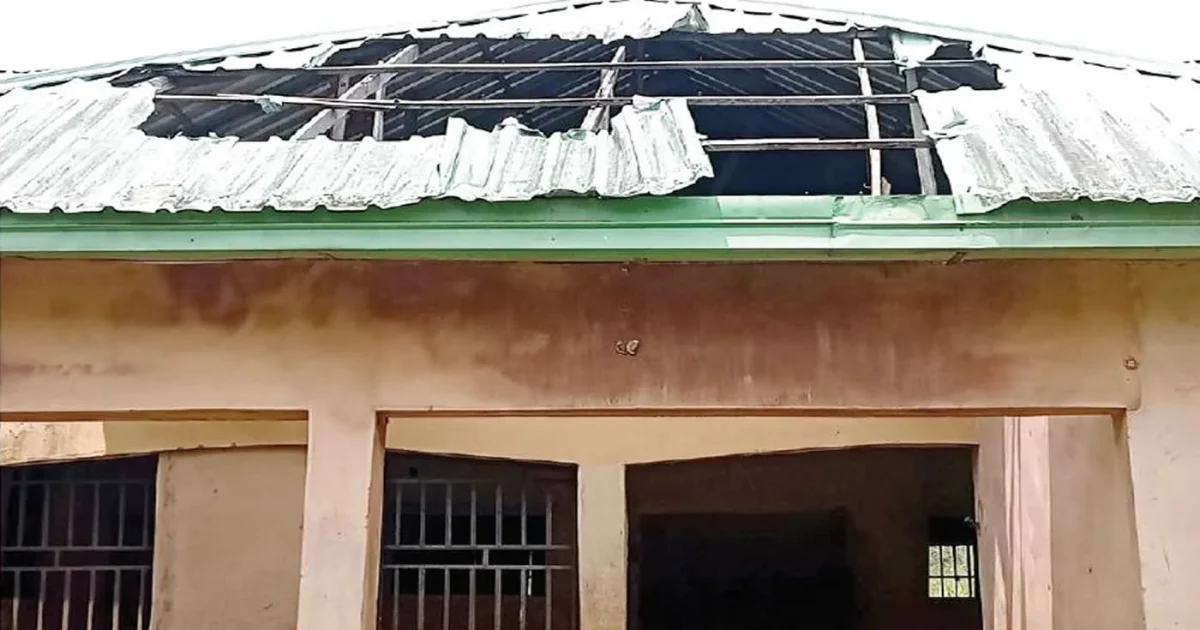
Nearly every building bears the scars of repeated vandalism. Doors have disappeared from many of the classrooms and hostels.
According to one of the caregivers, the missing doors stand as evidence of years of repeated break-ins by hoodlums, during which some female students were reportedly sexually assaulted.
But beyond the broken walls lies an even deeper crisis. The students battle hunger. They battle abandonment by government and, in many cases, by their own families.
They live without adequate security. Teachers remain unpaid. Hostels are deteriorating.
Staff quarters are crumbling. Classrooms are falling apart. Even education, the very reason the school exists, is slowly slipping away.
It was gathered that the students now receive lessons only in core subjects, while Physics and Chemistry have disappeared entirely from the timetable because there are no qualified teachers or functional laboratories.
Using sign language, one caregiver explained that the school still follows the same curriculum as conventional secondary schools.


The only difference is that the specialist teachers and laboratory facilities needed to teach science subjects no longer exist.
Saturday PUNCH gathered that the school once had several specialist teachers trained specifically to educate children with hearing impairments.
However, they retired one after another and were never replaced.
Gradually, the school lost not only its workforce but also the specialised support system that once made it a beacon of hope for children living with hearing impairments. Today, only a handful of teachers remain.
The students had little choice. They simply adapted, adjusting to life in a school where silence is defined not only by deafness but also by years of neglect that are gradually burying their dreams.
Teachers refuse postings
Saturday PUNCH gathered from a caregiver, who spoke on condition of anonymity because she was not authorised to speak, that teachers posted to the school often begin lobbying for transfers almost immediately after arriving, unwilling to endure the harsh conditions that have become the students’ daily reality.
A teacher, who also spoke on condition of anonymity for fear of reprisals, recalled a time when the school attracted highly trained specialist educators.
According to the teacher, the job once came with special allowances in recognition of the specialised skills required to teach children with hearing impairments. But when those incentives were scrapped, many experienced teachers gradually lost interest and left.
“The interest died,” the teacher said quietly.
Threatened into silence
The teacher also revealed that after members of the Ratels Group visited the school and released a viral video exposing its deplorable condition, staff members found themselves under intense scrutiny.
Instead of assurances of intervention, they received warnings.
According to the source, teachers and caregivers were cautioned against discussing conditions in the school with outsiders, with threats of sanctions hanging over anyone who spoke publicly.
No functional toilets
As our correspondent walked through the compound, another disturbing reality emerged.
Beyond the overgrown surroundings and abandoned buildings lay a sanitation crisis.
Human faeces littered parts of the premises. No functional toilet could be found, while clean running water was virtually non-existent.
Caregivers were seen returning from neighbouring communities, balancing heavy buckets of water on their heads after trekking long distances.
The water, they explained, was used for cooking and, whenever possible, for the children to bathe.
The scene painted a picture of survival rather than education.
Public outcry
Meanwhile, the school’s condition has triggered a blame game among public officials following public backlash after videos exposing its deplorable state went viral.
When contacted, the member representing Mbaitoli State Constituency in the Imo State House of Assembly, Innocent Ikpamezie, rejected criticism directed at lawmakers over the school’s neglect.
He insisted that the criticism was unfair.
According to him, Mbaitoli has 34 autonomous communities with numerous competing needs, making it impossible for one lawmaker to personally monitor every public institution.
He said some individuals had intervened months earlier by providing support, including sinking a borehole, after concerns about the school were brought to his attention.
“I can’t be everywhere. Some months ago, someone came to complain to me about the place, and I made plans to go there. But my friends, led by Emeka South, told me not to worry and to allow them to handle it as their support.
“I’m aware that Orodo Television raised awareness for water, and they sank a borehole there. They donated 10 bags of rice, noodles and a few other things. People from there confirmed to me that they did it, so I’m surprised they don’t have water there.
“Every last Monday, I appear live on Oziza FM for a phone-in programme. The idea is to interface with the people; till today, nobody has called to complain about the school. Otherwise, I would have gone there myself.
“Do you know how many students I have placed on scholarship? I reach out to schools across Mbaitoli and pay hospital bills for many people, just like the House of Representatives member representing Mbaitoli/Ikeduru Federal Constituency, Hon. Akarachi Amadi. I’m a lawmaker, not the Commissioner in charge of Education or Special Schools,” Ikpamezie said.
The member representing Mbaitoli/Ikeduru Federal Constituency, Akarachi Amadi, also reacted through his spokesman, Mr Irobi Darlington, saying they were unaware that conditions at the school had deteriorated to such an alarming level.
“Truth is, we saw that video and we weren’t aware of that level of dilapidation,” Darlington said.
Imo State reacts
In a statement titled Apology and Update on the Incident at the School of the Deaf and Dumb, Ofeakata Orodo, the state Commissioner for Primary and Secondary Education, Prof Bernard-Thompson Ikegwuoha, apologised over the state of the school and the reported criminal incidents.
“On behalf of the Ministry of Primary and Secondary Education, I sincerely apologise for the unfortunate incident that occurred recently at the School of Deaf and Dumb, Ofeakata Orodo,” he said.
“This is a deeply painful moment for the victims, their families and for all of us who hold the welfare of our children sacred.”
The commissioner confirmed that a section of the school’s perimeter fence had been breached, creating easy access for hoodlums.
He also disclosed that the principal failed to officially notify the ministry after discovering the damaged fence, although he stressed that assigning blame was not the priority.
“Our immediate focus is to find lasting solutions and protect the children,” Ikegwuoha said, adding that the ministry had directed the chairman of Mbaitoli Local Government Area to immediately provide security while efforts were underway to repair the damaged fence.
‘It reflects public education collapse’
The Imo State Programme Officer of BudgIT Foundation, Mr Chimezie Ebosie, said the school merely reflects the broader collapse of public education across the state.
Drawing from visits to 26 of Imo State’s 27 local government areas, he said many public schools are in similar states of decay.
Budget implementation figures, Ebosie argued, tell the same story.
According to him, only 23.6 per cent of the N49.46bn capital allocation for education in the 2025 budget was released, while in 2024, just 3.9 per cent of the education capital budget was implemented.
“Both the evidence on the ground and the budget performance figures show that education is not a priority for the current state government,” he said.
For the Executive Director of Virgin Heart Foundation, Ms Peace Dike, the suffering of the children did not begin with the recent public outrage.
She said her organisation had worked with the school for years.
Dike recalled that between 2019 and 2020, the foundation documented repeated cases of female students being sexually harassed by hoodlums who scaled the school’s perimeter fence.
The organisation also found that many parents had abandoned their children because of their disabilities, with some students never returning home during holidays.
“Our advocacy encouraged well-meaning Nigerians to donate mattresses, food items and clothing to the students,” she said.
“We also organised sensitisation programmes on sexual and reproductive health rights, human rights and career paths. Unfortunately, successive governments have turned a deaf ear to the school. It is sad that, for decades, those who could hear chose not to listen to these children’s cries for help.”


