



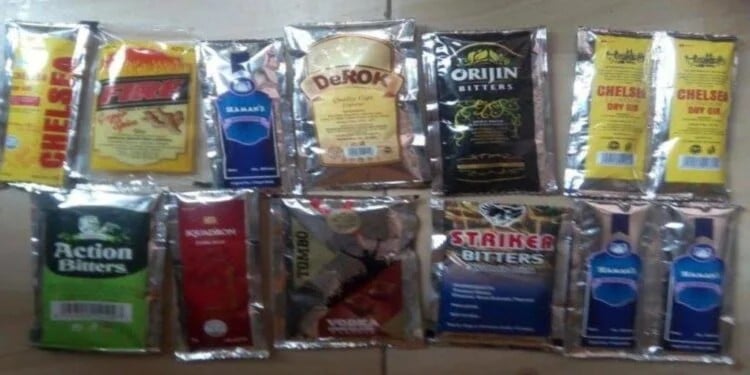
The National Agency for Food and Drug Administration and Control has dismissed as false a publication alleging that the Federal Government directed the agency to suspend enforcement actions relating to the regulation of sachet alcohol and 200ml PET bottle alcoholic products.
The Director General of NAFDAC, Prof Mojisola Adeyeye, in a statement on Wednesday, described the “publication as false, misleading and does not reflect any official communication received by the agency from the Federal Government.”
She said NAFDAC operates strictly within the ambit of its statutory mandate and in alignment with duly communicated Federal Government policies and directives.
“At no time has the agency received any formal directive ordering the suspension of its regulatory or enforcement activities in respect of sachet alcohol products,” the statement read.
PUNCH Healthwise had earlier reported that the Federal Government directed NAFDAC to suspend all enforcement actions relating to the proposed ban on sachet alcohol and 200ml PET bottle alcoholic products.
The report stated that the directive was contained in a statement issued by the Special Adviser on Public Affairs to the Secretary to the Government of the Federation, Terrence Kuanum.
Kuanum said the order followed a joint intervention by the Office of the Secretary to the Government of the Federation and the Office of the National Security Adviser, which raised concerns over the security implications of continued enforcement in the absence of a fully implemented National Alcohol Policy.
The government had also warned the agency to immediately stop sealing factories and warehouses over the issue.
However, in her rebuttal, Adeyeye said the agency remains committed to safeguarding public health, ensuring regulatory compliance and carrying out its responsibilities transparently and in accordance with established laws and due process.
She noted that any decision affecting national regulatory actions will be communicated through official government channels.
The NAFDAC boss urged members of the public, industry stakeholders and the media to disregard the false report and to rely only on verified information issued through the agency’s official platforms and authorised government communication channels.
She also cautioned against the dissemination of unverified information capable of causing unnecessary public anxiety, economic uncertainty or misinterpretation of government policy.
“NAFDAC remains steadfast in its commitment to public health, economic stability and national interest,” Adeyeye said.
It may be recalled that NAFDAC began the enforcement of the ban on the production and sale of alcoholic beverages packaged in sachets and small bottles below 200ml in January in line with the directive of the Senate, which had in November 2025 issued a directive to ban the products in December 2025.
The enforcement has since sparked several protests and agitations that the ban threatened 500,000 direct employees and the disruption of about five million indirect jobs across the value chain, as well as wiping out N1.9trn investment.
PUNCH Healthwise had earlier reported that health experts warned that children exposed to alcohol consumption early in life are highly prone to becoming lifelong alcoholics, with their bodies becoming adapted to alcohol intake from a young age.
The experts noted that early alcohol exposure sets children on a dangerous path that includes organ damage, compromised immune systems, school truancy, criminal associations, risky sexual behaviour and potential graduation to harder drugs like cannabis and methamphetamine.
A 2021 survey conducted by NAFDAC in collaboration with the Distillers and Blenders Association of Nigeria revealed that 54.3 per cent of minors and underaged children buy alcohol for themselves from various sources across the country, with 47.2 per cent of minors and 48.8 per cent of underaged children procuring drinks in sachets.
Based on the study’s findings, NAFDAC insisted that banning small pack sizes, including sachets and bottles less than 200 millilitres, could reduce the menace of underage drinking as these packs are easily concealed by children.
Copyright PUNCH
All rights reserved. This material, and other digital content on this website, may not be reproduced, published, broadcast, rewritten, or redistributed in whole or in part without prior express written permission from PUNCH.
Contact: [email protected]