

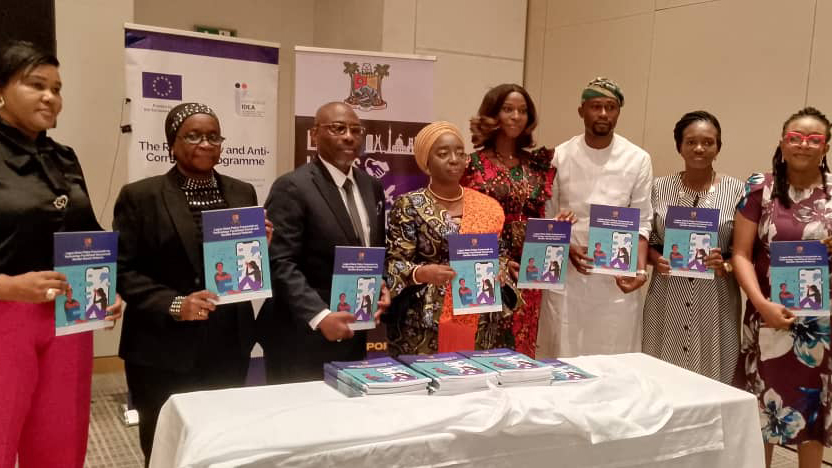
Lagos State Government has launched a new policy on Technology Facilitated Sexual and Gender-Based Violence (TFGBV) to address electronic gender violence and strengthen responses to evolving forms of abuse that extend into digital spaces.
The launch, however, coincided with the World Human Rights Day and the end to the 16 Days of Activism against Gender-based Violence (GBV), themed: “Unite to End Digital Violence Against Women and Girls.”
Wife of Lagos State Governor, Dr Claudiana Ibijoke Sanwo-Olu, while inaugurating the policy, noted that TFGBV is real, evolving, and deeply destructive, particularly for women, children, and vulnerable persons. She stressed that the unveiling of this policy framework is a bold and timely step by Lagos State to protect human dignity in both physical and digital spaces, ensuring that no one is left at the mercy of online predators or digital violators.
“This launch is particularly meaningful to me, coming at a time when we have intensified our collective actions during the 16 Days of Activism Against Gender-Based Violence.
“In the last few days, I have had the privilege of visiting various facilities and community organisations whose work is central to supporting survivors and strengthening our social response systems.
“Some of these centres include the Lagos State Rehabilitation and Training Centre in Majidun, where I emphasised the power of collaboration in addressing SGBV and supporting survivors’ journey to healing.
“I also visited the Community Women’s Right Foundation in Igbogbo, Vision Spring in Ebutte, Ikorodu, and the Juvenile Welfare Centre in Alakara, where I saw firsthand the dedication of frontline workers and pledged support for the upgrade of their facilities.
“These engagements reaffirmed that our fight against SGBV must be holistic, survivor-centred, and sustained across communities, institutions, and policy frameworks, both online and offline,” she said.
Sanwo-Olu described the recent commissioning of the remodelled Police Gender-Based Violence and Family Support Unit at Harold Shodipo Crescent in Ikeja as a significant milestone.
She stressed that the project represents a practical demonstration of commitment under the THEMES+ agenda to build institutional structures that guarantee justice, protection, and timely response for survivors.
“At the commissioning, I reiterated that gender-based violence is not merely an offence; it is a grave violation of humanity and remains one of the most pervasive human rights violations globally.
“The remodelled facility symbolises hope, healing, and renewed strength for countless individuals who need urgent help.”
“It also aligns with the global theme for this year’s 16 Days of Activism, which draws attention to the rapidly growing threat of technology-facilitated gender-based violence and calls on governments, tech companies, civil society groups, and individuals to rise and take action.
“Today’s policy launch is a strong response to that call. This framework will guide government agencies, law enforcement, civil society stakeholders, and digital platforms in coordinating their efforts to prevent digital abuse and ensure effective remedies for survivors.
“It provides the blueprint for a Lagos where online spaces are safe, digital tools are used responsibly, and perpetrators, whether behind screens or on the streets, are held accountable.”
“As we inaugurate the Technical Working Group, I charge its members to pursue implementation with passion, urgency, and unwavering dedication. The success of this policy depends greatly on your commitment to translating the framework into tangible results that improve lives, strengthen institutions, and ensure justice.
“As the Mother of Lagos and as a passionate advocate for the rights and safety of women, girls, and vulnerable persons, I reaffirm my continuous support for all initiatives aimed at eliminating SGBV in every form.
“We will continue to work together to build a Lagos where survivors receive justice without fear, where communities are empowered to speak up, technology is a tool for good, and every person, online or offline, can live with dignity, safety, and hope,” she added.
Also speaking, Executive Secretary of the Lagos State Domestic and Sexual Violence Agency (DSVA), Mrs Titilola Vivour-Adeniyi, noted that technology has not only transformed communication, but it has also introduced new pathways for harm: cyberstalking, non-consensual image sharing, online grooming, digital extortion, and other forms of technology-enabled violations.
She said that these abuses are real, pervasive, and deeply harmful, adding: “As a state, we have a responsibility to ensure that our protections evolve as rapidly as the threats confronting our citizens.
“This event is made possible through the unwavering support from the Rule of Law and Anti-Corruption (ROLAC) programme funded by the European Union (EU) and implemented by the International Institute for Democracy and Electoral Assistance (International IDEA).
“Their commitment to strengthening democratic governance and human rights continues to inspire and elevate our work. We deeply appreciate their partnership throughout the development of this policy.
“It is particularly symbolic that we are launching this policy today, Human Rights Day. Around the world, this day serves as a reminder that every individual has the right to dignity, safety, freedom, and protection; both offline and online.
“The launch of this policy on such a significant day reinforces Lagos State’s commitment to safeguarding the digital rights of its residents and ensuring that technology is not misused to perpetuate harm.
She noted that the launch seeks to formally introduce and disseminate the Lagos State Policy on TFGBV providing a unified framework for prevention, reporting, investigation, and response.
It also enhances the capacity of key stakeholders, including law enforcement and regulatory agencies, civil society organisations, educators, and digital service providers to identify, address, and prevent technology-enabled violations.
It further strengthens collaboration and coordination between government institutions and the private sector in combating online harms and ensuring safer digital spaces for all, increasing public awareness, ensuring that residents of Lagos understand their rights, the forms of TF-SGBV, mechanisms for reporting, and the support services available through the DSVA and our partners.
The launch also reaffirms the commitment of Lagos State to survivor-centred, technology-responsive legislation and policy implementation, positioning the state as a national leader in addressing digital forms of gender-based violence. She, therefore, thanked members of the technical working group for their dedication throughout the policy development process.
Meanwhile, Lagos State Attorney General and Commissioner for Justice, Lawal Pedro (SAN), observed that the unfortunate realities are that TFGBV is moving fast, and thus we must deal with how to curb the threat in Lagos State and respond in real-time to protect the victims and punish the perpetrators.
According to him, TFGBV manifests from childhood through older age, emphasising the need for a life-course approach that reflects the distinct needs of children, adolescents, and adults.
He, however, stressed the need for innovation to prevent TFGBV in our country, particularly in Lagos State, adding that the same social media should be employed to address gender-based violence by a transparent, methodologically sound, comprehensive, and inclusive process.
Pedro reaffirmed the state’s commitment to protection of human rights whether offline or online. He said that perpetrators of digital abuse would not find refuge in anonymity.
In his intervention, the Chief Judge of Lagos State, Justice Kazeem Olanrewaju Alogba, represented by Justice Abiola Soladoye, decried the attitude of some Investigation Police Officers (IPOs) in SGBV matters, and urged the Lagos State Commissioner of Police, Moshood Jimoh, to encourage them to attend court and testify during trials.
Assistant Commissioner of Police (ACP) in charge of Administration in the Lagos State Police Command, Mary Ayim, responding on behalf of the CP, pledged officers’ commitment in SGBV cases, stating that the command has good officers in the gender units, which are actually setting the pace for other gender units in the country right now.
In the last decade, the world has witnessed an unprecedented rise in digital harms. Globally, the United Nations (UN) reports that more than 58 per cent of women have experienced some form of online violence before the age of 30.
In Nigeria, a 2023 study found that nearly one in three young women active on social media have encountered at least one form of digital harassment—whether cyberstalking, non-consensual image sharing, threats, impersonation, or digital blackmail.
These are not abstract statistics. They translate into real fear, real psychological harm, real reputational damage, and in some cases, real physical danger.
