


Ayoola Babalola
Lagos State enforcement teams demolished or removed 1,544 structures illegally built on drainage channels across the city between 2025 and April 2026, according to figures released by the Ministry of Environment and Water Resources.
The Drainage Enforcement and Compliance Department identified a total of 2,218 structures in various communities that were found to be situated on or obstructing drainage alignments.
Of those, 1,544 were successfully cleared, a success rate that the ministry attributed to 70 per cent.
The remaining 30 per cent, roughly 674 structures, were not removed during the period under review. The ministry gave no timeline for when those would be addressed.
The figures were disclosed at the ministry’s annual press briefing held recently at the Bagauda Kaltho Press Centre, Alausa.
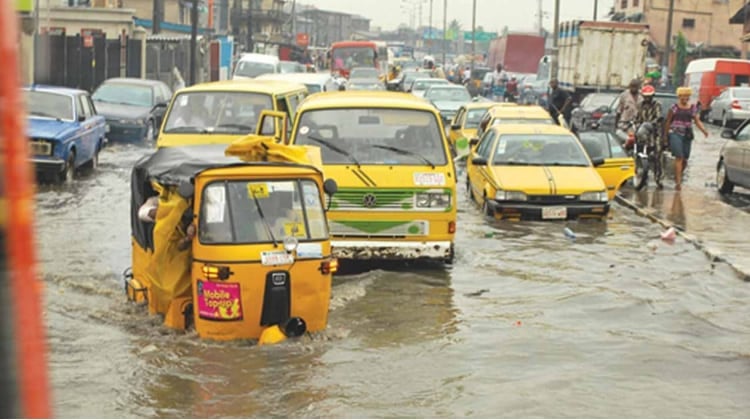
Drainage obstruction is widely identified as one of the primary causes of flooding in Lagos, a low-lying coastal megacity where heavy rainfall regularly inundates communities, damages roads and takes lives.
The city’s drainage network, comprising primary channels that carry water to the lagoon and secondary collectors that feed into them, can only function if the channels remain clear.
When structures are built directly on or beside drainage alignments, water backs up into surrounding neighbourhoods.
In addition to the building removals, the department said it restored 12 kilometres of primary channels and cleared 123.5 metres of right-of-way during the same period.
Separately, rapid-response teams cleaned approximately 210 kilometres of secondary and tertiary drains across all 20 local government areas, including emergency interventions during flooding events.
Nine facilities were also sealed for illegal wetland encroachment in areas including Ogombo, Lekki Phase II, Itoikin-Epe, and Majidun in Ikorodu — developments that officials said would have permanently degraded ecosystems that naturally buffer the city against flooding.
The scale of the enforcement challenge reflects a broader pattern across Lagos, where informal construction has for decades expanded into areas designated for drainage, open space or environmental protection.
Residents and developers who build on drainage channels rarely face immediate consequences, and enforcement has historically been inconsistent.
The ministry said that between April 2025 and April 2026, the state awarded construction contracts for over 100 kilometres of new secondary collector drains and 30 kilometres of primary channels — work that officials say will significantly expand the city’s drainage capacity once completed.
Flooding in Lagos causes losses running into billions of naira annually.
A report cited by the Lagos State Ministry of Finance at a separate briefing this month estimated that climate inaction could cost the city close to $40bn by 2050.
Copyright PUNCH
All rights reserved. This material, and other digital content on this website, may not be reproduced, published, broadcast, rewritten, or redistributed in whole or in part without prior express written permission from PUNCH.