

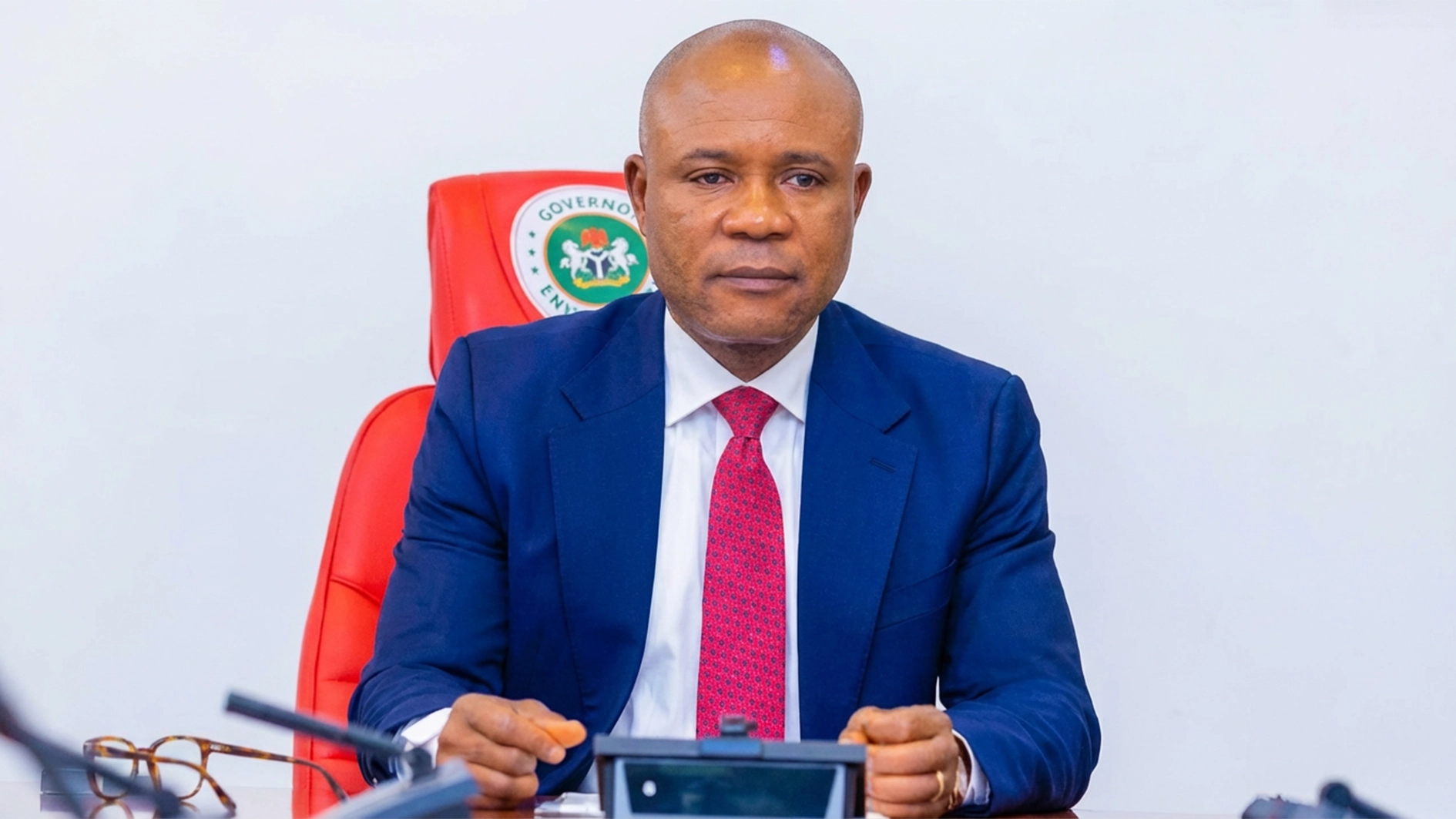
By October 14, 2025, the Enugu State chapter of the All Progressives Congress (APC) was torn between excitement and suspense when the state governor, Dr Peter Mbah, defected from the Peoples Democratic Party (PDP). How far the new ruling party will fare, as well as the impact of intraparty politics on governance from Mbah’s new role as leader, have become subjects of intense speculation, LAWRENCE NJOKU reports.
It is obvious that the All Progressives Congress (APC) in Enugu State never anticipated what hit it in mid-October this year. First, the state executive changed hands, just as the party transited to incumbency, with the current governor, Mbah, becoming its new leader.
What that change meant was that instead of taking orders from the Imo State governor, Senator Hope Uzodimma, to whom the displaced State Working Committee (SWC) was beholden, the new sheriff in town was the same man who defeated the party during the March 18, 2023, gubernatorial contest in the state.
It did not require rocket science to discern the political cataclysm that was to ensue. In a shocking October 10, 2025, statement by the APC National Working Committee (NWC), the elected SWC, led by Ugochukwu Agballah, was dissolved.In its place, a seven-member Caretaker Committee headed by the former State Chairman, Ben Nwoye, was mandated to run the affairs of the party, pending the election of another substantive leadership.
The change of baton at the Enugu APC Secretariat presaged the speculated defection of Governor Mbah. True to the predictions, four days after, precisely on October 14, the Enugu State governor, jettisoned his Peoples Democratic Party (PDP) and formally joined the APC, thus automatically assuming the leadership of the federal ruling party in the state.
With that development, both Agballah and the immediate past Minister of Science, Innovation and Technology, Uche Nnaji, lost control of the party structure. Agballah and Nnaji were loyal to the Imo State governor, Uzodimma, who is incidentally the leader of the party in the South-East, as well as the Chairman of both the South-East Governors’ Forum and the Progressive Governors’ Forum.
Perhaps, it was based on that stalwart position occupied by Uzodimma that Agballah threatened to stonewall Mbah’s entry into the party. Recall that as the APC governorship candidate during the 2023 election, Nnaji had continued to nurture the party after the election, ostensibly in readiness for a repeat contest against Mbah in 2027.
In what came as double jeopardy, Nnaji, who was the APC leader in the state by virtue of his governorship attempt, had resigned his ministerial appointment following the scandal surrounding the falsification of his educational certificates and qualifications.
However, before the ordeal that eventually claimed his office, Nnaji had transformed APC in the state, such that from its inability to win any elective offices in the 2023 general elections, the party was hopeful of changing the narrative with the power of federal might. That APC became attractive to elected officials from other political parties at the State and National Assemblies, and the scale of other defectors in the state enhanced that thinking.
It was the growing support and membership the party amassed that led to the open and stout opposition to Governor Mbah joining the party by the duo of Nnaji and Agballah when the matter came to the fore. But Nwoye, who had earlier jettisoned the party, was in the vanguard of the campaign for Mbah to be admitted into APC, and had criticised Nnaji and Agballah for the dismal reputation APC was enjoying in the state.
The entry of Mbah and dissolution of the state executive had dawned on Nnaji and Agballah that, unless they moved fast, they would completely lose grip of everything concerning the party they contributed to building. As such, they had regrouped to confront the leadership of the party. And in fact, while the national leadership of the party was in the state, receiving Mbah and all those that defected with him, the Nnaji and Agballah group stayed away. They had planned to address a press briefing after a meeting on that day to counter the action of the NWC, and their readiness to challenge the party in court.
Unfortunately, before they could arrive, security officials had been deployed to cordon off the venue slated for the meeting and arrest anyone in sight.
Some officials of the party, including Agballah’s aide, were arrested. Agballah himself narrowly escaped arrest as he had left his residence minutes before the arrival of the security officials.
Perhaps, knowing the danger that lay ahead should the aggrieved APC members resort to court, the immediate past governor of the state, Ifeanyi Ugwuanyi, intervened. He had arranged a meeting in his residence for Mbah and Agballah. This meeting had arrived at a truce several hours after. It agreed to accommodate members of the Agballah-led APC in the new Caretaker Committee of the party, as well as his other interests.
Therefore, of the nine-member local and ward caretaker committees, PDP, which Mbah was bringing into the fold of the APC, was to supply five members, while the APC was to bring four. That of the APC was split further, with Agballah nominating two names and Nwoye also two names.
Fractionalisation scare
PART of the challenge the APC has faced in the state since it was infiltrated by joiners from the PDP is that its members have continued to act independently and remain aligned with the structures that produced them. Integrating the party members into the new platform to understand that they are now one has remained a huge task.
The division among them is more noticeable during public gatherings involving the party. The sitting arrangement alone provides an inroad into the quiet discontent among the members, especially the women’s group. Although their women dress in the party’s uniform at functions, each of the groups sits only with those members from their original platforms.
At times, it becomes difficult to control the cacophony of music being supplied from the two camps during public gatherings as each sings to eulogise their members. Shouts of “our own”, or “Onye di Okay” (one contented) normally dominate the atmosphere when a highly placed official is announced to speak. In such gatherings, while those originally from the APC try to dictate the pace to indicate that they own the party, those previously from the PDP also attempt to show that they were responsible for forming the government in the state.
Aside from this, feelings of abandonment persist among the members. Appointments made so far by the governor are still from members of his former PDP who worked to ensure his victory at the polls. Those who were serving at various party offices before the state executive dissolution and could not benefit from the recently constituted caretaker committees feel neglected and marginalised. They had continued to press certain party leaders to intervene in their case by integrating them into the new arrangement.
It was apparently to protect those loyal to him and probably to assert control of his ward that a foundation member of the party, Osita Okechukwu, recently asked Governor Peter Mbah not to indulge certain stakeholders of the party, whom he regarded as “political bandits” led by Agballah, in the composition of the Caretaker Committee. Okechukwu was among those suspended by Agballah when he took over as chairman of the party for allegedly engaging in anti-party activities.
Okechukwu, who was particularly sad about the arrangement that saddled Agballah with the responsibility to nominate two members to the Caretaker Committee, had queried the rationale for it when he (Agballah) did not allegedly work for the party while he presided over its affairs.
He had produced the result of the last general elections, where the party secured 4,722 votes during the presidential election, to justify his case, alleging that Agballah’s “hostile leadership style drove many party members away and contributed to the lowest presidential vote tally in the country”.
Insisting that equity and fairness should be ensured in the composition of party executives, Okechukwu added that if the governor rates “Agballah so highly despite widespread reservations, then His Excellency should, as a matter of fairness, allocate two slots to him from the five slots belonging to the PDP”.
Those who read Okechukwu’s statement between the lines agreed that he may have spoken the minds of some aggrieved leaders of the party who made no contributions to the Caretaker Committee, alleging that Agballah had “single-handedly drawn up the list and submitted same to Governor Mbah since he never resorted to those he fell out with in the party”. Agballah ensured that the likes of Okechukwu and many others who formed the party remained suspended and out of relevance in the party throughout his leadership in the state.
However, Agballah, who responded swiftly to the allegations, told those who cared to listen that he served the party to the best of his ability, stressing that there were more than 200 political wards that had no APC presence when he took over the leadership of the party.
“Everybody who accepts me as the leader of the party is already cooperating with the Caretaker Committee, which comprises nine members. The party executive was duly consulted by the governor, who requested we make nominations, and he has accepted the list, and those people who are part of the Caretaker executive are already working with the governor to grow the party. If Osita is unhappy with what we did, he has the opportunity to make his own nominations,” Agballah stated.
Agballah insisted that Okechukwu had not been part of the APC since 2021, stressing that he (Agballah) would not want the situation that prevailed before he assumed leadership of the party in the state to continue. He insisted that he ran a disciplined party, “where there was zero tolerance for fifth columnists and moles, and I am very proud of it.”
Recalling the activities of some characters during his tenure, Agballah said, “all of them tried to undermine the growth of the party, but they could not succeed. I have decided to stay with the party, even though I have been removed as chairman, even though my executive was dissolved, and even though the dissolution was illegal. I have decided to stay back to give support to the Caretaker Committee members and would not undermine them. Most of the Caretaker Committee members played major roles in trying to undermine my leadership, but God did not give them a breakthrough. We continued to grow in leaps and bounds. As a Christian, I will not retaliate and will not do to them as they did to me.”
Notwithstanding the inherent challenges, the Ben Nwoye-led State Caretaker Committee has continued to advance the party’s course, even as stakeholders continue to wish that the defection had never occurred.
However, the Nwoye Caretaker Committee had concluded the inauguration of caretaker executives in the 17 local government areas and 260 wards of the state and had not hidden their intention to leave the party better.
Already, the party has concluded training for 1,300 ward e-registration agents with a vow to register 1.5 million new members in the state to boost its membership base. The e-registration is also aimed at boosting the party’s chances in the upcoming state elections.
A few days ago, the Commissioner for Innovation, Science and Technology in the state, Dr Lawrence Ezeh, gifted the party a fleet of buses and cash to facilitate their mobilisation and logistical needs.
The fleet consisted of one Coaster bus and four Toyota Hiace buses. While the women’s wing received the Coaster bus, the youth wing took delivery of a Hiace bus, and the remaining two buses were designated for administrative and mobilisation activities across the state. The Commissioner also handed out a cash of N50 million to enable the party operate effectively.
While the party is poised for next year’s congress to usher in a new elected executive, Nwoye had continued to appeal to the members to unite for the purpose of delivering at every election and deepening its hold in the state.
