



By Stephen Angbulu
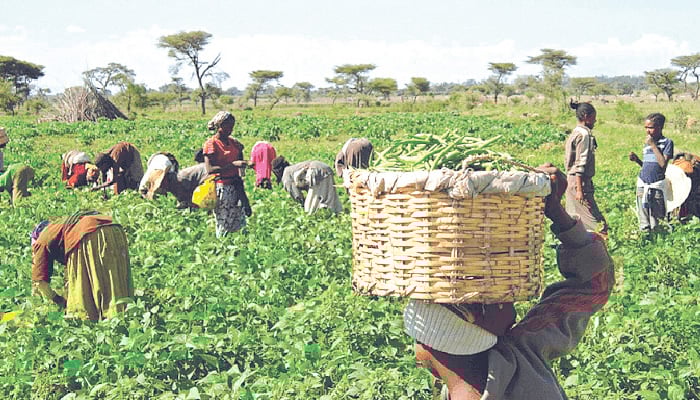
Farmland under cultivation across 13 pilot states fell 36 per cent below intended production levels during the 2025/2026 dry season, Sunday PUNCH can report.
According to newly validated data by the National Agribusiness Policy Mechanism, the shortfall was driven largely by farmers’ inability to access financing, rising input costs and growing climate-related pressures on dry-season farming.
The data, validated at a three-day NAPM Stakeholders Planning and Validation Workshop held in Ado Ekiti, was obtained by Sunday PUNCH from the Presidential Food Systems Coordinating Unit, which operates from the Office of the Vice President.
According to the Food and Agriculture Organisation, the country’s total cultivated land is estimated at approximately 34 million hectares.
Findings reveal that a 36 per cent shortfall across the 13 NAPM pilot states, which include major food-producing states, amounts to 12,240,000 hectares falling short of planned production targets.
The report showed that rice cultivation alone, which covers approximately 4.6 million hectares nationally, according to data from the Coalition for African Rice Development, recorded a 36 per cent gap, translating to roughly 1.65 million hectares of rice farmland falling short of potential output, equivalent to nearly four times the landmass of Lagos State.
Between 70 and 76 per cent of farmers surveyed identified access to capital as the single greatest constraint on production, while erratic weather patterns and rising irrigation costs compounded the challenge.
The findings come amid multiple distress signals released by the PFSCU’s early-warning system in late 2025, warning of climate-linked risks to dry-season farming.
Sunday PUNCH had reported in February that over 3,500 farmers across major rice-producing states, including Kebbi, Niger, Sokoto, Zamfara and Katsina, abandoned rice cultivation entirely for the 2026 dry season, citing accumulated losses estimated at N93bn.
Farmers recorded losses of N20,220 per hectare during the 2025 wet season, according to the PFSCU’s 2025 Major Wet Season Impact Report.
Despite the cultivation shortfall, the data showed that productivity per hectare improved across focus crops, suggesting that farmers who remained active adopted more intensive and adaptive farming practices.
The report said maize production recorded a 14.97 per cent increase, driven by improved inputs and a significant geographic expansion into southern states.
In parts of the South-West and South-East, maize accounted for over 70 per cent of dry-season cultivation.
At the workshop, the Executive Secretary of the National Agricultural Development Fund, Muhammed Ibrahim, argued that there was a growing disconnect between institutional mandates and farmer priorities.
He said, “The farmer in Ekiti, Borno or Benue does not care which agency delivers. They care that food is available, affordable and produced sustainably.”
Ekiti State Commissioner for Agriculture and Food Security, Ebenezer Boluwade, said more engagements would be required to close that gap.
“The workshop is designed as an opportunity to improve and accelerate our efforts, stabilise existing challenges, strengthen Nigeria’s resilience and respond effectively to food security issues while building a sustainable system,” he said.
The exercise brought together federal and state ministries, departments and agencies, development partners and private sector stakeholders as the NAPM pilot, launched in May 2025, enters its concluding phase across the 13 participating states.
Earlier surveys conducted under the NAPM Cycle 3, covering 33,507 farmers across the 13 states, had shown that 10.6 per cent of rice farmers intended to scale back production during the dry season.
The PFSCU subsequently deployed state focal persons across the pilot states in late March to deepen intelligence gathering and coordinate a targeted intervention response.
In an earlier interview with our correspondent, Coordinator of the NAPM and Technical Assistant to the President on Agriculture, Marion Moon, warned that the profitability drawing farmers away from food staples toward export crops such as sesame seed could be short-lived.
“If everyone starts to go into sesame, the prices will crash, and profits will shrink again,” she said.
The PFSCU had recommended the activation of a Dry-Season Rescue Programme for maize and rice, proposing subsidised or guaranteed inputs, targeted irrigation support and structured financing to stabilise production and prevent further migration of farmers away from food crops.
Copyright PUNCH
All rights reserved. This material, and other digital content on this website, may not be reproduced, published, broadcast, rewritten or redistributed in whole or in part without prior express written permission from PUNCH.
Contact: [email protected]