





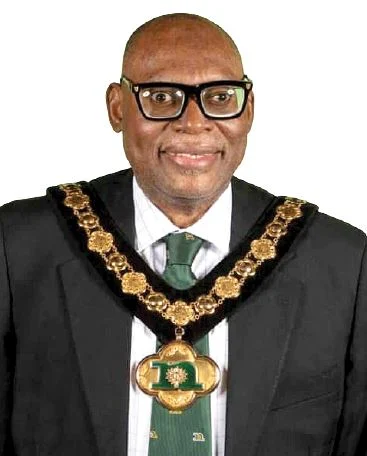


Newly elected Chairman of Nottinghamshire County Council in the United Kingdom, Christopher Adegoke, speaks with DARE AKOGUN on becoming the first Black and minority person to occupy the position since the council’s establishment in 1889
Congratulations on your emergence as the first Black and minority Chairman of Nottinghamshire County Council since its establishment in 1889. How significant is this moment for you personally and for the Black community in the UK?
This is a very important milestone achieved through the grace of God. It is a significant moment for me personally and, as a member of the minority community, I am truly honoured to have been given the opportunity to occupy this position.
I believe it sends a strong message that people from diverse backgrounds can attain positions of leadership through commitment, hard work, integrity and service to their communities.
You are an indigene of Koro in Kwara State and an alumnus of the University of Ilorin. Tell us about your upbringing and how your early life shaped your leadership journey.
My father, the late Olu Koro of Koro, Oba Elijah Adegoke Oyun, strongly believed that education could take anyone to the highest level of their chosen career. He ensured that all his children attended good schools and received the best education he could afford at the time.
I remain deeply grateful to him for his sacrifices, guidance and unwavering commitment to our future. Those values of discipline, responsibility and respect for service have remained with me throughout my life and continue to influence my approach to leadership.
Did you spend most of your formative years in Nigeria or the United Kingdom, and how did those experiences influence your worldview and political aspirations?
I spent my formative years in Nigeria. I was born in Kaduna and attended St. Michael’s Primary School there before moving to Lagos when my father was transferred through his work. In Lagos, I attended St. John’s Aroloya for a few years before relocating again with my father to Ilorin, Kwara State, where I enrolled at St. Barnabas Primary School, Sabo Oke.
After primary education, I gained admission to ECWA Secondary School, Igbaja, before later transferring to Government Secondary School, Ilorin. From there, I proceeded to Kwara State Polytechnic, where I became the first Marshal of the institution’s Jazz Club. I later attended the University of Ilorin, where I obtained a Bachelor’s Degree in History and subsequently a Master’s Degree in Public Administration.
Living and studying in different parts of Nigeria exposed me to diverse cultures, traditions and communities. Those experiences broadened my understanding of people and strengthened my passion for public service and community development.
Looking back at your childhood and educational journey, what experiences best prepared you for public service and leadership?
Some of the defining moments were my academic pursuits and the life experiences that accompanied them. Like many young people, the journey was not without challenges, but by God’s grace, I was able to overcome them.
Those experiences helped to build resilience, discipline, perseverance and a sense of responsibility. They taught me the value of hard work and prepared me for the demands of leadership and public service.
What inspired your interest in politics and community leadership in the United Kingdom?
I come from a family with a strong tradition of leadership and community service. My father was an Oba, while some of my senior siblings have gone on to become respected leaders in the religious and educational sectors.
I also had an uncle and a cousin who served as local councillors in the Koro-Ekiti area, supporting their communities and contributing to local development. Given that background, it felt natural for me to follow a similar path. Today, I am privileged to serve my local community as a county councillor and now as chairman of the council.
Migrants and minorities often speak about challenges relating to integration and representation. Did you encounter discrimination or barriers during your political journey, and how did you overcome them?
I believe such experiences can be relative. However, many people overcome challenges by being honest, approachable, kind and willing to support others. When people see that you are sincere, humble and disciplined, they are often willing to work with and support you.
On the other hand, behaviours such as dishonesty, indiscipline and criminality can create unnecessary barriers. My focus has always been on serving people genuinely and building trust within the community.
Before becoming chairman, what would you consider your biggest achievement as a councillor?
For me, it has always been about the quality of service I provide to the community and my commitment to helping people. The greatest achievement is knowing that I have consistently dedicated my time and energy to supporting residents, addressing their concerns and contributing positively to the development of the community.
Beyond politics, what other passions and interests define you?
I am very much a family man. I particularly enjoy spending time with my young daughter. I was blessed with her later in life and she has brought renewed energy, purpose and motivation into my life. Rather than slowing me down, she inspires me to keep working hard and remain focused on creating a better future for the next generation.
As someone with Nigerian roots holding a prominent political office abroad, how connected are you still to Nigeria, particularly Kwara State?
I remain strongly connected to Nigeria, and especially to Kwara State. My heritage, family roots and upbringing are deeply important to me. No matter where one lives, one never forgets where one comes from. I continue to maintain close ties with people back home and remain interested in developments that affect the state and the country as a whole.
What lessons can Nigerian politicians and public office holders learn from the governance system in the United Kingdom?
I believe politicians in Nigeria need to place greater emphasis on service delivery and the welfare of the people.
As we do in the United Kingdom, there should be sustained attention to infrastructure, road maintenance, public safety and creating an environment that enables businesses and enterprise to flourish.
Leadership should ultimately be about improving the quality of life of citizens through practical and measurable outcomes.
Nigeria continues to grapple with governance challenges, youth unemployment, insecurity and declining public trust in institutions. What is your assessment of the country’s political landscape?
Nigeria’s political environment can sometimes be controversial, but I believe there are many good people who genuinely want the country to succeed and who are committed to serving the public interest. Creating opportunities and support systems for such individuals should be a priority. With the right leadership, accountability and commitment to development, Nigeria has enormous potential for progress.
Many young Nigerians are becoming disillusioned with politics. What advice would you give to youths interested in governance and leadership?
Young people should not give up on politics. They need to understand that if they do not participate by supporting and voting for credible candidates whom they believe can move the country forward, they cannot completely distance themselves from the consequences of poor governance. The future belongs to young people, and they must be prepared to engage constructively in the democratic process.
Diversity and inclusion have become major global issues. What does your emergence as chairman say about representation and opportunities for minorities in British politics today?
It demonstrates that diversity and inclusion are valued and recognised in British politics today. Becoming the chairman of Nottinghamshire County Council is a rare privilege, and it shows that opportunities exist for people who are honest, hardworking, sincere and committed to serving their communities.
It reinforces the belief that leadership positions should be accessible to everyone based on merit and service, regardless of background.
How do you intend to use your office as the chairman and first citizen of Nottinghamshire to promote inclusivity, community development and stronger engagement with residents?
I intend to continue serving the people and ensuring that no one is left behind. We stand for everyone, regardless of their background or circumstances. I will do my utmost to represent Nottinghamshire effectively at the local, national and international levels while promoting inclusion, community engagement and opportunities for all residents.
Finally, what message do you have for young people from Kwara State and Nigeria who see your journey as proof that global leadership is possible regardless of background?
My message is simple: never give up on your dreams. Remain realistic, responsible and resilient in your pursuit of success. There will be challenges along the way, but determination, discipline and hard work can open doors you never imagined possible.
Young people in Kwara State and across Nigeria have enormous potential. If they remain focused and committed, they can achieve even greater heights and make meaningful contributions both at home and across the world.


