



The African Group of Negotiators on Climate Change has accused countries advocating a complete phase-out of fossil fuels of hypocrisy, alleging that some of them are simultaneously pursuing behind-the-scenes deals to secure petroleum supplies.
The group on Thursday said countries pushing for an end to fossil fuel production and consumption must demonstrate consistency between their public climate commitments and private energy arrangements, warning that the conflicting positions were undermining trust in the global climate negotiations.
The African negotiators also insisted that the transition away from fossil fuels must reflect the continent’s economic realities, protect workers and farmers, and allow African countries to process and utilise their natural resources rather than impose additional development burdens on them.
The position comes as negotiations at the 31st United Nations Climate Change Conference in Antalya, Türkiye, approach their conclusion, with disagreements over fossil fuels, climate finance and the pace of the global energy transition remaining major issues.
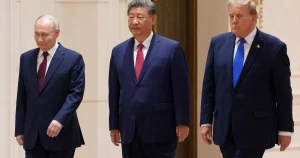
His remarks followed reports of a new trilateral declaration issued by China, the United States and Russia on Thursday after an unprecedented summit hosted by Chinese President Xi Jinping in Shenzhen, attended by US President Donald Trump and Russian President Vladimir Putin.
The declaration reportedly included commitments to pursue talks on nuclear risks, increase petroleum supplies and advance reforms of the United Nations.
The proposed cooperation on petroleum supplies was linked to efforts to strengthen global refined petroleum availability amid energy market pressures arising from the conflict involving Iran and disruptions around the Strait of Hormuz.
The reported agreement drew criticism at COP31 from the European Union’s climate chief, Wopke Hoekstra, who described the development as unfortunate and urged countries to invest in domestic clean energy to avoid repeating energy supply shocks.
But speaking during a press conference, the Chair of the African Group of Negotiators, Nana Dr Antwi-Boasiako Amoah, described the contradiction between countries’ climate rhetoric and their pursuit of petroleum supplies as hypocrisy in the global climate process.
Although he declined to comment specifically on the reported petroleum supply arrangement involving China, the United States and Russia, Amoah maintained that his criticism was directed at what he described as inconsistencies in countries’ overall approach to fossil fuel production and supply.
He said, “For China and U.S. issues, I don’t have information about it. But I’m just commenting on fossil service in total as parties. This is the hypocrisy in the whole process. And so at one point, you see some countries talking about taking fossil out completely, and the underground making deals to get fossils service in their pipelines. And that is the hypocrisy that we have in this whole process.
“So if fossil service is something that we want to do away with as parties, let’s be honest to our commitments. Let’s stay with it head on, not to be going back doors to do certain things and later come back and make it look awkward in the face of the other people. That is hypocrisy.”
Amoah added that the continent’s participation in COP31 was guided by the need to protect multilateralism, secure the means to implement climate commitments and ensure that the transition was just and credible.
He said, “Our first point of call is the protection of multilateralism. Africa feels safe to be under multilateralism because this is the only place that we can function properly as a people. And therefore, any attempt, any plans to destroy this process is a red line for us as Africa.
“We also came to this COP with understanding that this COP would deliver for implementation. And in view of that, our slogan to the COP presidency is implementation meets means of implementation.”
He argued that countries responsible for providing climate finance must match their commitments with actual financial support, particularly for adaptation programmes in vulnerable developing countries.
“If the presidency is talking about implementation, it means that parties that have responsibility to deliver means of implementation must keep to the language of the COP presidency to deliver this on the ground. This is why and how climate finance is very important, especially adaptation finance,” he added.
The African group also called for a just transition that recognises the continent’s development priorities, including employment protection, local industrialisation and the use of its natural resources to support economic growth.
Amoah said any transition that placed an unfair burden on African countries would be rejected, stressing that the process must be designed around the continent’s specific circumstances.
He said, “We also came with understanding that this COP would deliver a just and credible transition. So any transition that is going to be burdensome to the African continent is rejected.
“And therefore, the just transition conversation might be situated within the African context where our farmers are protected, our workers are secured, African resources are given space to be processed and utilised within the continent, then also credible institutional structures are layered within the transitional process.”
The group further warned that the effects of rising global temperatures were disproportionately severe for Africa, making adaptation an urgent priority even as countries pursue emissions reductions.
According to Amoah, the implications of global warming and temperature overshoot must be assessed in relation to their effects on African economies and communities, rather than focusing exclusively on mitigation targets.
He said, “We are also saying that adaptation is very important because currently we are talking about overshoots of temperature. Even within this context of 1.5 or just above 1.5, we have implications.
“For Africa, 1.5 translates into 4 degrees, 4.5 degrees in southern geographical context in the African region, meaning that the overshoot is going to bring even much harsher conditions to the African continent.”
He explained that greenhouse gases remained in the atmosphere for extended periods, meaning that the consequences of excessive emissions would continue to affect countries and future generations long after the gases were released.
“Our understanding is that greenhouse gases have a much longer life within the atmosphere. Some gases can be out there for over 500 years, some 300 years.
“Even methane that is a short-lived pollutant can stay within the environment for at least 20 years. And so overshooting the temperature growth means that we are overshooting the impacts that affect our continent. And this is something that we want to see clearly articulated in any languages that is available in this space,” he said.
The Paris Agreement, adopted in 2015, established the international framework for limiting global warming to well below 2 degrees Celsius above pre-industrial levels while pursuing efforts to restrict the increase to 1.5 degrees Celsius.
However, negotiations over how quickly countries should move away from fossil fuels have remained contentious, particularly between developed economies and developing countries whose industrialisation, energy access and public revenues still depend significantly on oil, gas and coal.
African countries have consistently argued that a fair transition must recognise their limited historical contribution to global emissions, development needs and the need for adequate financial and technological support.
The continent has also maintained that climate action should create opportunities for local manufacturing, value addition and employment rather than restrict its ability to benefit from its natural resources.