





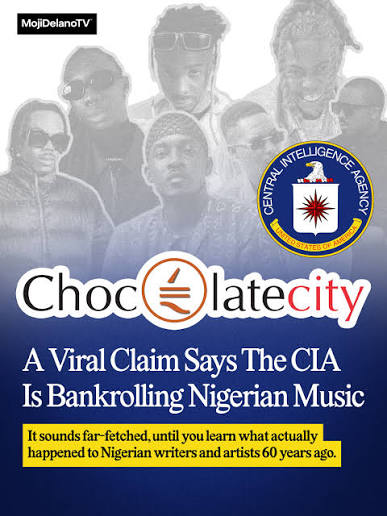
It sounds far-fetched, until you learn what actually happened to Nigerian writers and artists 60 years ago.
For months, a rumour has been spreading that major Nigerian record labels like Chocolate City are secretly funded by the CIA and the U.S. government to influence African youth.
Although it seems unlikely, the claim comes from a former U.S. official who points to real historical events, prompting the record label to publicly deny the rumor recently.
So we did what MDTV always does: we separated the verified from the viral. Here’s the full story and the 60-year history that makes this more complicated than a simple “true or false.”
The Spark
Chocolate City, home to top stars like Blaqbonez, Young Jonn, and M.I Abaga, issued an official statement addressing rumors that it is secretly funded by the Central Intelligence Agency (CIA) and linked to Universal Music Group (UMG).
While the 20-year-old Nigerian record label didn’t name who started the claim, it firmly denied the allegations and clarified its independent ownership structure.
The rumour had been building momentum for months, and by mid-September 2026, it became too widespread for the respected music company to ignore without going on the record.
The claim traces to Mike Benz, a former U.S. State Department official (he worked briefly there in 2018) who now runs the Foundation for Freedom Online.
In a viral video, Benz claimed that the CIA has long used music and art to influence people. He pointed out that during the Cold War, the U.S. government funded concerts and cultural programs to show off Western culture, and he argued that similar government-backed music programs are still happening today.
For context, Benz often shares similar theories about hidden government control. For instance, he previously claimed that the decline of rap music was linked to the Trump administration cutting funding for the U.S. Agency for International Development (USAID).
He built his reputation claiming the government ran a massive censorship campaign during COVID-19 and the 2020 election. Experts question his track record, so while his latest claim might still be true, it’s best to view it with some healthy skepticism.
Who Amplified It In Nigeria?
The claim didn’t stay in American media circles as Nigerian journalist David Hundeyin picked it up and pushed it hard on X, directly referencing a Benz livestream clip titled “Mike Benz On The US Government Program Producing Music Industry Plants.”
He framed it as evidence that certain artists’ rapid rise wasn’t purely talent-driven while accusing critics of protecting Chocolate City’s interests rather than engaging with the claim.
Worth knowing: Hundeyin has his own controversy history after he was dismissed from a Cambridge fellowship in 2023 following an investigation into his conduct, after attendees accused him of making misogynistic and sexist comments at an event.
Again, this is not a verdict on the claim itself, but part of assessing who’s carrying it and why.
Read Also: The Great NIMC Denial: Why Your NIN Data Is Selling For ₦100 Despite “Unhackable” Firewalls
Here’s the part that’s real, not alleged: the U.S. State Department, in partnership with the Recording Academy, did launch the American Music Mentorship Program (AMMP), which is a deliverable of its “Global Music Diplomacy Initiative”.
It brought together 20 mid-level music professionals (producers, executives, lawyers, talent agents and promoters) from Egypt, Ghana, Kenya, Morocco and Nigeria to work with Recording Academy experts on things like intellectual property rights and AI’s impact on the industry.
Participants were vetted and selected by U.S. embassies in their home countries, and the two-week program was based at the Recording Academy’s Los Angeles headquarters, including visits to Google/YouTube, Cultural Agencies & Affairs, and Apple’s Culver City campus.
So, a real U.S. government music-industry program, involving Nigeria, does exist. That’s not in dispute.
The Gap Between “Real” And “Proven”
What we could not independently verify: that Chocolate City specifically was a named AMMP beneficiary, or that any Nigerian label received CIA funding, control, or direction as opposed to standard state-department cultural diplomacy.
AMMP’s public materials describe workshops and networking, not funding grants, editorial control, or ownership stakes.
This is the main point of the whole debate: just because a government music program exists today, and just because the CIA secretly used art programs during the Cold War, doesn’t mean a specific record label is being controlled today.
Correlation, historical pattern, and proof are three different things, and right now, only the first two are confirmed.
Chocolate City’s Defense
Chocolate City responded via its official X account, stating plainly that the allegations were false while insisting it has never had any contractual relationship with UMG. The label also rejected any suggestion that it is funded, controlled, or directed by a foreign intelligence agency or state actor.
It described itself as wholly Nigerian-owned and independent, built over two decades through commercial partnerships, not covert financing.
It is also worth noting that Chocolate City’s actual business deals are fully public and normal.
These include a 2025 agreement with Nigeria’s Federal Ministry of Arts, Culture, Tourism and the Creative Economy to rebuild the National Film Institute, aimed at creating jobs and growing the economy, and a 2019 distribution deal with Warner Music Group. None of these records show any funding or connection to the CIA.
Why This Isn’t A New Story: The 1961 Lagos Festival
The suspicion Benz is tapping into builds on real, documented history in Nigeria. In 1961, an organization called the American Society of African Culture (AMSAC) opened an office in Lagos. It hosted a massive two-day arts festival that brought famous African-American performers together with top Nigerian artists, framing the event as a celebration of Pan-African culture and unity.
AMSAC had so much money to throw around that locals began calling it “Uncle Moneybags.” However, in 1967, public reports exposed that AMSAC was funded almost entirely by the CIA through secret pass-through grants. This was in order to gain support from African leaders, polish its image on race relations, and push back against Soviet influence. Most of the artists involved had no idea the CIA was paying them.
That programme is why claims about U.S. government involvement in the arts still sound believable to many people today.
The same pattern touched Nigeria’s literary golden age. The Mbari Writers and Artists Club in Ibadan (founded 1961) was home to Wole Soyinka, Chinua Achebe, Christopher Okigbo and others in a genuine renaissance of postcolonial African writing.
Its financial backbone, and that of its literary journal Black Orpheus, ran through the Congress for Cultural Freedom (CCF). The CCF was an organization later exposed as a CIA front waging ideological war against Soviet influence, with money routed through a shell entity called the Farfield Foundation.
The CIA didn’t tell writers what to write. They simply:
• Decided who got funded.
• Decided who got a platform.
• Let those chosen voices shape the culture.
Then Vs. Now
So how comparable is this, really?
Target Audience:
• 1960s: Writers and intellectuals.
• Today: Musicians and record labels.
Organisations Involved:
• 1960s: Congress for Cultural Freedom and AMSAC (both confirmed CIA fronts).
• Today: AMMP (a confirmed U.S. State Department program, but with no proven secret links).
Goal:
• 1960s: Counter Soviet influence.
• Today: Counter Chinese and Russian influence (alleged, not proven).
Strategy:
The strategy is identical in both eras: instead of controlling the art, they fund and mentor the people who control the platform. By backing industry gatekeepers, the culture you create naturally reflects what they want, without ever having to tell an artist what to make.
Proof:
• 1960s: Backed by official government documents and proven history
• Today: Based only on a live video, viral social media posts, and a public denial
So What Would The Goal Actually Be?
In the 1960s, the CIA didn’t need to dictate what Achebe or Soyinka wrote, but by deciding who got published and invited to festivals, it determined whose work reached the biggest stages. Audiences absorbed the result as culture, not propaganda.
The 1960s goal was blocking Soviet influence. A modern equivalent for Nigerian music (hypothetical and unproven) would carry an identical goal of shaping the sounds that define a generation before rival powers like China or Russia can.
A country’s music and heroes are its most persuasive export because no one feels lectured by a song they love.
That is what really matters here. It’s not about one label taking a call from spies, but how easily the people controlling the platform can influence what a whole generation listens to and believes.
The Diplomatic Case
Unlike Cold War CIA fronts, the State Department isn’t hiding the American Music Mentorship Program (AMMP). It offers mentorship and networking (not direct funding or editorial control) to help music professionals in five nations, including Nigeria.
Cultural diplomacy is standard soft power and the U.S. openly models AMMP on Cold War programs like the Jazz Ambassadors, much like France uses Francophonie or China uses Confucius Institutes.
The debate isn’t whether AMMP exists, but what it does. Its 2026 funding notice explicitly states its goal is to advance U.S. strategic interests and promote American values. Questioning where legitimate cultural exchange ends and quiet influence begins is a fair debate for Nigerians to have and it’s written right into the policy itself.
Whatever the geopolitics, there’s a mundane truth underneath: Nigerian labels have historically operated with weak copyright enforcement, thin local capital markets, and limited access to global distribution infrastructure.
When international funding, or distribution offers arrive, many labels take them because the alternative is staying small in a market that doesn’t reward staying small.
That doesn’t prove foreign control. However, critics point out that the real issue is relying on foreign money and platforms can quietly influence people’s choices, even without any secret agreements.
With its young demographics, Africa has become a frontline for international influence and world powers openly acknowledge this strategy in their foreign policy.
China’s infrastructure-led Belt and Road approach, Russia’s expanding security partnerships, and Western reliance on media, education, and cultural programming as its comparative advantage are all publicly acknowledged strategies, not secret ones.
Music and youth culture are part of this struggle because they reach far more young Africans than any official government statement ever could.
That’s the environment this controversy is unfolding in, even if the specific claim about Chocolate City remains unproven.
What We Still Don’t Know
We don’t know who first connected Chocolate City by name to AMMP, whether any documentation supports that specific link, or whether Benz’s claim is based on verifiable sourcing or inference from the program’s existence. Chocolate City has denied it unequivocally.
Neither Benz nor Hundeyin has published primary documentation tying the label to CIA funding specifically, as opposed to the general existence of the State Department program.
Until someone produces a document, contract, or a funding record, this remains an allegation resting on historical pattern-matching. This is, however, a legitimate line of inquiry, but not proof.
Nigeria’s creative economy is genuinely being courted by the U.S., China, the UK, and others bu whether that courtship crosses into covert influence over specific companies is a much harder claim to prove, and right now the receipts aren’t there.
What we can say for certain is that cultural funding has been a real tool of foreign statecraft in Nigeria before, and the labels and platforms shaping what young Nigerians hear, believe, and aspire to deserve the same scrutiny we’d apply to any other institution with that much reach.
So we’re asking you directly: Should Nigerian creatives be required to publicly disclose foreign government funding or partnerships or does that scrutiny only make sense once real evidence exists?
Drop your thoughts in the comments section.


