

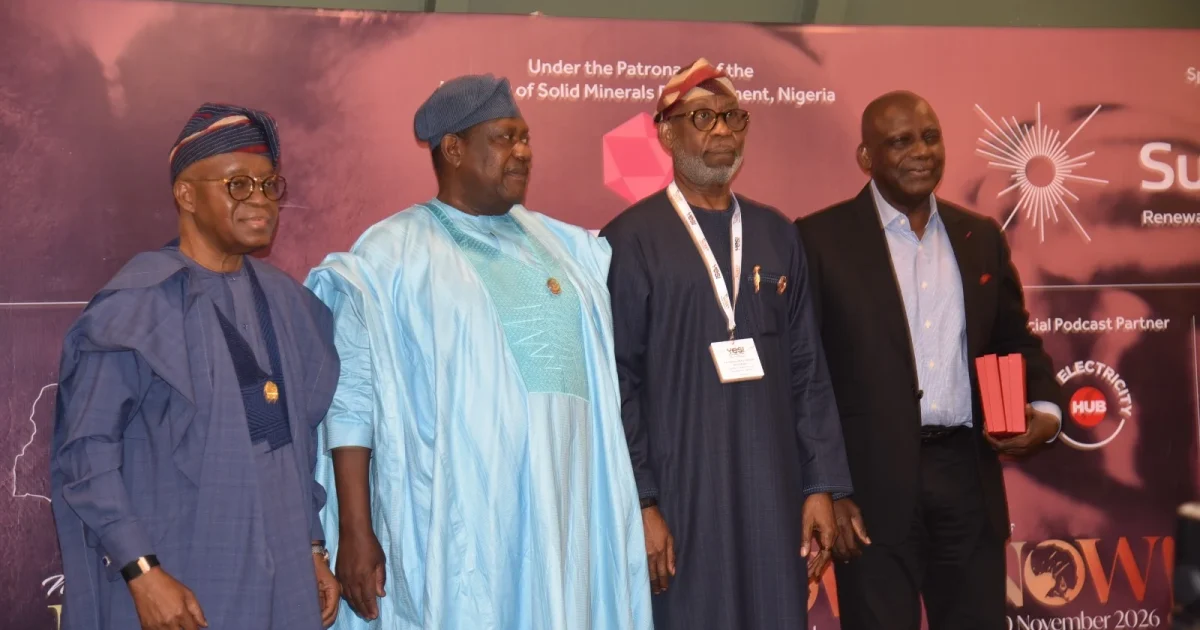

President Bola Tinubu has directed public institutions to remove unnecessary bureaucratic bottlenecks, improve coordination and engage investors in a predictable and timely manner as the Federal Government seeks to translate its economic reforms into tangible investments across the energy, infrastructure and mining sectors.
The President said Nigeria could no longer afford a situation where investment opportunities remained on paper because of administrative delays, poor coordination among government agencies and uncertainty in the regulatory environment.
Tinubu, represented by the Secretary to the Government of the Federation, George Akume, gave the directive on Thursday in Abuja at the opening of the Nigerian Industry in Energy, Infrastructure and Mining Summit, tagged Nigeria NOW.
He said the success of his administration’s economic reforms would be measured not by policy announcements or expressions of interest from investors but by completed projects, functioning infrastructure, expanding businesses and jobs created for Nigerians.
In his address, the President said, “I expect public institutions to remove avoidable bottlenecks, coordinate across their mandates and work with investors in a predictable and timely manner.
“For my administration, delivery means moving beyond policy announcements and expressions of interest to investment decisions, financial close, construction, commissioning and measurable public benefit.”
The President’s directive comes amid the Federal Government’s efforts to attract private capital into critical sectors of the economy following the removal of the petrol subsidy and the unification of the foreign exchange market, among other reforms introduced by his administration.
While the reforms have been presented as necessary to restore macroeconomic stability and create a more competitive investment environment, businesses have continued to face challenges associated with infrastructure deficits, financing costs, regulatory uncertainty and multiple government approvals.
Tinubu said the government recognised that reforms must deliver practical benefits to citizens rather than remain policy objectives.
He stated, “It is precisely why reform cannot remain an end in itself. It must produce tangible economic opportunities and better living conditions for our people. This conviction informs our declaration of 2026 as a year of delivery.”
According to him, the decision to bring energy, infrastructure and mining stakeholders together reflects the administration’s understanding that industrial development cannot be achieved by treating the sectors independently.
He explained that affordable and reliable electricity was necessary for production, while efficient transport and logistics infrastructure would connect businesses to markets. Similarly, the development of solid minerals would provide raw materials for manufacturing, technology and emerging global supply chains.
The President said Nigeria’s investment proposition was supported by its large domestic market, entrepreneurial population, energy resources, mineral deposits and access to the wider African market.
However, he noted that these advantages could only be fully exploited through credible institutions, efficient infrastructure, competitive industries and projects capable of attracting financing and reaching completion.
On the energy sector, Tinubu said the government was prioritising improved electricity access, reliability and commercial sustainability while encouraging private investment in generation, transmission, distribution and decentralised energy solutions.
He said Nigeria would pursue an energy mix that combines its natural gas resources with renewable energy to support households, businesses and industries.
He added that the country’s participation in initiatives such as Mission 300 would support efforts to expand electricity access.
“But the true test of success will be whether additional households and productive enterprises receive dependable and reliable electricity,” he said.
On infrastructure, the President said the government was focusing on transport corridors, ports, railways, roads and digital networks to connect economic centres and open underserved communities to investment.
He stressed that projects must be properly prepared, financially credible and capable of delivering long-term national value.
For the mining sector, he said the government was determined to move beyond the export of unprocessed minerals by improving geological information, ensuring transparent licensing and encouraging responsible exploration, beneficiation and processing.
Tinubu said the objective was to develop integrated value chains that would support Nigerian industries, create skilled employment and ensure that host communities benefited from mineral development.
He urged investors to bring technology, finance and commercial expertise into the country, assuring them that the government would continue to strengthen regulatory certainty and institutional support for sustainable returns.
The President also said the summit should provide an opportunity for direct engagement among project owners, financial institutions, developers and government authorities to identify investment risks, resolve constraints and establish practical steps towards implementation.
He urged ministries, departments and agencies, as well as state governments, to present credible investment opportunities and sustain engagements with prospective investors beyond the event.
“The value of this summit will ultimately be reflected in partnerships concluded, projects advanced and investments delivered,” he said.
Meanwhile, the Minister of Solid Minerals Development, Dele Alake, said Nigeria’s longstanding dependence on oil revenues had constrained the development of other productive sectors, stressing that the country’s economic diversification drive was necessary to create sustainable jobs and industrial growth.
Alake said successive governments had failed to channel sufficient oil revenues into manufacturing, agriculture, solid minerals and industrialisation when the country enjoyed substantial earnings from crude oil exports.
He argued that the failure to diversify the economy during the period of high oil revenues had left Nigeria vulnerable when crude oil earnings began to decline.
According to him, the petrol subsidy regime further weakened public finances by diverting resources that could have been invested in critical sectors.
He said, “Ideally, the revenue accruing from the oil sector should be channelled to the constructive and regenerative sectors of the economy of Nigeria, like manufacturing, like solid minerals, like agriculture, industrialisation, that will catalyse jobs, create massive employment, transfer technology and, of course, enhance mental development.
“We didn’t do that. So, for decades, we went on this happy-go-lucky journey. But when you do that, something is waiting for you at the end of the day.”
The minister described fuel subsidy as a major obstacle to funding infrastructure, education and other essential public services, arguing that its benefits were not reaching ordinary Nigerians as widely claimed.
