

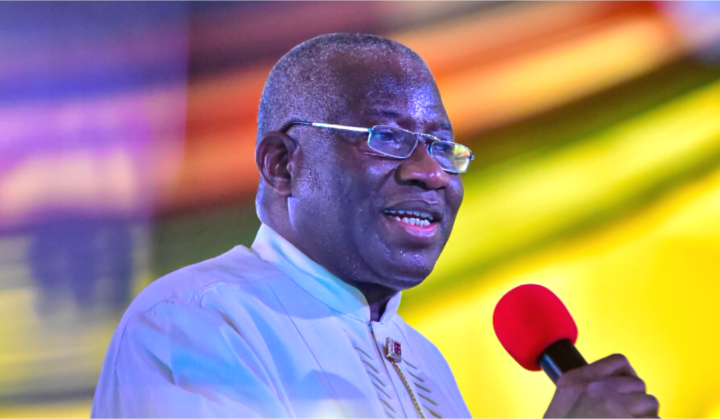

Ex-President Goodluck Jonathan has urged the Federal Government to revisit and revive the Almajiri education programme and the Great Green Wall project as part of efforts to tackle insecurity and create jobs for Nigerians.
Jonathan said the programmes, introduced during his administration, were designed to address some of the socio-economic factors contributing to insecurity, including unemployment among young people.
The former president, who was represented by his former Chief of Staff, Mike Oghiadomhe, spoke at the public presentation of Beyond the Bullets: Policing Terrorism in a Democratic System, a book written by a former Inspector-General of Police, Mohammed Abubakar, in Abuja on Saturday.
Jonathan said the Almajiri schools initiative was intended to equip young people with skills beyond religious education and enable them to contribute to national development.
“My administration engaged in the establishment of Almajiri schools, aimed at providing skills to millions of youth population beyond religious education only,” he said.
He added that the initiative was designed to help young people earn a living while reducing the number of those available for recruitment into violent crime.
Jonathan also highlighted the Great Green Wall project, saying it had the potential to address environmental challenges and create employment opportunities.
“We also engaged in the Great Green Wall project, which, apart from arresting desertification and making more fertile land available for crop farming and animal husbandry, had the potential of providing employment for hundreds of thousands,” he said.
He therefore urged the government to reconsider both programmes, saying, “I therefore use this opportunity to call on government to revisit and review these programmes.”
The former president described terrorism as an ongoing national and global challenge that required sustained commitment and cooperation across successive administrations.
He said the fight against terrorism should not be regarded as the responsibility of one government alone, but as a collective effort requiring institutional learning and continuity in security policies.
“The fight against terrorism is not the responsibility of one administration or the other. It is a continuing national and global challenge that requires sustained commitment, institutional learning, and cooperation across successive governments and generations,” he said.
Jonathan, who said his administration had made efforts to strengthen Nigeria’s security response, noted that the title of Abubakar’s book underscored the need to go beyond the use of force in addressing terrorism.
Also speaking, the President of Dangote Industries Limited, Aliko Dangote, called on the government and private sector to work together to create jobs and stimulate economic growth, arguing that military force alone could not eliminate terrorism.
“If you don’t create jobs, it’s difficult to fight terrorism and get it out of the way,” he said.
The industrialist said entrepreneurs had a responsibility to partner with the government by investing in businesses that could generate employment and prosperity.
“On our own side as entrepreneurs, we have to partner with government, create jobs, create growth, and also prosperity, and that will help when they are also fighting with force,” he said.
Dangote said combining economic opportunities with security operations could help Nigeria overcome terrorism, banditry and other forms of violent crime.
“If you use these two things, we will get rid of terrorism, banditry, and the rest,” he said.
He cited the economic cost of the conflict in the North-East, saying a UNICEF report put the cumulative national economic loss at about $100bn since the conflict began.
“Personally, I believe when you look at the agricultural side of the country and other things, this is more than $100 billion by far,” he said.
Dangote, however, urged Nigerians to support efforts to address insecurity rather than leave the responsibility to the government alone.
“Fighting terrorism is not only for the government alone, but it’s our collective responsibility. What we need to do is to join hands with the government in fighting this menace, because it is a collective responsibility on all of us,” he said.
In his remarks, Abubakar said the fight against terrorism must not undermine democratic principles, human rights and the rule of law.
He said security agencies must protect citizens without treating entire communities as suspects, warning that discriminatory security policies could weaken public trust and undermine counterterrorism efforts.
“The book insists on a vital point that I learned in service. Fighting terrorism should never mean treating the whole community as suspects,” he said.
Abubakar warned that excessive use of power could damage the relationship between security agencies and the communities they were meant to protect.
“When fear becomes policy, discrimination becomes security,” he said.
He also stressed that democratic institutions, including the courts, legislature, media and civil society, should not be regarded as obstacles to national security.
“They are the ground rails that prevent security from becoming domination,” he said.
The former police chief said effective counterterrorism required coordination among security agencies, intelligence gathering, accountability and respect for the law.
He added that justice remained central to democratic security, insisting that investigations must be credible, evidence tested and victims heard.
“Democracies must answer violence with process,” he said.
Abubakar said the central message of his book was that the fight against terrorism should combine effective security operations with fairness, accountability and respect for human dignity.
