

Johnson Idowu
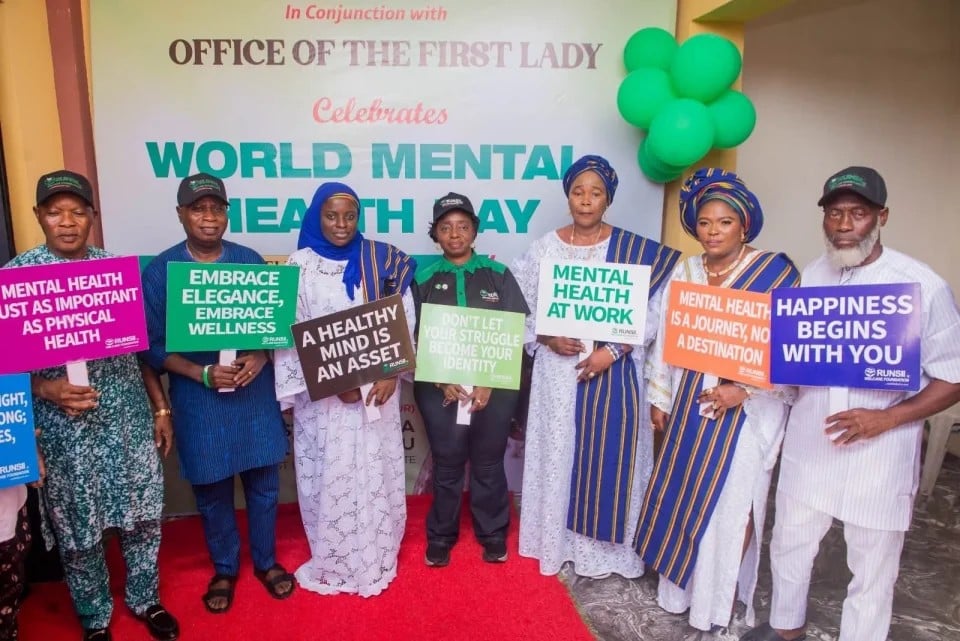
Lagos State First Lady, Dr Ibijoke Sanwo-Olu, and the Orunsii Welcare Foundation have sensitised residents of Badagry to mental health issues, urging families and communities to pay attention to behavioural changes and support people experiencing emotional distress.
The sensitisation was held in commemoration of the 2026 World Mental Health Day symposium on Wednesday at the Badagry City Hall, Badagry, Lagos State.
World Mental Health Day is an annual observance held every October 10, with the 2026 edition themed, “Lived Experiences Shared: Real Voices, Real Changes.”
Speaking at the event, Sanwo-Olu explained that the programme, organised by the foundation in conjunction with the Office of the First Lady, was aimed at taking mental healthcare awareness to the community level.
She noted that the programme brought together market women, members of Community Development Committees and Community Development Associations, religious groups, youths and artisans to discuss mental health and ways of supporting affected persons.
She urged residents to watch for changes in the behaviour of children and adults, noting that withdrawal, loneliness and bereavement could affect mental wellbeing.
“Mental health issue is different from mental illness. A lot of times, the signs are there, even from the children. Sometimes you see a child that is bubbling and the following week, is not bubbling again. So you should be suspicious that something is going wrong,” she stated.
She added that the foundation had previously taken similar awareness programmes to Ikorodu and was working to extend mental health education across the divisions of Lagos State.
She also encouraged residents to register with the Lagos State Health Insurance Scheme to reduce medical expenses, while urging families to “give a listening ear to anyone that they see that has been experiencing mental health issues.”
Also speaking, the Secretary, Board of Trustees, Orunsii Welcare Foundation, Laja Odunuga, disclosed that the foundation’s research conducted in Alimosho about five years ago informed its decision to embark on the sensitisation.
He explained that many people experienced anxiety, depression and sleep difficulties without seeking professional help because of inadequate awareness and stigma.
According to him, the foundation was seeking to promote openness, care and confidentiality while empowering community influencers to identify people in distress and guide them towards appropriate support.
“We found out that it was a topical issue, but grossly underreported. So, what you even see in the hospital is the tip of the iceberg.
“We have artisans, market women, traders, women groups, socio-cultural groups, churches, and mosque members here. The whole basis of it is that we are empowering them. We are building their capacity,” he stated.
Odunuga said participants were expected to take the lessons back to their communities and support follow-up interventions.
He added that the foundation also focused on elderly care and support, assistance to indigent paediatric patients and environmental sustainability, noting that it had supported 15 secondary hospitals and two tertiary hospitals in Lagos in caring for indigent children.
The Medical Director, Badagry General Hospital, Dr Sunday Adeshola, said mental health conditions should not be ranked by importance, as untreated illnesses could have serious consequences.
Adeshola stressed that mental health problems affect not only individuals but also families and communities, making collective support essential for prevention, treatment and recovery.
He called for stronger social support networks around people experiencing mental health challenges, saying families and communities had important roles to play alongside healthcare professionals.
On substance abuse, the medical director described it as a major component of mental health problems, warning that hospitals alone could not tackle the problem because it often began within communities and required a broader response.
He stated that substance abuse was widespread and affected young people in particular, including those in primary, secondary and post-secondary institutions.
According to him, some people became dependent on painkillers, alcohol and substances obtained from informal sources without initially realising that they were developing an addiction.
Adeshola called for early intervention, saying prevention should begin from the school level and involve families, healthcare workers, religious organisations, the police, courts and social welfare services.
He added that while commencing treatment for substance abuse could be relatively straightforward, keeping recovering persons away from the substances and addressing the circumstances that pushed them into abuse remained the more difficult task.
The Chairman, Badagry Local Government Area, Babatunde Hunpe, thanked the First Lady and the foundation for taking the programme to Badagry, describing the initiative as an important addition to existing efforts to educate residents about mental health.
“Before now, we’ve been educating our youth, the elderly, and our people, but this one is like giving us more enlightenment to ensure that we take more steps than what we have been doing in-house,” Hunpe stated.
He said the local government would seek to extend the lessons from the programme to schools, churches and families.
The highlight of the sensitisation included health talks on mental health issues and care.
Copyright PUNCH
All rights reserved. This material, and other digital content on this website, may not be reproduced, published, broadcast, rewritten or redistributed in whole or in part without prior express written permission from PUNCH.
Contact: health_wise@punchng.
