

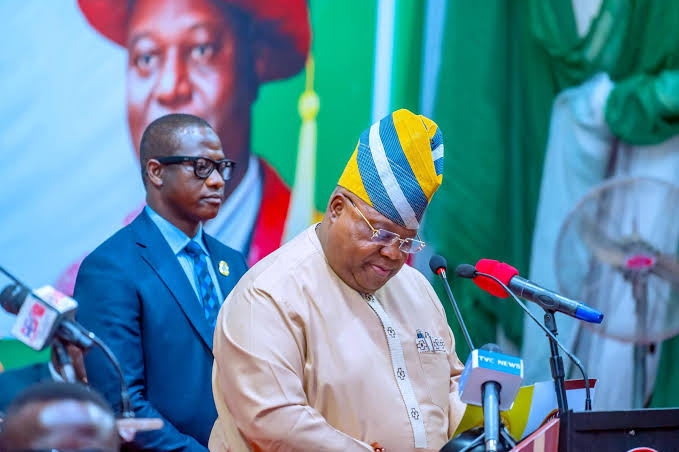
What Adeleke’s re-election really tells us about Nigerian democracy and the road to 2027
On Saturday, August 15, 2026, over 1 million Osun State residents cast ballots to decide who governs them for the next four years. By Sunday morning, INEC’s returning officer, Prof. Joshua Olalekan Ogunwole, had the answer: incumbent Governor Ademola Adeleke, running this time under the little-known Accord Party, secured a second term with 511,067 votes against APC’s Bola Oyebamiji, who polled 444,815, while ADC’s Najeem Salaam came third.
While it looks like a simple re-election on the surface, the actual situation is far more complicated. The election was shaped by several dramatic events, including a major political party switch by the governor, formal corruption reports over vote-buying allegations, and technical glitches at voting sites. Additionally, voter turnout remained low despite high registration numbers, while a viral celebrity intervention drew nationwide attention.
Here’s what Osun 2026 actually teaches us beyond the scoreline.
Lesson 1: Voters Follow The Person, Not Always The Party
Adeleke didn’t win this election as a PDP candidate. He won it in 2022 on the PDP platform, then defected to the Accord Party in November 2025 after the PDP’s internal leadership crisis left it unable to secure a place on INEC’s final candidate list for the election.
That set up a genuine political experiment: would Osun voters follow Adeleke to a brand-new party, or stay loyal to the PDP brand that first brought him to power?
What was once uncertain is now obvious. Before the election, experts wondered if voters originally supported his party or the man himself, warning that changing parties could cost him the vote. Instead, he won 19 out of 30 local government areas under a political party that was virtually unknown a year ago. In Nigeria’s fast-changing political landscape, that personal popularity matters far more than the final vote count.
What was once uncertain is now obvious. Before the election, experts wondered if voters originally supported his party or the man himself, warning that changing parties could cost him the vote. Instead, he won 19 out of 30 local government areas under a political party that was virtually unknown a year ago. In Nigeria’s politics, that personal popularity matters far more than the final vote count.
Lesson 2: Money Politics Is Still A Live Threat To Electoral Credibility
Election day wasn’t just about ballots but also reportedly about cash. Multiple outlets documented allegations that APC and Accord agents paid voters up to ₦20,000 in Ejigbo LGA, while separate reports described vote-buying incidents in Ikire during accreditation. It’s important to stress that these are allegations, not court-established facts, and no party has been convicted of any offence connected to this election.
But the concern was serious enough that the civil society group SERAP filed a formal petition asking INEC, the EFCC, and the ICPC to jointly and transparently investigate reported vote-buying, financial inducement, illegal election financing, voter intimidation, violence, and misuse of public resources connected to the election.
Read Also: “NO REFUND AFTER PAYMENT” — Is This Warning Issued By Businesses Even Legal?
SERAP went further, calling for independent regional and international assessment through the African Union, ECOWAS, and UN human rights mechanisms as additional scrutiny.
Regardless of what any investigation finds, the constant allegations of vote buying during every election cycle reveal the main lesson that discussions around electoral integrity in Nigeria are still stuck on cash-for-votes.
Lesson 3: Technology Upgrades Don’t Guarantee A Glitch-Free Election
INEC’s Bimodal Voter Accreditation System (BVAS) was supposed to be the safeguard against manipulation and impersonation but on election day, it stumbled in visible ways.
Reports described technical failures that affected voter authentication at multiple locations, including a case in Ife East where a professor could not vote after the system failed to verify his face and thumbprint. This authentication problem also affected accreditation at multiple locations that day.
Even Governor Adeleke’s own polling location experienced voting card reader issues. By the end of the vote counting, the online portal was still working to upload everything, with results from 3,664 polling stations uploaded and 99 still pending publication.
While the missing results represent a small percentage across thousands of locations, it highlights that voting technology still faces occasional delays. Public confidence in elections relies heavily on smooth, reliable systems.
Lesson 4: How Davido Became Osun’s Unofficial Whistleblower And Situation Room
Afrobeats star Davido, who is Governor Adeleke’s nephew, didn’t wait for election day to start using his massive following as a check on the process. Days before the vote, he shared a video of Osun East senator Francis Fadahunsi allegedly telling supporters that “whenever you see Accord members, kill them,” and that voters would be blocked at the polls even with valid PVCs. Davido translated the remarks for his over 30 million followers, and the resulting outrage forced Fadahunsi to publicly clarify he only meant Accord should be defeated “with votes, not violence.”
That set the tone for how Davido operated once voting began. Rather than watching from the sidelines, he actively monitored and shared live updates on X and Instagram, publicly pressuring INEC over the pace of result uploads, posting at one point: “INEC, it is now 2:33 p.m., yet no result has been uploaded to the IReV portal. What is the delay?”
The peak tension came when Davido urged US President Donald Trump and the international community to monitor the Osun election following a clash with Edo Governor Monday Okpebholo, who mocked Adeleke. He also urged voters to safeguard their ballots, demand signed result forms, and ensure real-time uploads.
As the governor’s nephew, his willingness to publicly call out alleged incitement, rather than just celebrate a win, turned his massive online presence into real-time accountability that forced public responses from officials and politicians.
Lesson 5: Record Voter Registration Didn’t Translate To Record Turnout
Osun went into this election with more registered voters than ever before at 2,339,233 registered voters which is the highest number recorded in the state’s governorship election history. 81.5% of the registered voters collected their Permanent Voter Cards. That should have set up a landmark turnout but it didn’t.
The 1,005,800 total votes cast represented only about 43% of registered voters, meaning fewer than 4 in every 10 eligible voters actually participated. That’s a modest improvement on 2022’s 42.16% turnout, but it’s still evidence of a stubborn pattern in Nigerian democracy that motivation to actually vote often doesn’t follow registration.
Whether it’s distrust in outcomes, logistical barriers, or apathy after repeated disputed elections, the gap between “registered” and “voted” remains one of Nigeria’s most persistent civic challenges.
Lesson 6: Political Violence Still Shadows Nigerian Campaigns
Beneath the numbers, this was also a violent campaign season. Reports referenced violence claiming at least eight lives in key areas in the run-up to the election, while both major parties reportedly alleged the killing of their own members across several local government areas during the campaign period.
On election day, ADC candidate Najeem Salaam’s polling unit in Ejigbo was reportedly stormed by suspected thugs shortly after he voted, and a police commissioner described the overall security situation as calm despite pockets of unrest.
Although unverified, these repeated claims of violence and vote-buying highlight a clear issue that while Nigeria has improved voting access and technology, it still struggles to guarantee consistent safety for stakeholders.
Lesson 7: Vote Buying Has Evolved Into Organized Voter Importation
The vote-buying conversation usually centres on cash changing hands at the polling unit on election day, but Osun 2026 showed the practice isn’t confined to the polling unit, or to voting day itself. It can also be organized days in advance, far from any voting booth.
On the eve of the election, police in Ikire arrested a sitting member of the Osun State House of Assembly, Hon. Abiola Ibrahim Inaolaji, alongside 143 suspected electoral mercenaries allegedly camped at his residence, with more than 200 Permanent Voter Cards recovered during the raid.
Police said early investigations showed suspects were brought from Ondo to Osun State to interfere in the election. The suspects reportedly confessed that a politician gave them voter cards and promised them money to vote.
These are unproven claims under investigation, and everyone involved is presumed innocent. However, if true, it shows an organized system importing voters across state lines is a much bigger threat to election fairness than standard cash-for-votes.
Lesson 8: In Osun, The Courtroom Is Part Of The Election
If you think Sunday’s declaration is the final word, Osun’s history says otherwise. Since Nigeria’s return to democracy in 1999, Osun has conducted seven governorship elections, and every one except the first has been challenged through an election petition.
This makes it one of the states where tribunal rulings have most frequently changed or threatened to change who actually governs.
The most dramatic precedent happened after the 2007 election when the Court of Appeal spent nearly three years in litigation before nullifying Olagunsoye Oyinlola’s re-election and installing Rauf Aregbesola as governor instead in one of the longest governorship disputes in Nigerian history.
Adeleke’s win also carries historic weight beyond the scoreline as he becomes only the third elected governor in Osun’s history to secure a second term, joining Oyinlola and Aregbesola in that small club.
Even Adeleke’s 2022 victory was eventually decided in court. An election tribunal originally removed him from office in favor of Oyetola, but an appeal court restored his win, and the Supreme Court officially finalized the decision in March 2023. With the APC already hinting at challenging the recent results, Osun’s election saga is far from over.
Lesson 9: State Elections Are Increasingly Fought With Federal Firepower
Osun’s governorship race was never just a local contest between two Osun politicians.
APC’s Oyebamiji brought in strong political backing from outside the state, capped by the biggest show of federal force yet: Senate President Godswill Akpabio, personally representing President Bola Tinubu, led a mega rally in Osogbo days before the vote.
High-profile leaders including Edo Governor Monday Okpebholo, Imo Governor Hope Uzodimma, Ogun Governor Dapo Abiodun, Kaduna Governor Uba Sani, Kogi Governor Usman Ododo, Minister of Works David Umahi, and former Osun Governor Gboyega Oyetola all travelled to Osun to campaign directly on his behalf.
At that rally, Akpabio urged Osun voters to “link” the state to the centre, arguing that with over 30 of Nigeria’s governors already in the APC, Osun should join them. Okpebholo went further, publicly criticizing Adeleke’s leadership and mocking his dancing persona.
Deploying the Senate President, sitting governors, and ministers for a single state election highlights the ruling party’s strategy to treat local races as national battlegrounds. This leaves voters questioning whether the winning candidate will answer to them or to the national power brokers who secured their victory.
Lesson 10: Osun Was Explicitly Treated As A Dress Rehearsal For 2027
International observers noted this as well as the EU-backed Election Observation Hub deployed over 800 accredited monitors across all 30 local government areas, framing the Osun election as a key test of the new electoral rules and a preview of the 2027 General Election.
Their pre-election findings weren’t reassuring as the Hub flagged security risks, misinformation, and the exclusion of vulnerable groups as significant concerns heading into the vote. On election day, the Hub catalogued incidents of vote buying, thuggery, and BVAS glitches.
When international monitors explicitly frame a state election as a preview of the upcoming general election, the stakes become much higher. Every issue in Osun, from failing voting machines and delayed uploads to uninvestigated allegations, serves as evidence in the ongoing debate over whether Nigeria is prepared for 2027, rather than just a local incident.
Lesson 11: Osun Showed What Happens When The People Protect Their Vote
Despite vote-buying allegations and documented violence, Sunday’s declaration still triggered genuine, spontaneous celebration across Osun, rather than the muted uncertainty that has followed other contested Nigerian elections.
In Osogbo, Ile-Ife, Ede and other towns, supporters who had waited at collation centres from as early as 5 a.m. broke into street celebrations chanting “Imole!” as soon as results were confirmed, with residents openly crediting the outcome to their own vigilance at the polls.
Much of that loyalty traces back to a specific grievance: civil servants inherited 30 months of half-salaries and years of unpaid pensions from the previous APC administration. By election time, Adeleke’s government said it had paid over ₦80 billion in inherited pension debt and cleared more than two-thirds of the salary arrears, a record labour unions in the state publicly cited when endorsing his second term.
Beyond revealing systemic flaws, Osun 2026 showed ordinary citizens actively defending and celebrating their votes. It demonstrates that public trust relies on more than just solid technology and fair officials as the people must also believe their vote brings real change to their lives.
Lesson 12: A Win For Osun Is Also A Win For Nigerian Democracy
Beyond the local scorecard, Osun’s outcome carries weight for the whole country. Heading into the vote, residents and commentators openly worried that the scale of federal mobilisation behind APC’s candidate, the Senate President, five sitting governors, and federal ministers campaigning for one state seat, was less about local governance and more about tightening the ruling party’s grip on every remaining opposition-held state ahead of 2027.
That concern isn’t abstract. With over 30 of Nigeria’s 36 states already under APC control, critics argue that each opposition state absorbed pushes Nigeria closer to a de facto one-party system, where dissent survives only until the centre decides to dislodge it. Adeleke’s re-election, on a fledgling party platform facing that machinery, pushed back against that trajectory.
Whoever a Nigerian chooses to stand behind, whether Accord, PDP, Labour Party, or any platform that puts them at odds with the centre, deserves the same right Osun defended on Saturday: to have that choice count. That’s the bigger lesson for 2027: political survival for anyone outside the ruling party still depends on ordinary people showing up, not on the machinery ranged against them.
If Osun’s result proves anything on the road to 2027, it’s that federal firepower and money politics, however overwhelming, are not automatically
What Osun Means Beyond Osun
The 2026 Osun governorship election served as a crucial test for several key issues. It tested whether voters favor individual candidates over political parties, if vote-buying still works, and how well new voting technology handles pressure. Additionally, it examined whether social media presence truly improves local accountability and if high voter registration actually translates into actual turnout.
When a superstar with 30 million followers forces faster action from election authorities than formal petitions, it raises a fundamental question: who actually holds power over these institutions? Is celebrity pressure a welcome shortcut to accountability, or merely a temporary fix that depends on having famous relatives?
If the Osun race offers a preview of the 2027 general election because it was marked by vote-buying, technical failures, and massive outside political cash, it casts serious doubt on the nation’s readiness. Left unchecked, these recurring issues cause everyday citizens to question whether their individual votes actually make a difference.
Share your thoughts in the comments, and tag someone who should see what a “free and fair” election must still overcome.
