

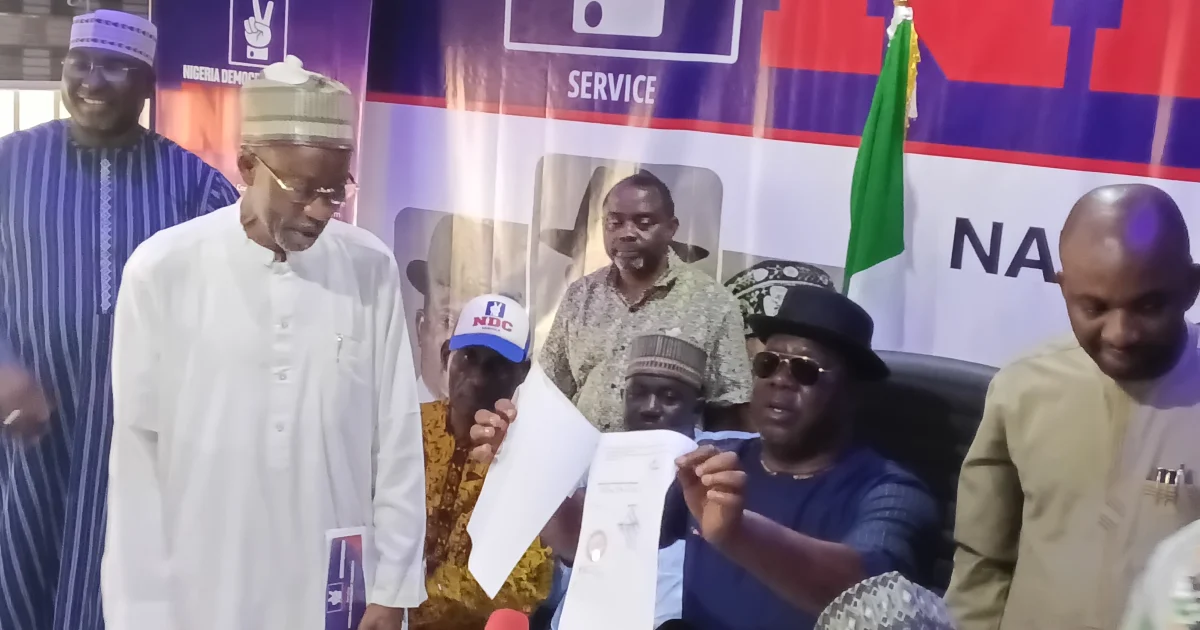

The Nigeria Democratic Congress has introduced a strict anti-defection policy requiring all its candidates for elective offices to sign indemnity and affidavit forms committing to vacate their seats if they defect from the party after winning elections.
The policy, unveiled on Tuesday at the party’s national secretariat in Abuja, is expected to affect prominent members, including the party’s presidential candidate, Peter Obi, his running mate, Rabiu Musa Kwankwaso, and other recent entrants into the party ahead of the 2027 general elections.
Speaking during the signing ceremony attended by some candidates and aspirants, NDC National Chairman, Moses Cleopas, said the move was aimed at protecting the party’s electoral mandates and strengthening internal discipline.
According to him, the decision was informed by repeated cases of politicians winning elections on party platforms only to defect to rival parties after securing office.
He said, “In our last NEC meeting, a motion was moved, supported, and established that when we take over the government, people elected on the platform of our party must respect the party’s instrument.
“This is not just a party for one man to rise and achieve his ambitions and do anything he likes with the party.
“This is a political party that we desire to groom and hand over to the next generation.”
He said the NDC had observed a trend in which elected officials abandoned the parties that sponsored them for personal or political reasons.
“One thing we have come to observe is that in the present polity, when people contest elections and win under political parties, they become gods.
“And in between the time that they ought to have, they will just use one minor excuse to dump the platform and perhaps go into the ruling party,” he said.
Cleopas cited the experience of the Labour Party after the 2023 elections as justification for the new policy.
“A very typical example that we have all seen in the last three years is the Labour Party, where so many individuals won elections under the platform of the party.
“Now, we are in another election cycle. Go and check their history. How many of the people who won elections under the Labour Party and were inaugurated are still members of the party?
“If all of them had remained, you and I can imagine how the Labour Party could have been today, even if they had not won the presidency. When you see these kinds of things happening, it is expedient that you start to think of how to guide your political parties,” he stated.
The NDC chairman stressed that while membership of the party was voluntary, anyone seeking to contest elections on its platform must agree to abide by its rules.
“If you want to contest the election under the platform of the NDC, you are free to come. Nobody is forcing you. But when you come, you should know that there are certain rules by which we, as a political party, guide our members.
“One of them is that if you contest an election under our platform and win, under no circumstances, as against what is provided for in the 1999 constitution, that you will just wake up to say that I don’t like the NDC again, or I don’t like the face of my national or state chairman. Therefore, now that I am already elected, I am leaving the party,” he said.
He said candidates would be required to sign affidavit and indemnity forms before receiving the party’s ticket.
“If you win, the mandate is owned by the party. If you otherwise choose to leave, go the same way you came and leave what you picked from here.
“That is why we brought our National Legal Adviser and his team to prepare documents that include affidavit and indemnity forms for every candidate in all categories to fill and take the oath,” he stated.
The party’s National Legal Adviser, Reuben Egwuaba, defended the policy, describing political parties as voluntary associations governed by internal rules accepted by members.
“A political party is just like a club, church or mosque where there are rules and regulations. That is why the 1999 constitution, under Section 222, states that a candidate of a political party is just a mere agent of the party.
“And once a candidate is declared the winner and inaugurated, until the expiration of the tenure upon which that candidate won the election and was inaugurated, the mandate belongs to the political party, not any other.
“So, if you are privileged to win the election after clinching the party ticket, that does not mean the mandate belongs to you,” he said.
Despite the significance of the policy, several prominent party figures, including Obi and Kwankwaso, were absent from the event.
The development is widely seen as an attempt by the NDC to avoid the wave of defections that has weakened several opposition parties in recent years.
Obi’s political career has seen him move from the All Progressives Grand Alliance to the Peoples Democratic Party, the Labour Party, the African Democratic Congress and eventually the NDC.
Kwankwaso has also belonged to multiple parties, including the PDP, the All Progressives Congress, the New Nigeria Peoples Party, the ADC and the NDC.
Former Adamawa State governorship candidate, Aishatu Binani, is also among recent entrants into the party, having moved from the APC to the ADC before joining the NDC in 2026.
