

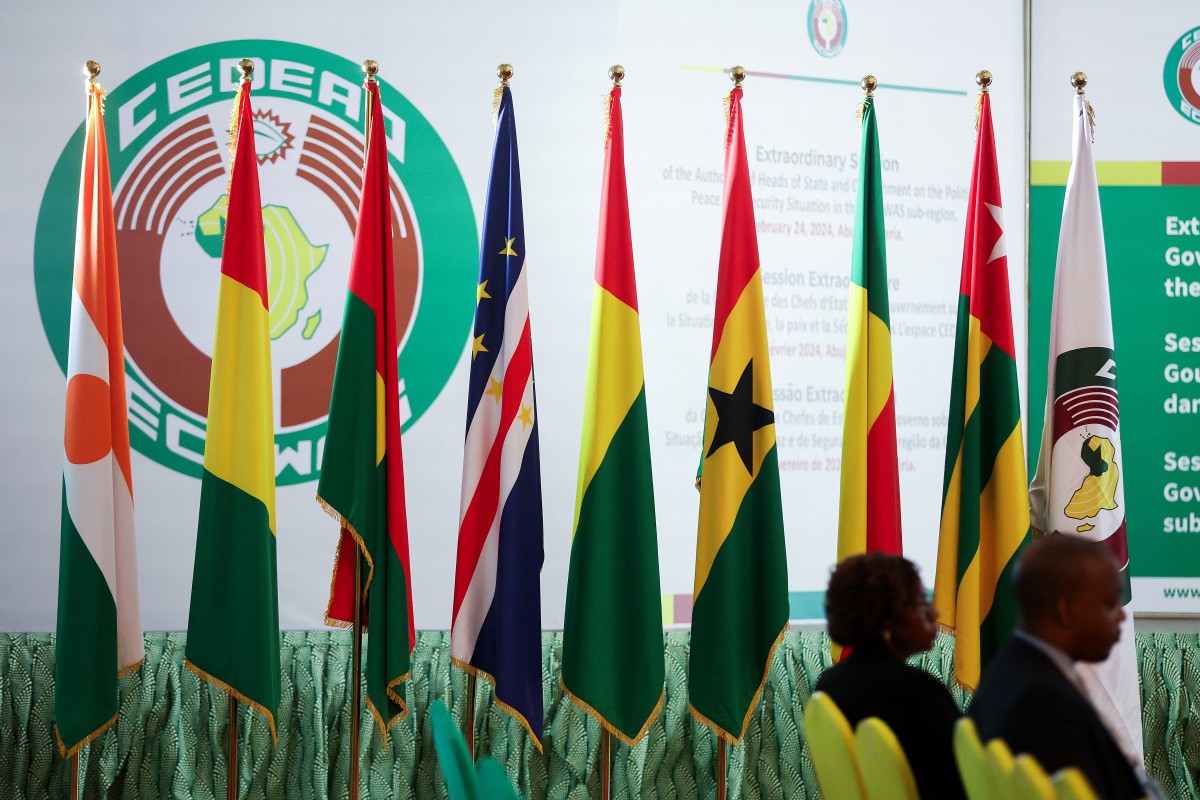
(FILES) (FILES) Flags of Economic Community of West African States Commission (ECOWAS) countries are displayed inside the Nigeria presidential villa, after the extraordinary session of Economic Community of West African States (ECOWAS) Heads of State and Government in Abuja, Nigeria on February 24, 2024. The withdrawal of Mali, Niger and Burkina Faso from the Economic Community of West African States takes effect on Wednesday after a year of political tensions, fracturing the region and leaving the bloc with an uncertain future.
On January 29, 2024, the three countries led by military regimes formally notified ECOWAS of their desire for “immediate” withdrawal. But the texts of the West African organisation required one-year’s notice for it to be effective. (Photo by Kola Sulaimon / AFP)
The Chairman of the Nigerians in Diaspora Commission (NiDCOM), Mrs Abike Dabiri-Erewa, has called on the Economic Community of West African States (ECOWAS) leaders to renew their attention to address obstacles hindering visa-free travel among member states.
Speaking with journalists in Lagos on Friday, where she received in her office a Nigerian biker, Judith Amadi, who rode from Lagos to France and back, Dabiri-Erewa lamented that despite the promise of seamless movement across the sub-region, travellers along the corridor still faced some challenges.
She explained that the ECOWAS passport was designed to allow citizens of the region to move freely across borders, but said the challenges still persisted years after the agreement.
She, however, expressed that ECOWAS leaders were gradually addressing the challenges, but said the issue should continue to receive public attention.
She said: “She (Judith Amadi) was not the first to face it; others in the past have equally faced the same challenge. It’s an issue that should be brought to the forefront of our ECOWAS leaders because we are supposed to travel visa-free.
“That is why we have an ECOWAS passport. These issues that are still being faced along our borders are things that all the countries involved should look at. And I believe that they are looking into it. As we tell our story, the idea is to let everyone remain aware of the challenges.”
Earlier, Amadi, in an interview with journalists, lamented challenges at West African borders as some of the issues she had to contend with in the course of her ride.
Amadi completed a historic solo motorcycle journey from Lagos to France and back between October 18, 2025 and January 3, 2026. She said the aim of the effort was to raise awareness and financial support for cancer patients.
Amadi stated that the two-and-a-half-month journey highlighted the stark difficulties Nigerians face when crossing borders within West Africa, especially with her green passport.
According to her, border delays, unofficial charges, and repeated stamping requirements slowed her journey across several West African countries, adding that it was a different experience travelling within Europe with her Schengen visa.
“Trying to pass from one country to another with a Nigerian passport was too much of a struggle. I would be asked to wait while someone with a different passport would come and go freely.
“You’re aware of the official visa fees, but when you get there, you’re told to pay for stamping and extra documentation that are not part of the official process. We are in a West African community. We’re not supposed to be paying for these things. Movement is meant to be borderless,” she said.
She also mentioned bad infrastructure along the African corridors as one of the challenges she faced during the period, but said the journey achieved its advocacy goal.
Besides, Amadi advocated support for Nigerians living with cancer.
“One chemotherapy session costs between N300,000 and N500,000, depending on the cancer type and stage. How many average Nigerians can afford that? That’s why financial support is critical for patients to complete their treatment,” she said.
